Loading... Please wait...
Categories
 New Products
-
 $109.09
-
 $169.90
-
 $59.90
-
 $109.90
-
 $32.90
Our Newsletter
- Home
- Voodoo Estate
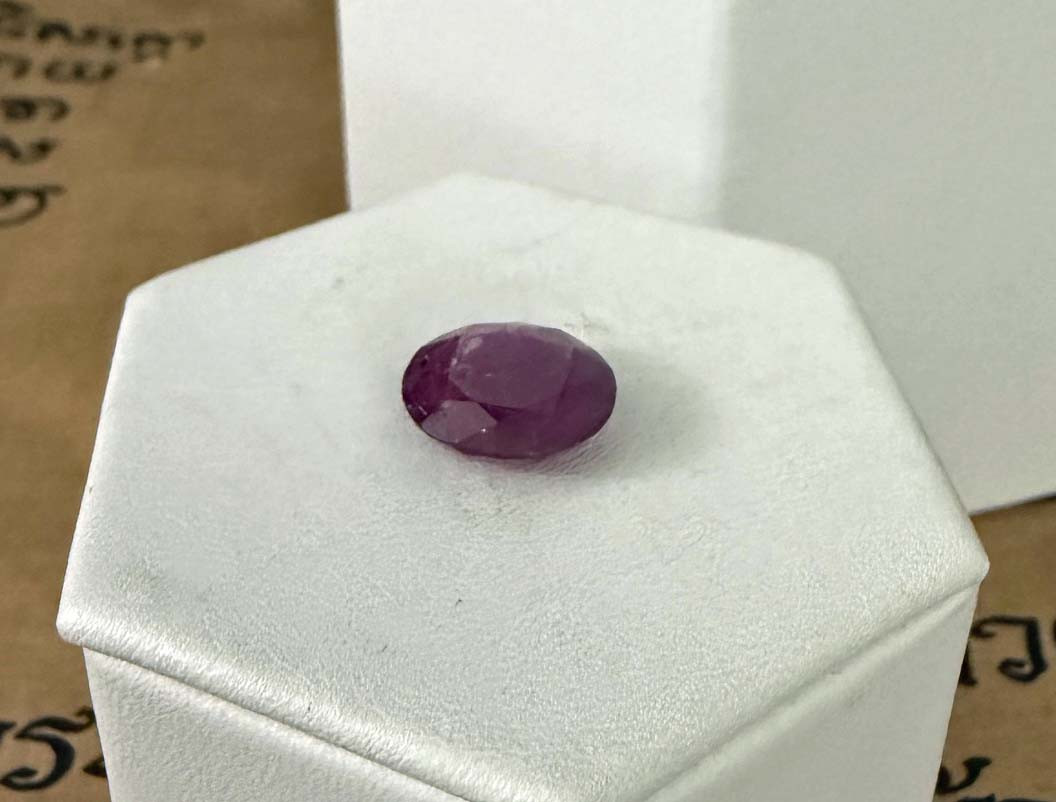
- 7 ct., Faceted Round Cut Thai Trade Raw Ruby Anahata Gem - A Black Pyramid Vèvé Room Find - The Voodoo Estate
7 ct., Faceted Round Cut Thai Trade Raw Ruby Anahata Gem - A Black Pyramid Vèvé Room Find - The Voodoo Estate


)
Product Description

~ Voodoo Priestess Estate ~ ©
A Black Pyramid Vèvé Room Find
The Voodoo Estate!
This type of call usually gets us excited as they are a treasure trove. Located here in Florida, there was no electricity or running water so we rigged our own lighting and in we went. If you have ever seen the Adams Family you will have some idea as to what we were greeted with! Then the attorney handling the liquidation gave us some background. The estate had belonged to an alleged powerful Voodoo Priestess/JooJoo Exorcist, grand daughter of a Marie Laveau, and favored daughter of a Marie Glapion.
These names meant nothing to us, but the late night talk of Voodoo and exorcism in the old mansion was enough to make us decide to spend the night in a hotel and return in the morning to assess the estate. The rest is history.
Our research has shown that this woman was what she claimed and was indeed descended from a long line of well known Voodoun family originating in New Orleans in the early 1800's. We were pretty unnerved by this until we discovered they were also devout Catholics! Although I have to admit this was unlike any Catholic home we have ever been in and some of the items found inside were a little more than disturbing.
Found in what was named "The Black Pyramid Vèvé Room," this room was an interesting work of architecture. Windowless and located just above the Main Ballroom in the center of the mansion, it was only accessible through a trapdoor and cast iron spiral staircase from the storage room above it. The floor was four feet below the Main Ballroom ceiling, well concealed by the baroque architecture. The architect had concealed the room in the floor above by surrounding it with four guest suites, it was dead center in the mansion.
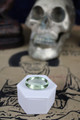
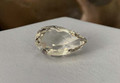
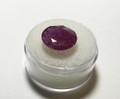
The gem is of fair cut and good color of highly included material with some transparency.
Some of her journal entries concerning this raw ruby read, “This is a heart chakra stone, and an invocation tool for Raphael.”
“Their color brings light and change into your world.”
“Wear it to shed the body of toxins.”
"It is a true anahata talisman that will allow your will to affect the decisions of others".
~!~
Our own research revealed Anahata as the fourth primary chakra, according to the Hindu, Yogic, Shakta, and Tantric Buddhist traditions. In Sanskrit, anahata translates to English as unhurt, unstruck and unbeaten. Anahata Nad refers to the Vedic concept of unstruck sound, the sound of the celestial realm. Anahata usually is associated with a calm serene sound that is void of violence. The Anahata chakra is positioned in the central channel in the spine at the heart region, with its kshetram or superficial activation site actually in the heart region between the two breasts.
It is represented by a smoke-grey lotus flower, with 12 petals. Inside of it is a smoke-colored region that is made from the intersection of two triangles, creating a shatkona. The shatkona is a symbol used in Hindu Yantra that represents the union of both the masculine and feminine form. More specifically it is supposed to represent Purusha (the supreme being), and Prakriti (mother nature, or causal matter). Often this is represented as Shiva - Shakti. The deity of this region is Vayu, who is smoke colored, four-armed, holding a kusha and riding upon an antelope, the animal of this chakra.
The seed syllable is the mantra 'Yam', dark-grey in color. Within the bindu or dot above the syllable resides the deity Isha (Lord in an all pervading form). Isha is either shining white or blue in color, has either 1 or 5 faces with 3 eyes on each face; has 2, 4 or 10 arms, is clad in a tiger skin, holds a trident and a drum and/or is making gestures of granting boons and dispelling fear. His shakti is Kakini, who is shining yellow or rose in color. She has a number of variations, having either 1, 3 or 6 faces, 2 or 4 arms, and holding a variety of implements, occasionally a sword, shield, skull and trident. She is seated on a red lotus.
The twelve petals are vermilion in color, and upon them are inscribed the syllables kam, kham, gam, gham, ngam, cham, chham, jam, jham, nyam, tam and tham in Sanskrit. They match the vrittis of lust, fraud, indecision, repentance, hope, anxiety, longing, impartiality, arrogance, incompetence, discrimination and defiance.
Anahata is considered the seat of the Jivatman, and Para Shakti. In the Upanishads, this is described as being like a tiny flame that resided inside the heart. Anahata is so called because it is in this place that sages hear that sound (Anahata – Shabda) which comes without the striking of any two things together.” It is associated with the element of air, the sense of touch, and with actions of the hands.
Anahata is associated with the ability to make decisions outside of the realm of karma. In Manipura and below, man is bound by the laws of karma, and the fate he has in store for him. In Anahata, one is making decisions, 'following your heart', based upon one's higher self, and not from the unfulfilled emotions and desires of lower nature. As such, it is known as the heart chakra. It is also associated with love and compassion, charity to others, and forms of psychic healing.
Meditation on this chakra is said to bring about the following siddhis, or occult powers; he becomes a lord of speech; he is dearer than the dearest to women; his senses are completely under control, and he can enter at will into another's body.
~!~