Loading... Please wait...
Categories
 New Products
-
 $1,490.90
-
 $0.01
$0.01
-
 $59.90
-
 $109.90
-
 $835.94
Our Newsletter
- Home
- Thai Amulets
- Jeweled Red Mardi Gras Sex Magic Spirit Box and Contents - A Séance Reading Room Find - The Voodoo Estate ~!~ ~!~ SOLD! ~!~ ~!~
- Home
- Oddball Rings
- Jeweled Red Mardi Gras Sex Magic Spirit Box and Contents - A Séance Reading Room Find - The Voodoo Estate ~!~ ~!~ SOLD! ~!~ ~!~
- Home
- Gemstones
- Jeweled Red Mardi Gras Sex Magic Spirit Box and Contents - A Séance Reading Room Find - The Voodoo Estate ~!~ ~!~ SOLD! ~!~ ~!~
- Home
- Spell Boxes
- Jeweled Red Mardi Gras Sex Magic Spirit Box and Contents - A Séance Reading Room Find - The Voodoo Estate ~!~ ~!~ SOLD! ~!~ ~!~
- Home
- Kuman Thong
- Jeweled Red Mardi Gras Sex Magic Spirit Box and Contents - A Séance Reading Room Find - The Voodoo Estate ~!~ ~!~ SOLD! ~!~ ~!~
- Home
- Altar Cloths
- Jeweled Red Mardi Gras Sex Magic Spirit Box and Contents - A Séance Reading Room Find - The Voodoo Estate ~!~ ~!~ SOLD! ~!~ ~!~
Jeweled Red Mardi Gras Sex Magic Spirit Box and Contents - A Séance Reading Room Find - The Voodoo Estate ~!~ ~!~ SOLD! ~!~ ~!~


)
Sorry but this item is currently unavailable.
Please check back at a later stage.
Product Description

It has now been nearly twenty-four and a half years ago since we were called to do an estate that had been closed up for seventeen years!
The Voodoo Estate!
This type of call usually gets us excited as they are a treasure trove. Located here in Florida, there was no electricity or running water so we rigged our own lighting and in we went. If you have ever seen the Adams Family you will have some idea as to what we were greeted with! Then the attorney handling the liquidation gave us some background. The estate had belonged to an alleged powerful Voodoo Priestess/JooJoo Exorcist, grand daughter of a Marie Laveau, and favored daughter of a Marie Glapion. These names meant nothing to us, but the late night talk of Voodoo and exorcism in the old mansion did cause some uneasy feelings so we decided to spend the night in a hotel and return in the morning to assess the estate. The rest is history.
Our research has shown that this woman was what she claimed and was indeed descended from a long line of well known Vodoun family originating in New Orleans in the early 1800's. We were pretty unnerved by this until we discovered they were also devout Catholics! Although I have to admit this was unlike any Catholic home we have ever been in, yet some of the items found inside were a little more than disturbing. There was no feeling of dread or unwelcome in the mansion, however there was quite a bit of contraband and other items we can or will not sell here.
This is one of a few lots from this estate we will be posting this week, so check our other listings.
We will, upon the new guardian's request, issue a named Letter of Authenticity with each lot from this estate, complying with the terms set forth to us by the estate's attorney.
Some Back Story
This is one of the thirty-three named "spirit boxes" which we recovered from the main séance, reading room, its foyer lounge and storeroom. The Reading Rooms were a commercial endeavor that had a wealthy following and is where many of the major séances of this estate were conducted. Many, if not all of her associates worked these rooms, conducting séances, card readings and numerous forms of divination for their clientele. Apparently this was a lucrative endeavor, as it remained active for over six decades.
Her journals also list a host of well known psychics and mediums that would make guest appearances and that these events were booked to capacity well in advance and held in secret to the general public.
Her journaled inventory tells us, "the spirit boxes have been gathered here as they have been found to contain active and permanently attached spirits that add to the ambiance of these rooms." Ya think?
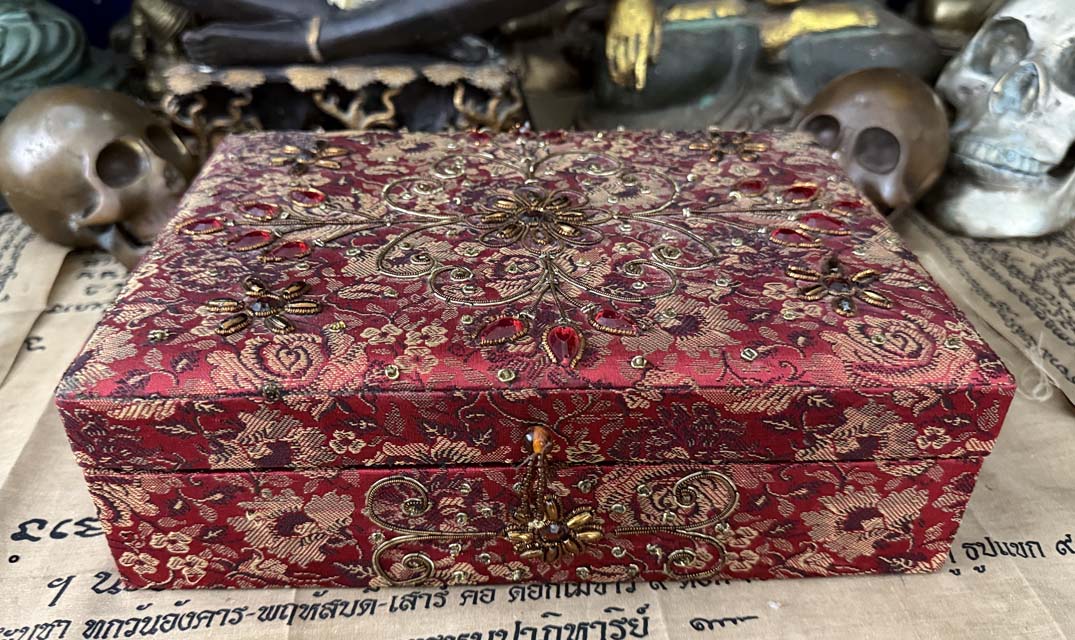
This box is named in her inventory as the "Jeweled Red Mardi Gras Sex Magic Spirit Box" and goes on to describe it and its contents as being "frequently used in divinations."
The box and its contents continued to be mentioned in their journals as being used in this room right up and through the 1970's, with many spirits making their presence known on numerous occasions.~!~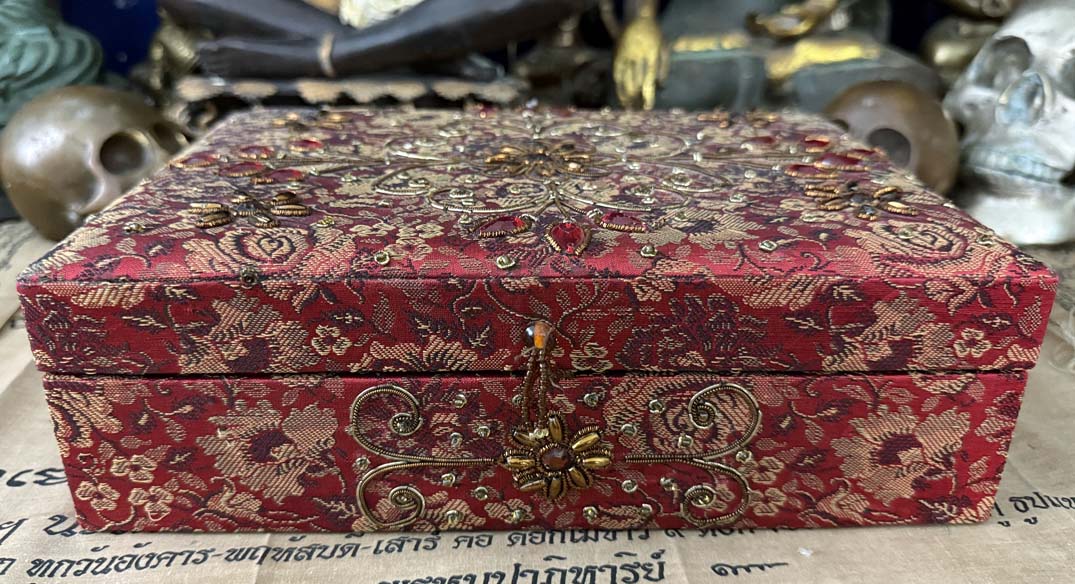
The Box, It's Contents, Description and Commentary
Her journals tell us the box was purchased in New Orleans during the Red Mardi Gras. The traditional official colors of Mardi Gras are purple (justice), green (faith), and gold (power). Red is used to symbolize the "blood of Christ." Although she does not tell us what year this Red Mardi Gras took place, the box first appears in her inventory in 1977. "Red Mardi Gras" may refer to the Krewe of Red Beans parade on Lundi Gras in New Orleans which specialized red-themed beads and decorations, or perhaps the "Red River" Mardi Gras in New Mexico.
She does tell us she, along with her associates, used this box in their divinations by having clients choose an item from the box and place it in one of their pockets or a purse and tale it home with them with specific instructions on its care and use which remain a mystery to us due to damaged ledgers. They would often return the item, sometimes swapping it for another and sometimes keeping it, but again, we do not have the details.
~!~
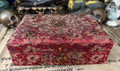
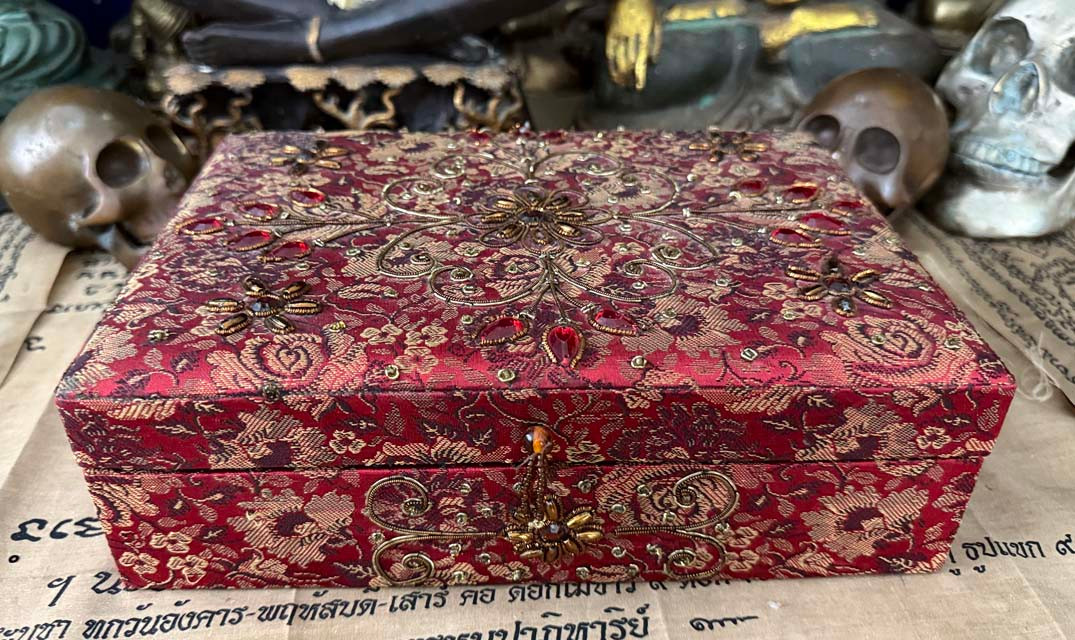
Examination reveals a 10 1/8" x 7 1/8" x 3 1/8". jeweled silk brocade (wood?) box weighing 1 lb., 13 oz. (812 grams). There is a Made in India paper tag still attached to the bottom and it is fitted with a compartmentalized interior tray and a mirror in the inside of the lid, all in very good to excellent condition.
The Contents
Found within we find...

Ma Saep Nang, Phra Sant Yant, Sex Magic Dream Ritual Cloth
Her journals and inventory tell us this is a, "Ma Saep Nang Phra Sant Yant Sex Dream Ritual Cloth" one of a group consisting of four types of these cloths created by different monks, given to her by Uncle Khoo. The first of these cloths were received in a 1946, and these were printed on cotton. These three bundles of 144 cloths each were received in 1959 and are printed on cellulose cloth.
~!~


Her notes also instruct us to "advise all with interest to get as close to the ancient relics of Egypt found in 1922. They will be in the United States again in the 21st. Century along with pieces never to be seen on these shores before or again. Look at them, concentrate and scry them."
She was obsessed with the King Tut Finds and Exhibits, memorizing the hieroglyphics and scrying them for proper translation. What She writes is really some pretty bizarre stuff, but we went to the numerous shows and still advise all who have any opportunity, to view them.
Although this really does not pertain to these scarabs, it does set the background for her interest in Egyptian Revival. The 1922 discovery by Howard Carter and George Herbert, 5th. Earl of Carnarvon, of Tutankhamen's tomb received worldwide press coverage that sparked a renewed public interest in ancient Egypt.
Many of these pieces are attributed as being, "spelled for use in the Resurrection Ceremony avenging the death of Osiris." These scarabs however were specified for what amounts to be her rendition of the Weighing of the Heart Ceremony.Onyx; 2 1/4" x 1 5/8" x 1 1/16", 77.5 grams.
Rose Quartz; 2 1/4" x 1 5/8" x 1", 93.9 grams.
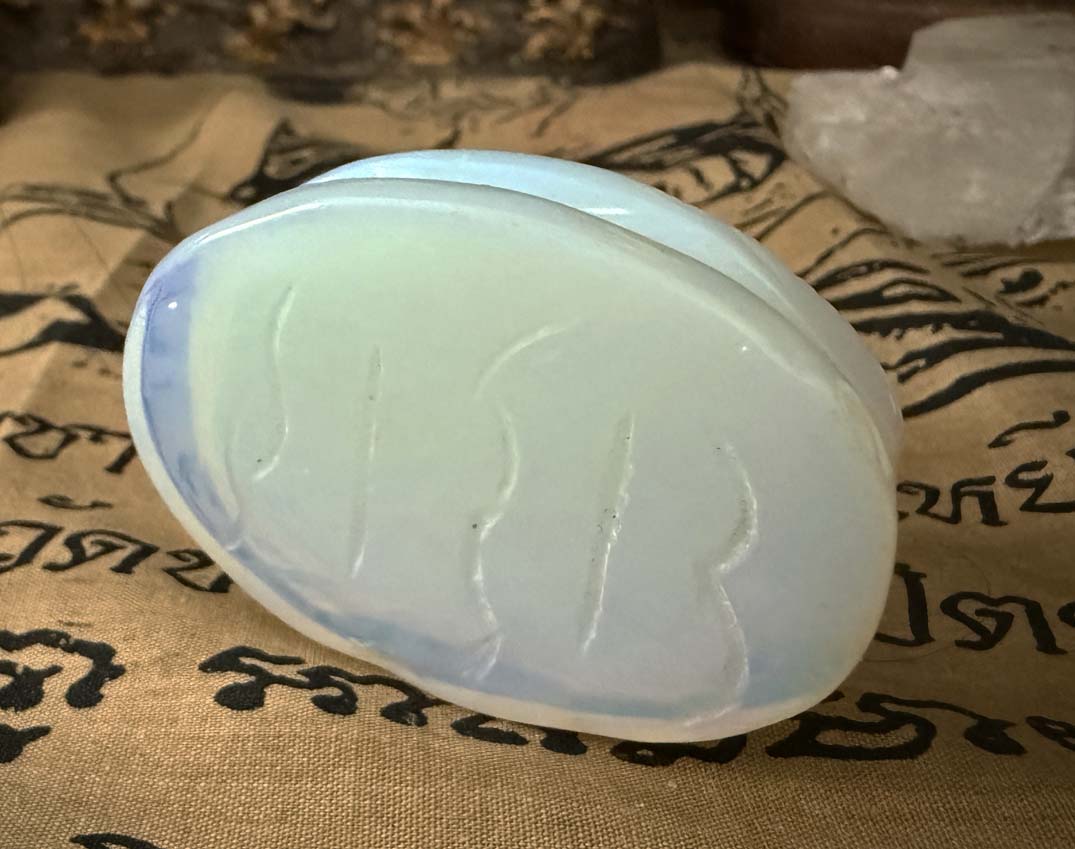
Opalite; 2 1/4" x 1 5/8" x 1 3/16", 89.5 grams.
“It is made under the auspiciousness of Saturn.”
“We have long been associated with magic and for occult purposes onyx is frequently used. It is a stone of black magic as it is in tune with the energies along which run, sorcery, necromancy and most obscure and mysterious aspects of magic. It is, of and in itself, not evil. This is certainly misconception. If this be the course you find you are on, it is you, and not the stone who has influenced this. The stone is neutral until influenced otherwise, but then, watch out!”
“As a reading tool, it proves out excellent in the research of occult knowledge, as spiritual writings become clear, and understood deep within your breast.”
“We have spelled this stone to follow you into, and influence your dream state, to which, some might consider nightmares. Allay any confusion, this is not caused by evil, look for the boon as you will find unexpected opportunity and luck if you observe all that is there for you to see.”
“The stone allows travel between multiple planes of existence by softening the barriers between our worlds.”
"When officiating transitional life and death, it summons friendly spirits who will accompany and guide a dying soul as they enter their journey.”
"The stone has proven suited to contact the ancestral spirits and recall visionary memories of lives past.”
“It may always be counted upon to provide intuitive insights during divination.”
“This stone forms a canine like bond with you as you work with it. It is faithful, preventing illusions and affording protection from illness, foul deed and misfortune.”
"Here is a stone whose energy directly relates to the heart chakra. As such, it is often used as a healing stone for the heart, both physically and emotionally. It brings comfort and eases depression and stress that are often the underlying cause of migraine headaches and addictions. I often couple it with amethyst for healing."
Opalite is a man-made, iridescent glass designed to mimic natural opal and moonstone. It is known for its milky, glowing appearance with shifting blue, pink, or peach undertones. It is used in jewelry and for metaphysical purposes such as promoting calm and clarity, though it lacks the unique color play of real opals. It's often mistakenly called a natural stone but is an affordable, synthetic alternative valued for its ethereal look and symbolic meanings, particularly in recent pop culture.
She notes of using opalite in private séance ceremonies, "using the play of light to attract them, as they always come, this is their frequency."~!~

Three (3), 34" Continuous Strands of LiDiex Glassworks Goldstone Chip Necklaces
Strands of gemstone chips were generally found lining the bottom of her spell boxes and this one is no exception. Her journals tell us "nothing is to waste at the cuttings" and that these were strung for her own use.

The Four Lemurian Cave Crystals
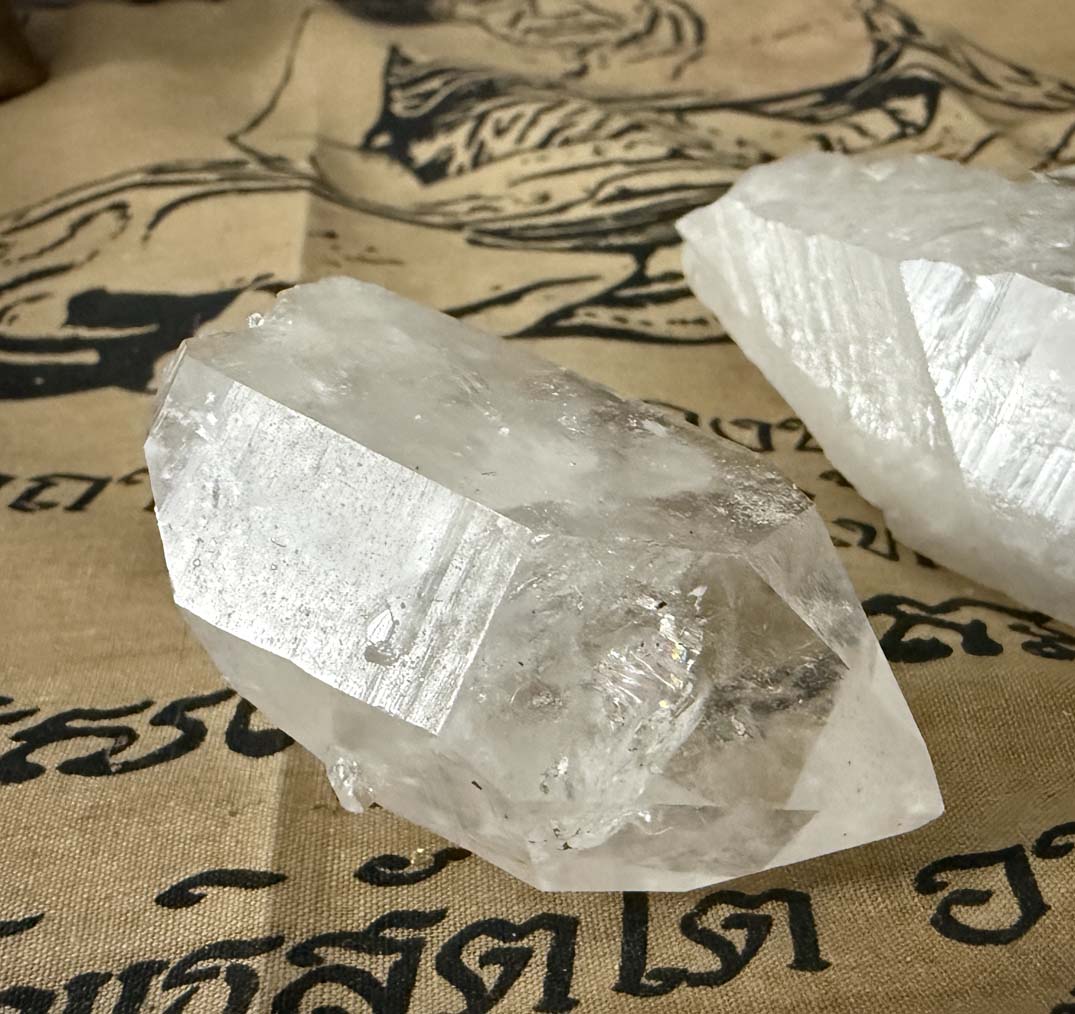
She has inventoried the four natural quartz crystal formations found in this box and shown above as, "Brazilian Lemurian Cave Crystals" as the title implies. Her journals and inventory tell us they are from the second batch of 'teaching crystals' she had brought back from Brazil, this time in 1952. We know this was her second trip to recover these crystals using the same guide that had taken her party to a group of crystal caves in southern Brazil where these formations were recovered, three years earlier.
The observatory itself was torn from the roof by Hurricane Andrew.
Their journals indicate their use of these crystals in past life dream recall, divination and spell invocation. They describe their being, "held aloft in both hands before being drawn into the chakra in descending order as a prelude to entering the meditative state."
~!~
~!~
It measures approximately 2 3/4" x 1 7/8" x 1 1/8" and weighs 107.5 grams.
Generator crystals will have six equally sized side planes terminating in a central tip. It is unusual to find this shape naturally occurring in nature. One might find a point with the energy signature of a generator, but its physical confirmation will not be generator specific with equal size planes and centrally located tip. Those that are have usually been ground and polished into generator points. The energy of these crystals will not be the same as a naturally occurring point as the internal structure of the crystal is not the same.
The energy of this formation, although not perfect, is that of a generator or Merlin crystal as the energy emits from its centrally located point. There are also numerous sharp areas of this formation which they tell us were intentionally used to draw blood onto the crystal in order to activate it.
Close examination reveals many hidden Record Keeper, triangular etchings on some of the body planes that do not conform to the norm. Record keepers are usually small, slightly raised or indented triangular shapes found on quartz crystal faces.
They are usually in alignment with the crystal's point. Sometimes though they appear sideways or upside down and are the called Trigonic record keepers. The record keepers can be found by shining a light on the faces of the crystal and moving it around slowly until they appear. It is believed that record keepers will appear out of nowhere and move around, in and on the crystal formation.
The crystal displays Striations. These are often called bar codes which are the parallel raised ridges on the body of the crystal.
The crystal also displays areas of self healing. Self healed crystals were broken off of their original matrix. This occurs with the movements and shifts in the Earth, environment, pressure, and other nearby forming crystals.Gazing within the uppermost third of the crystal, which views with excellent clarity. She goes on to tell us, "there are elestial etchings along the planes. Use these to access Akashic records."
The phantom displays the former state of growth of the crystal. Phantoms are rare and add collectability and value to a crystal. Quartz assists in healing any condition and is respected for its purifying effects. This is an excellent crystal for meditation. Although it does not meet the exact configuration of a generator formation, it still emits the energy of one. Their journals tell us "it has a powerful direct focused energy emission."
~!~
An Isis crystal is strongly in tune with feminine energy and amplifies it. Be it male or female, it is an aid in contacting one's 'female' or unselfish side. Isis crystals channel the power of the Goddess. For men, an Isis crystal will help one act in tune with one's feminine side and become aware of feminine aspects that men find troubling. For women, the Isis crystal will regain some of the power and energy that society has taken from you.
This one measures approximately 2 1/2" x 1 1/2" x 1 1/8" and weighs 75.7 grams.
~!~
Its Tabular shape refers to it having a flat shape, ie; two sides that are wider than the other four. These crystals are also commonly known as “Tabby.” Her journals confirm the general belief that this formation is an excellent transmitter of thought energy and contain information relating to our planet.
~!~
And finally we have a Self Healed, Tabular, Bridge, Record Keeper crystal formation that measures approximately 4" x 1 11/16" x 1" and weighs 90.7 grams
Bridge crystals are formed when a crystal grows through or across a larger host crystal. This is a type of epitaxial growth or intergrowth. It is a unique formation that creates a bridge-like appearance between the two crystals.
They are thought to serve as connectors, bridging different states of being, relationships, or dimensions.
~!~

The amulets and necklace shown here were assembled in the spring of 1973. That was when the group of eleven Theravada Buddhist Monks sailed here aboard the Agwe at the invitation of the 1888 LiDiex. They left for home in mid July. It is obvious their hostess and host went out of their way to make their guests feel welcome.
Most, but not all of their names were censored out of the journal entries and we believe this Somdej Phra Nyanasamvara, was the man who would go on to become the 19th. Supreme Patriarch of Thailand who would later be appointed by King Bhumibol Adulyadej in 1989.
In 1972, he was given the title Somdet Phra Nyanasamvara, the same basic title that he bears today. This is a rarely used monastic title that had not been granted to a Thai bhikkhu in over 150 years! The granting of this title placed Somdet Phra Nyanasamvara at the top of the Thai monastic establishment, and set the stage for his being named "Sangharaja," or "Lord of the Sangha" (Supreme Buddhist Patriarch of Thailand).
Other than being a notable person and willing participant in a 'mass dressing and blessing' of a group of mostly Buddhist depictions their hosts provided from their personal collections, Somdet Phra Nyanasamvara does not stand out in these journal entries. He is however worthy of further research so we are providing a link to his Wikipedia page if this is of interest to you;
https://en.wikipedia.org/wiki/Vajira%C3%B1%C4%81%E1%B9%87asa%E1%B9%83vara
~!~

The Agwe
This estate included four off-site properties. One of which was a nautical dry-dock, warehouse and storage yard on Old Griffin Road in Dania Beach Florida. This was another overgrown property we literally had to cut our way into. The massive bougainvillea that lined the fence line is what most likely prevented vandalism and theft, although her journals tell otherwise, attributing this to her spells of protection.
Restoring power to the site we began our inventory with the surprise find of their yacht, named, "The Agwe." Her journals, inventory and our own research revealed this one hundred and seventy two foot, twin screw diesel, steel-hull motor yacht was custom built for her in 1930 by the Defoe Ship Building Company. This was a small ship builder that was established in 1905 in Bay City, Michigan which went out of business in 1976 after failing to renew its contracts with the United States Navy.

He is described in her journals as being, "in excess of six feet of sinewy muscle, deceptively strong, easily matching two of his size in their grappling," and, "extensively, shaved, tattooed and pierced," in addition to, "shown to be capable of high magic without devices."
Both their journals claim his ability to heal wounds, shape shift, travel through time and space, telepath and create life with the power of his thought. They also corroborate the sharing of identities with a number of other LiDiex, "being a master of disguise and misdirection, often with his mere thought," according to these entries. This gave these men the ability to appear two or more places at once, an old family ploy that was apparently often used by their mistress.
It is this LiDiex who is attributed with making her introduction to Alexandra David Neel and his journals tell of numerous meetings and short adventures with her. Claiming at the age of twenty four to have met Neel for the second time in the company of Prince Sidkeong of Sikkim and of being her teacher of the Tibetan language having already spent six years with the Great Hermit as apprentice.
Much is already written on these subjects, so there is no need to elaborate here in this already overly long text, but we wholeheartedly recommend a cursory search for some very interesting reading.
~!~
But Back to the Party!
The Monk's Contributions
~!~
~!~

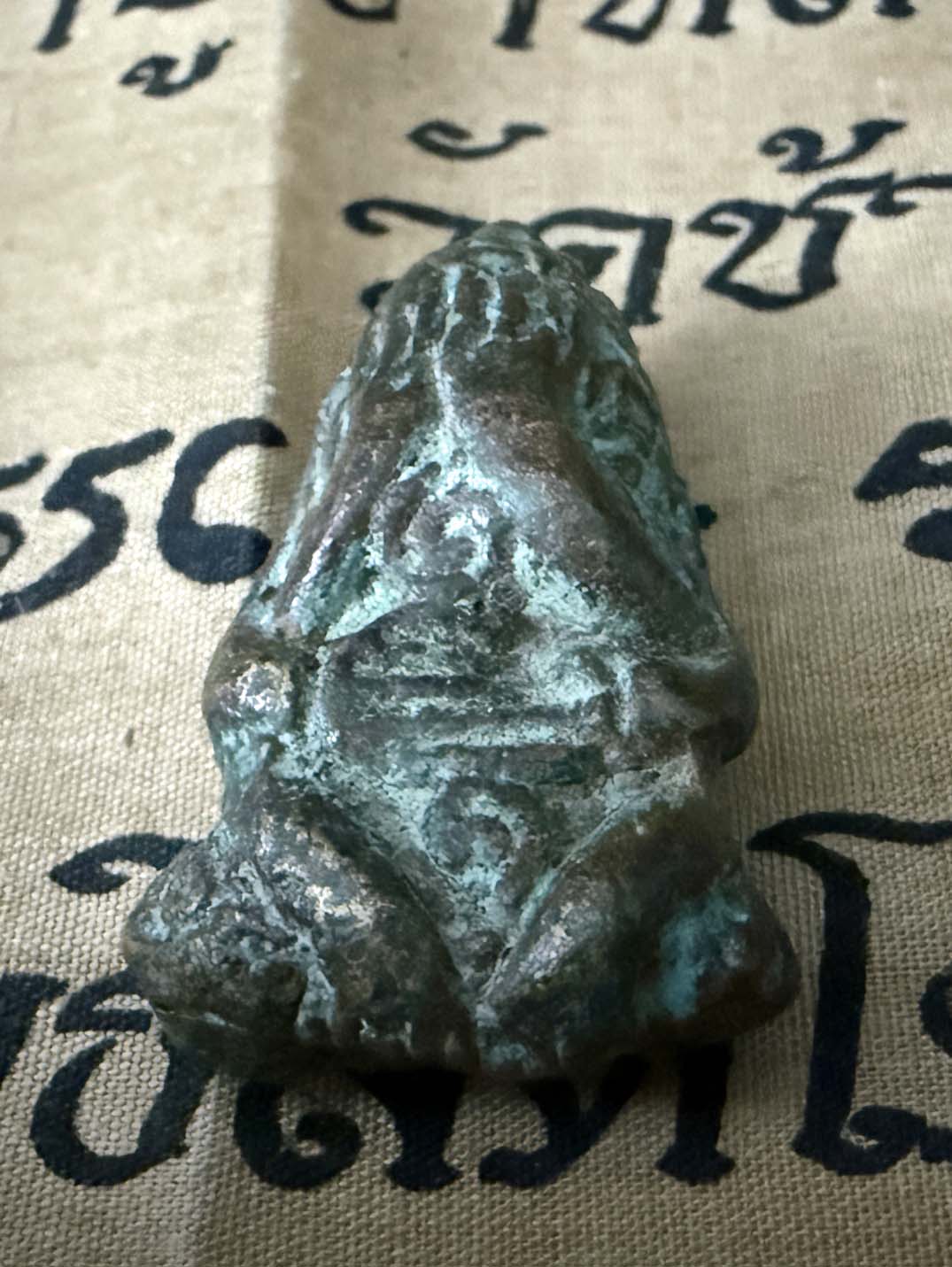
Kuman Thong
In an entry dated May 3rd., 1941, their journals tells us the LiDiex were in Thailand in the company of a monk named Luangpor Tae just prior to the outbreak of WWII. It is apparent from their journals the LiDiex had dealings with numerous, respected monks and this was another multi-generational series of relationships as their notes make reference to others, such as his father, who had spent four years with Luang Por Tah, master to Luang Phor Tae.
Their journals graphically detail his participation in the making of Gumarnthong with Luang Phor Tae, along with two unnamed Cambodian Monk's. A practice he brought home and taught to his mistress and others with close ties to this estate. Some other entries from the LiDiex journals that pertain to these charms read; “We have kept numerous Gumarnthong so here is some knowledge that will be of assistance to you.”
”All were authored by Sorcerer Monks. I have had hand and bear witness to their major ingredient (root) being taken from graves where mother and unborn child reside together. A violent death, such as murder, suicide, or accident, are preferred in that order. The child is roasted until charred and these charred remains are the key ingredients of these charms, along with powdered pieces taken from temple graves, tombstone and dirt from the same site along with magic herbs that the monks hold secret and sacred. But know you also, this practice is fraught with danger from the violent awakening of the mother’s ghost, whose sheer force of momentum is overpowering for most, leaving apprenticed monks maimed or blinded.”
“They are quite capable of being taught to perform evil bidding’s by their feeding on blood, but if you choose to train one as such, know it does not rest in peace and bears constant watching. A blindfold of red cloth, or placed facing a Buddha depiction puts him to sleep, as he is truly corrupted from your blood feedings.”
”Notes on the care and feeding Gumarnthong. Like all children, they prefer sweets, any candy will do, preferably one you will share, but do not let it become unappealing or allow the sweet to draw ants. Fresh milk, but this too must be removed, and not permitted to spoil in front of the child. Mine have loved a mixture of hard boiled egg, milk and rice, but again, I warn you to change the child’s meal and do not allow it to spoil before him. Fresh fruit, peeled or prepared for a child, including a small toy at mealtime is always a treat.”
“They love blood, especially that of their parents. Even more so of a creator, or one present at their making, that can recover the child from a blood feeding.”
”It is your child, never forget this. They look to you for love and guidance. Taking their cues from your mindset, they will help you perform dark and evil deeds, but remember, this invitation to practice dark arts demands payment.”
“He has cleared numerous obstacles from my life’s path, and love’s new toys as reward!”

Mae Pher
In the Thai occult tradition, a Mae Per (also spelled Mae Bper or Mae Pher) amulet is a powerful animist talisman representing a female spirit deity often translated as "Mother Per." She is used to attract, love and promote success in business.
She is typically depicted as a woman in a birthing squat position her knees drawn up or legs spread apart. This imagery is not meant to be erotic or vulgar; rather, it symbolizes the power of creation. The life force and intense energy of childbirth.
It also represents woman's sacrifice, the pain and blood of birth. This is believed to hold immense protective and creative magic.
In Thai spiritualism she is often paired with the Palad Khik (phallic amulet) to represent the balance of male and female energies.
She is Maha Sanaeh, an attraction charm, famous for enhancing one's personal charisma and sex appeal. It is said the worshipper becomes irresistible to others so she is often used as a love charm to find a partner or strengthen a relationship.
Her energy is full of Metta Maha Niyom (mercy and popularity), an amulet said to make people feel kindly toward the worshipper.
Business owners, salespeople and gamblers use her to attract business, close deals and provide windfall luck.
It is believed she safeguards the home and protects women especially during childbirth or against black magic.
These are often "barang" or "prai" amulets, meaning they are believed to be inhabited by a spirit. They may contain "spiritual" materials like cemetery soil or sacred herbs.
Mae Per amulets should be kept at waist level or lower (e.g., in a pocket or on a key chain) and should never be placed on the same level as or higher than a Buddha image.
Worshippers often warn against misusing the amulet's attraction powers for immoral purposes, such as pursuing someone who is already married.
~!~Examination reveals she is cast from a very dense clay with hand painted details and phra yant. Her red glass vaginal gem is set in a red prai material vagina,
She measures approximately 2 1/16" x 1 1/8" x 9/16", and weighing 17.3 grams.
~!~

In Ma Saep Nang Pim Yai Nuea Daeng Pid Tong Hlang Yant Lanna Animist Seduction Charm Early Era Kroo Ba Wang Wat Ban Den
Her journals and inventory list this as "In Ma Saep Nang Pim Yai Nuea Daeng Pid Tong Hlang Yant Lanna Animist Seduction Charm Early Era Kroo Ba Wang Wat Ban Den," as the title implies. This tells us it was made by the famous KrooBa Wang of Wat Ban Den, circa 2500 BE (1957). This was information given to her by the visiting monks. She confirms it being made from prai material and that it was part of a very small batch.
Here again we find damage to her journal pages destroying the balance of her notes concerning it.
Our own research revealed the maker and his amulets are very well known for their use as seduction charms. Our consulting experts tell us it was most likely made in 1957/58 and is part of a very small custom made batch numbering under twenty pieces! And to our knowledge it is one of four known to exist, Larger batches of all pims appear to have been sold out years ago for around $300 USD, each. Kroo Ba Wang was known to use this material called Red Sabu Luead Powders, Prai Earths and Muan Sarn for these amulets.
This one measures approximately 1 3/4" x 1 1/16" x 3/8" and weighs 19.9 grams.
This is an early era In Ma Saep Nang hand pressed amulet from the Great Kroo Ba Wang, of Wat Ban Den. The amulet is evidently made from the Muan Sarn clay. with inscribed Agkhara Spells in Nuea Daeng. This empowers it with the Ancient Northern Lanna Tradition Wicha through these magic incantations inscribed upon the surface. It is a rare, classic amulet, from Master Kroo Ba Wang, of Wat Ban Den. The Ma Saep Nang of Kroo Ba Wang are found in numerous shapes, such as the Roop Sum arch shape, Rooop Hua Jai heart shape, and some rare Ongk Kroo Models with Takrut, released in the later era, were immersed in Nam Man Prai Oils, which are however despite being of a later era, are also extremely rare finds.
~!~
Luang Phu (LP) Kroo Ba Wng, was born in 2434 BE (1891), into a family of farmers and market traders. In order to obtain an education he would have to stay in a temple and learn with the Monks. So, at the age of nearly nine years old, his father took him to live at the nearby temple where he learned to read and write. Three years later, he was ordained into the Sangha as a Samanera Novice Monk in the year 2445 BE (1902).
He soon began practicing Khom Sanskrit Agkhara and Wicha, and became adept at meticulous chanting of Agkhara from memory.
He was well known for being able to raise the funds and labor to build numerous temples in his lifetime. LP Kroo Ba Wang was best known for his Wicha, Horasart (Astrology), Amulet making, Maha Sanaeh, Metta Maha Niyom Maha Lap Magic, and his Candle Magic to eliminate Bad Karma.
Then in the year 2513 BE (1970) he became ill. Now weak with age he was unable to travel, he spent his last years on earth performing meritorious acts for the temple and worshippers. He died at Wat Ban Den, in the year 2516 BE (1973).
~!~

The Golden Rooster
Their journals were of little help in providing any history of this amulet due to ledger damage and our own research did not fare much better! Our resident and associate experts feel it is a one of, most likely made by a forest monk on tudong.
The Thai's believe, a golden rooster amulet painted on stone, often resembling sandstone or made from sacred "holy powders" is a powerful talisman used for wealth attraction and business success. The rooster is revered for its diligence in "scratching the earth" to find food, symbolizing a steady flow of income and the ability to find opportunities where others cannot.
Prosperity and Wealth are known as Maha Lap and amulets such as these are believed to bring great fortune. Hence, it is favored by merchants and entrepreneurs.
Roosters are watchful guardians that ward off misfortune, evil spirits, and "backstabbing" in the workplace. The rooster is also a symbol of national pride, linked to a legendary cockfight where Prince Naresuan won freedom for the Thai kingdom from Burmese rule. Khun Paen is also noted as being very successful with his fighting cocks.
Most "painted" or relief-style rooster amulets follow the traditions of these renowned monks:
Luang Phor Parn (Wat Bang Nom Kho): Famous for his "Phra Phuttha Khi Kai" (Buddha riding a rooster) amulets. These are often made from sacred powders that look like stone and are prized for business luck.
Luang Phor Ruay (Wat Tako): His name literally means "Rich." His amulets frequently feature vibrant, painted golden roosters and are highly sought after for financial empowerment and protection.
Luang Phor Phat (Wat Huay Duan): Known for modern, colorful "Longya" (enamel-painted) amulets that combine traditional protection with striking visual detail.
This one measures approximately 1 3/8" x 1 3/8" x 1/2" and weighs 12.7 grams.
~!~
The Palad Khik
There is enough legible material in the damaged area of their journals to tell us this Palad Khik was made by one or more of the unnamed, attending guest Monks to the estate in 1973.
~!~
Palad Khik translates to, "honorable surrogate penis," from the Thai. Essentially, it is a penis amulet, but it is also much more than that, and it is deeply ingrained into Thai and Cambodian culture to this day. They are usually worn by men and boys, strung under their clothing to the side of their own genitalia as an amulet to absorb any negative magic that might be directed to their own.
They are images of Shiva Linga representations as brought to the region by the Cambodian monks of the 8th. century returning from India after studying the Hindu beliefs. Shiva is one of the Hindu Trinity, and was the Highest Deva of the Khmer Brahman Race, along with Brahma and Vishnu being close second.
Even today, they are made and blessed by monks with a known talent for producing effective Palad-khik. The inscriptions are words of magic, along with the embodiment of any animals and or humans represented which are taken seriously.
These amulets are usually not used by women, but her journals tell of their using them in regenerative, fertility and love rituals that involved alcohol and narcotics that are far to risqué to publish here. This holds particularly true with this palad-khik, as she prescribes it's use to "attract men through visual arousal of manual and oral cock manipulations." Indeed!
She also reveals that these rituals were carefully mapped out by her and her associates from early Brahmanistic tradition. Our own research reveals a ritual being performed by young contemporary Thai woman called Tam Sak that bears a close, although tamer resemblance to the ones she describes.
~!~
The NecklaceOddly enough, we were unable to find any journal or inventory mention of this necklace. We are assuming it is of Thai origin and meant to accommodate a single amulet, but see no provision for mounting save an opening in the bottom focus bead which we conclude could be used to fit a bale or ring by a crafts person.
It appears to be unworn and made from wood and coconut shell beads. The necklace measures approximately 24" as a continuous strand (12" drop) and weighs 17.3 grams.
~!~
Brazilian Shaman's Amethyst Tower
Her journals also tell us this 2 13/16" tall amethyst tower is an enhanced cut of a natural crystal obtained during her 1962 Brazilian Shaman Artifact Hunt. Although she does not name them in her notes she solicited a handful of Brazilian holy men, healers, sorcerers and seers to act as guides to her party, and relinquish some of their precious finds usually in trade for guns.
She writes of the source of amethyst as being highly regarded by her guides for its spiritual protection abilities and that her spells had enhanced this.
She has inventoried, this as, "a Generator Energy amethyst Crystal Point."
The natural angles of the crystal faces of this formation, although not perfect, are that of a generator or Merlin crystal as the energy emits from its centrally located point which is in very good condition. Although it does not meet the exact configuration of a generator formation, it still emits the energy of one.
Many of the inclusions are heat sensitive Aurora Borealis or Rainbow inclusions which were caused by fractures and rising gas during its formation. These rainbow crystal are noted for their happy energies and love auras. These inclusions will appear white until you pick it up and exhale upon it revealing the colorful display. Connect to the gift of love these crystals with Rainbows bring.
~!~

Gems were found loose, lining the bottom of many her spell boxes and this box was no exception. She notes of using loose gems "as sacred center stones" indicating their "placement upon the chakra to induce a specific response or action."
~!~


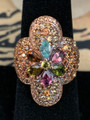
Aunt Nadiene's, Thai 22k White Gold Vermeil Citrine and Garnet Gems Ring
Her journals and inventory tell us the ring is one of many her Aunt Nadiene had made for her by a Thai jeweler of Chanthaburi beginning in 1956/57. This jeweler had copied a handful of gold and gemstone rings in vermeil, many of which were gifted and inherited by her. While there, she purchased a sizable quantity of jewelry from at least four of the areas jewelers to be sent home for resale to their clients. Often times claiming to cast spells or attach spirits to a selected piece of jewelry at a client's request.
Aunt Nadiene
Although not a blood Aunt, she had been "taken into the fold as a child found" by her "mother" as she was said to refer to Marie Glapion. Further chronological investigation revealed her to be the daughter of a prostitute that was in her mother's (Marie Glapion) employ. Other notes found might lead one to believe her mother was an Algul. Described as a vampiric jinn like creature they claimed to have encountered in remote desert regions.
Our own research has not revealed very much other than Algul literally translates to "horse-leech," or "blood-sucking Jinn." An example was found in the 'Thousand and One Nights' as Amine. Although a drinker of blood, it is a Jinn, or demon that was never human. Unkillable by most means, it can be destroyed by fire and sometimes magic. Most inhabited unchartable regions of desert, but oil production has driven them from their homes and she claims "they live among us, posing no threat to adults save sexual fulfillment, but they must be watched around children and livestock."
~!~
It is not clear if Aunt Nadiene was abandoned by her mother or if the mother died, orphaning the girl, but she was apparently treated and referred to as a family member, indoctrinated along with her "niece" and for many years she was her traveling companion and guardian.
Her journals note of Aunt Nadiene's passing in 1966.
She also notes of wearing Aunt Nadiene's jewelry, "Connected to her so closely in life, it awakens psychic qualities with a feeling of devotional joy to wear them."
Other journal entries allege incidents of Aunt Nadiene, "owl shape shifting," claiming the Great Horned Owl as being her spirit guide or token spirit animal, and because of this, her taking due care in the handling of owls in her bird and reptile ceremonies, not submitting them to the torturous ceremonial deaths many other species endured during these ceremonies.
She also notes of a number of dreams in which a Great Horned Owl wearing her aunt's jewelry would appear to her. They also go into detail of her gazing into her stones (sphere's), to draw upon Aunt Nadiene's power to help her in this life.
~!~
The Ring, Its Components and Commentary
The gems are all of good to very good cut and color and view eye clean while displaying an abundance of flash.
More often than not, their metal of choice was silver as she notes, "Silver is the mirror of the soul related to the moon energies. It strengthens connections of the astral and physical bodies. A metal unmatched in its psychic energies and healing abilities, I have used it as a spell medium, to heal the speech impaired and to help public speakers achieve eloquence. Induced into the drink, it has expelled the toxins that caused headaches, arthritis, intestinal and blood disorders. More importantly it attracts, enhances and stores energies of gemstones, driving out negative energies the stone may have absorbed."
Some of her journal entries concerning citrine read; "This stone has very strong, positive vibrations that are readily available. Its energies intensify with use which is enhanced by their cutting."
"The stones have proven useful in calming all associated with them. A proven aid for those seeking spiritual growth. The meditations and healing's that I have administered with these stone have been most rewarding."
"Power crystals that are to be used wisely and with respect. They are ever manifesting one's wants and needs. Look to them in healing as these are ancient ceremonial crystals for use high in the order which allows their energy to be configured and directed."
We found no w=explanation for the missing gem. Although they would sometimes strip the stones from some jewelry for use in their practices, we do not believe this to be the case, but rather sim,ply just a lost and missing gemstone which we did not recover.
~!~
Of rhodolite garnet she writes; "vivid dream stones of past life remembrance. These are energies of love and life that enhance these within us. It cleanses and renews, comforts and protects, doing well for those in need of self respect and courage."
The ring is marked "925" with no maker's or assay mark. It tests as .925 Sterling Silver Standard and weighs 10 grams.

The Lingam
Their journals tell us, "Chanting Siva Mantras and Stotras we gather to pay reverence to the Lord of all deities who bestows upon us his grace instilling in us, through His invocations, power and bravery."
"Here we celebrate Mahaashivaraatri. A special day of worship. It is on this night the first Shivaling originated. It is this night that Lord Shiva married the Goddess Parvati. All should pay reverence during this festival of joy as He is pleased by the smallest of offerings taking delight in His worship according to prescribed scripture."
"Every 13th day of both fortnights of the lunar month is a special day of worship as are Monday's. On these days one may come to this altar and find sugar, yogurt, ghee, candy, Holy Water, rum, milk, incense and fruit for offering."
According to her journaled inventory, this is one of the Narmada River Shiva Lingam that were brought to the estate in 1954.
~!~
The majority of these stones were inventoried as being acquired by the 1888 LiDiex from the Narmada River in India over a four decade period. Named as "Narmada Siva Lingams in Ghee" they were well inventoried, with their individual vibrations dictating where they would be placed and how they would be used. Some were even found in the gardens!
~!~
The acquisition of these stones is entered in a dated inventory where she makes note of receiving groups of these stones to be used at her altars. "Hand picked by my charge from a secret river gorge that opens to him to give forth it's treasure to us".
There are numerous journal entries noting of this LiDiex's travels to the Narmada river "in search of the stones with my calling" as he writes in one entry. A common thread in these entries relates of his being possessed by Lord Shiva who would cause him to be, "plunged beneath the river's surface into a world of chilling underwater darkness. But Lord Shiva has not the intention of my drowning, but my awakening as He leads me to a small cave outcropping just beneath the bank of the river."
This "outcropping" described as shown in the photo below was visited a total of five times by this LiDiex and it is here that most of these stones are alleged to have been recovered.
He also notes of this as being "a secret cave that is hidden by the tide of the river's flow."
~!~
In another entry he writes, "These are stones of reverence whose energy connects heaven and earth. This is an energy with no end or beginning with a heavenly (upward) direction. It is the vertical axis which both holds apart yet joins heaven and earth, dividing then uniting them at the same time. It is symbolic of cosmic integrity, much in the order of the Tree of Life, being both the foundation and support ensuring balance between heaven and earth."
He leaves an instructional message describing their proper placement and procedure, "Display the stone on your main altar. Dress appropriately and wear no shoes as a show of respect. Pay homage by gently touching the stone in a circular motion with both hands. In reverence touch your third eye or heart Chakra while bowing forward in gesture of prayer. Place gifts of flowers, foodstuff, candles and clothing at the base of the Lingam. These offerings then must be given to the needy. This is a powerful sacrament that I am obliged to pass on to you."
~!~
There is much more information concerning the Shiva Linga that is written and available today then there was back then in this country. Today, a simple internet search reveals the Narmada River to be one of the seven sacred holy places of pilgrimage in India. It is considered to be very sacred by the Hindu and apparently she and her associates were in agreement as she herself claims to have bathed in it nine times during her lifetime and it is attributed as being one of the reasons for all of their good health and longevity.These Lingams, which appear to be agate or jasper eggs are crypto crystalline chalcedony that she claims were sent to us by the way of a meteorite that fell to Earth several million years ago. Their journals make numerous entries concerning these stones, their vibrations, shape, color and markings all having significance in their power and use. One of these entries reads, "an energy that exudes with knowledge and wisdom which works well with breath and fluids of the body."
The Narmada River is considered to be one of the most powerful healing rivers in the world and she claims "the water has placed powerful healing, regenerative energy into the Shiva Lingams." These stones are sacred in both Hindu and Buddhist beliefs and were once gathered one sacred day a year from an area near the source of the Narmada River about 300 miles north of Mumbai. Of the stones gathered, the most beautiful are polished into this traditional egg shape by the action of the river then given a final hand polish using dung, mud, honey and Ghee (clarified butter).
According to Vedic text, Narmada sivlings illustrate harmony through duality. In these sivlings are the energy of divine acceptance of what is. They represent power, creation and the physical plane or grounding of those who accompany these sacred stones. Some of her other entries read, "this is a karmic stone with intense power of light and dark that shows no preference for either and will respond to the calling forth by multiplying these in return to the user in thought, intent and ability, but it too seeks a source of power so take heed in intent as it's use has unintentionally drained the life of the living to fulfill a spell."
Although some of the stones were "boudoir" and "Menstrual Altar" found and used as sexual or phallic devices, she notes, "Shiva is creation, destruction and regeneration which the lingam represent, granting heightened consciousness, power and the ability to travel along planes of power. Do not see this as a sexual phallus only as this is at it's basest form."
"It's sexual symbolism, like sex in general, is an obsession of the Christian mind. Those following the Tantric path seem to be unable to move beyond this symbolism to it's spiritual practice, remaining instead at a superficial level while the energy of the cosmos remains elusive to them."
"It is a high symbol of worship on this plane that brings mystical union of the conscious and unconscious."
"Sacred stone of the heart chakra that manifests love energy, harmony and balance of the soul in tune with the universe. They activate the Kundalini and stimulate an intense energy through the body that awakens all centers along the path to the crown chakra."
Once again, there is now much more information available concerning the Narmada River and the stones that are taken from it. Far too much to put into this already lengthy text, but it is fascinating reading concerning Hindu and Buddhist mysticism that we wholeheartedly recommend one to continue to research and experiment on their own.
~!~
The Narmada River
Another common thread in their journals concerns a group they name as "Rosicross" being responsible for the hiding and/or destruction of Native American Holy sites. Other entries however tell of such world wide cultural sites that have been pillaged, used in a sacrilegious manner, hidden and/or destroyed throughout history by the Rosicross.
The modern day construction of large dams on the River Narmada in central India and its impact on millions of people living in the river valley has become one of the most important social issues in contemporary India.
This LiDiex penned an entry that goes on for sixteen pages with drawings that will most likely be published on it's own, but we thought you might like a glimpse now so some selected entries are included here;
“Awash in color, the predominant color is tan. This originates from the river basin. The remainder of the stone, with it’s red brown coloration is made of meteorite properties. Symbolically, the tan coloration symbolizes the male qualities, the reddish brown color, the wisdom of the Femini” (his spelling).
~!~
“This overall structure is element to Shiva containing his vibrational energy which is the highest vibration I have recorded in over two thousand mineral specimen.”
~!~
“There will come a day when India is governed by the powers of the Rosicross. This will mark three to four years to the Revelation and will be noted by the deaths of the devout, killed by the damming of the river. The harvest of the stones will have been intentionally hampered but the stones will be recognized as national treasures.”
Ya think?
~!~They offer a balanced energy source", writes this LiDiex. This Narmada River Shiva Lingam was used as an item of revered worship. She describes; "they are to be caressed and revered with offerings made to the Lord Shiva." It's use is also described as "being revered as the Shiva in the form of Shiva linga. The Auspicious One who cleanses us all by the very utterance of His name."
There are many other entries concerning their use of these stones. In addition to being used in a manner of reverence through food offerings they would also be used as phallic devices in a manner where the stone would caressed and stroked, in order to "arouse the sexual desire of Shiva" which it is said culminated in, "sexual fulfillment of Shiva through our own flesh."
Some other entries read; "Here is Shiva's cosmic column of fire the center of reverence and worship at this shrine. It is his manifestation carved in stone. It is his visible symbol here on earth that embodies the creative and destructive power of the Lord which resides in all aspects of the planes we may travel.""Shiva is arupa so he took the form of Shiva lingam out of mercy to bless us."
"This is an embodiment of Shiva's energy which all find to be soothing and healing to the mind and body. This energy aids in relaxing meditations to promote psychic dreams and extend perceptions beyond the physical senses."
This Lingam is of very fine polish with areas of residue from their anointing. It measures approximately 2 15/16" in length x 1 1/4" in diameter and weighing 99.4 grams.
It should also be noted that these Lingam are naturally formed stones that have a top and a bottom. The top being the end of the stone that "met the river's current" being slightly smaller than the bottom. It is said they are meant to be displayed with this smaller end up.
Now here's the onion. In many cases we have found the weight of these stones has varied between handling and handler depending on who handled and weighed them. They never varied for that individual, but for another would weigh differently, but consistent to them.
They say, "the lighter the stone the better" in reference to their own documentation of this phenomenon, indicating that "one should have guardianship when the burden is easy for them and hard for others."
Again we say "Ya think?"
~!~
The StandAlthough recovered with this lingam and original to this estate, the stand we recognize as the work of a local craftsman in the employ of a shop she ands her associates frequented named The Barefoot Mailman. The name of the store was a homage to South Florida's "barefoot mailmen." Between 1885 and 1892, when no roads existed between Palm Beach and Miami, they delivered mail on foot, along a 68 mile route. Described as "Spencers on steroids," there is a web and Facebook page dedicated to them.
~!~
Her journals and inventory tell us it was custom made, from gold washed jeweler's bronze with a butterfly motif.
It is unmarked, measures approximately 1 3/4" x 5/8" and weighs 19.5 grams.
~!~

Pewter and Crystal Hot Air Balloon
~!~
Pewter
Her journals tell us pewter was commonly used in occult practices. In the olden day high lead content alloys was often a component." Today, lead is usually not alloyed in modern pewter for safety reasons.
Her journals go on to tell us, "Cast iron, copper and pewter are strongly connected to kitchen witchery. Potions are more powerful when brewed in cauldrons made of pewter, and kitchen spells will work more effectively when you use pewter in the working."
~!~
Hot Air Ballooning
One badly damaged ledger containing her journal entries dated 1910, tell us of her first hot air balloon ride in Mexico City in 1910. No further information was discernible of this event, but our own research revealed an AI response;
These are results for hot air balloon Mexico 1910
Search instead for hot air balloon Mexico 1910
AI Overview
Historic photographic evidence shows hot air balloons were present in Mexico City around 1910, particularly near Juarez Avenue. While modern tourism hot air ballooning at Teotihuacán didn't become popular until the mid-20th century, early 1900s photography confirms balloon activity during the era of the Mexican Revolution and the completion of major excavation work on the pyramids.
 Historical Context: A 1910-1915 photograph from the Library of Congress shows a hot air balloon over Juarez Avenue in Mexico City.
Significance: While the specific 1910 flight purpose is not detailed, this was a time of significant transition in Mexico, celebrating the centennial of the 1910 Revolution.
Modern, organized hot air balloon rides at Teotihuacán only began decades later, utilizing the area's stable climate.
Another online search revealed;
AI Overview
Hot air balloon imagery in occult, spiritual, or psychological contexts generally symbolizes rising above, gaining a higher perspective, and emotional release. It is used in guided visualizations for letting go of negative emotions (sandbags) and achieving mental freedom, often relating to "cognitive defusion".
Metaphor for Consciousness: In psychological visualization, the balloon is a tool to view difficult emotions from a distance, rather than being "in" them.
Spiritual Ascension: It is used as a metaphor for spiritual growth or rising above, sometimes equated with relying on the Holy Spirit to guide life, just as a balloon relies on the wind.
Literal Visualization: A common exercise involves visualizing oneself in a hot air balloon basket, releasing sandbags that represent negative emotions to rise higher.
Occult/Channeling: In some esoteric practices, it can be a symbol used in fortune-telling or spirit readings, representing comfort and divine perspective, as noted by an Instagram user on Instagram.
The symbol primarily functions as a visualization for detachment and gaining a "bird's-eye view" of one's life circumstances.
~!~
Lagniappe
From Wikipedia, the free encyclopedia
A lagniappe (/'lænjæp/ LAN-yap, /læn'jæp/ lan-YAP) is "a small gift given to a customer by a merchant at the time of a purchase" (such as a 13th doughnut on purchase of a dozen), or more broadly, "something given or obtained gratuitously or by way of good measure." It can be used more generally as meaning any extra or unexpected benefit.
The word entered English from the Louisiana French adapting a Quechua word brought in to New Orleans by the Spanish Creoles.
Etymology
After the Spanish conquered the Inca Empire, some Quechua words entered the Spanish language. The Spanish Empire for a time also included Louisiana, so there was a Spanish presence in New Orleans. In his book Creoles of Louisiana, George Washington Cable comments on the effects of the Spanish presence on Louisiana Creole French:
The Spanish occupation never became more than a conquest. The Spanish tongue, enforced in the courts and principal public offices, never superseded the French in the mouths of the people and left but a few words naturalized in the corrupt French of the slaves. The terrors of the calabozo, with its chains and whips and branding irons, were condensed into the French tri-syllabic calaboose; while the pleasant institution of ñapa—the petty gratuity added, by the retailer, to anything bought—grew the pleasanter, drawn out into [the] Gallicized lagniappe [emphasis added].
Lagniappe is derived from the South American Spanish phrase la yapa or ñapa (referring to a free extra item, usually a very cheap one). La is the feminine definite article in Spanish as well as in French (la ñapa or la gniappe = the ñapa/gniappe). The term has been traced back to the Quechua word yapay ('to increase; to add'). In Andean markets it is still customary to ask for a yapa (translates as "a little extra") when making a purchase. The seller usually responds by throwing in a little extra.
Although this is an old custom, it is still widely practiced in Louisiana. Street vendors, especially vegetable vendors, are expected to throw in a few green chili peppers or a small bunch of cilantro with a purchase. The word is used in the Gulf Coast region of the United States and in other places with historic links to French Creole culture, such as in Trinidad and Tobago. The concept is practiced in many more places however, such as the Spanish-speaking world, Southeast Asia, North Africa, rural France, Australia, the Netherlands, and Switzerland.
Though the word is included in English dictionaries it is used primarily in the region influenced by New Orleans (and therefore Louisiana French) culture and so may be thought of as being more Cajun French or Louisiana Creole French than English. This is especially so since the spelling has been influenced by French.
Mark Twain writes about the word in a chapter on New Orleans in Life on the Mississippi (1883). He called it "a word worth traveling to New Orleans to get":
We picked up one excellent word—a word worth traveling to New Orleans to get; a nice limber, expressive, handy word—"lagniappe." They pronounce it lanny-yap. It is Spanish—so they said. We discovered it at the head of a column of odds and ends in the Picayune, the first day; heard twenty people use it the second; inquired what it meant the third; adopted it and got facility in swinging it the fourth. It has a restricted meaning, but I think the people spread it out a little when they choose. It is the equivalent of the thirteenth roll in a "baker's dozen." It is something thrown in, gratis, for good measure. The custom originated in the Spanish quarter of the city. When a child or a servant buys something in a shop—or even the mayor or the governor, for aught I know—he finishes the operation by saying—"Give me something for lagniappe."
~!~
That being said, this LP Koon Somdej is the lagniappe to the new guardian of this box and it's contents. It is not original to this estate, but rather an authentic BE 2554 (2011) amulet purchased at the amulet counter of Wat Ban Rai in 2011.

Five Tier Throne, 18 Thank Khai 2554 Phra Somdej
A Very Limited Editionin
Enameled Gold Micron Case with Achroite Gems~!~

The Amulet

Unusual, authentic Voodoo Priestess Estate piece and at a bargain price.
This is truly a rare opportunity to own anything with attributes to this estate.
The majority of this estate is now gone. Most of what we had left, and it was considerable, has been split up and sold to a couple of private, foreign collector practitioners and will never be available to the public again. We made the decision to do this as we have had some pretty strange visits from even stranger individuals and there have been enough unexplained phenomenon going on in the warehouse where her things were kept that many of our employees refused to go in there. The pieces offered and sold here are some of the few remaining pieces that will ever be offered to the public.
Nice addition to any collection, wardrobe or decor, displays really well.
Really doesn't get any better than this.
There are 66 photographs below to tell the rest of this tale.
Buyer to pay $0.00 for Insured Ground Shipping with Tracking, handling and lagniappe.
Rest assured your order will be carefully packed to withstand the onslaught of the most deranged of carriers.

International Buyer's, Please email us for a Shipping Quote.
Payment is due at listing end. Check our other listings, and sign up for our newsletter as new items are usually listed daily.
©Text and Photos Copyright 2001-2026 bushidobuce, all rights reserved.
~!~
Props are not part of the deal, but you knew that already.~!~