Loading... Please wait...
Categories
 New Products
-
 $89.90
-
 $129.90
-
 $89.90
-
 $149.90
-
 $49.90
Our Newsletter
11" Wish Granting Engraved Nepalese Kukri with Bronze Coin and Copper Sheath circa 1958 - An 1888 LiDiex Gift and Green Tara Altar Find - The Voodoo Estate


)
Product Description

~ Voodoo Priestess Estate ~ ©
11" Wish Granting Engraved Nepalese Kukri with Bronze Coin and Copper Sheath, circa 1958
An 1888 LiDiex Gift and Green Tara Altar Find
Nearly twenty-five years have now passed since we were called to do the estate that had been closed up for seventeen years!
Our research has shown that this woman was what she claimed and was indeed descended from a long line of a well known Vodoun family originating in New Orleans in the early 1800's. We were pretty unnerved by this until we discovered they were also devout Catholics! Although I have to admit this was unlike any Catholic home we have ever been in and some of the items found inside were a little more than disturbing.
~!~
The Tara Altars
Green Tara
Green Tara is a tantric meditation deity whose practice and imagery is used by practitioners of the Tibetan branch of Vajrayana Buddhism to develop inner qualities and understand outer, inner and secret teachings of compassion and emptiness. Tara is actually the generic name for a set of Buddha’s or bodhisattva’s of similar aspect. These may be properly understood as different aspects of the same quality, as bodhisattva’s are metaphoric for Buddhist virtue’s.
~!~
The kukri is a type of knife or short sword with a distinct recurve in its blade that originated in the Indian subcontinent. It serves multiple purposes as a melee weapon and also as a regular cutting/chopping tool throughout most of South Asia. The kukri, khukri, and kukkri spellings are of Nepali English origin.
The kukri is the national weapon of Nepal, traditionally serving the role of a basic utility knife for the Nepali-speaking Gurkhas, and consequently is a characteristic weapon of the Nepali Army.
Since the kukri's earliest recorded use in the 7th century, it has accumulated a number of myths, the most persistent being that the blade must draw blood before it can be sheathed, a belief rooted in the misconception that the kukri exists purely as a weapon of war. In reality, the knife's uses extend far beyond combat. Nepalese farmers and laborers rely on it to cut crops and clear brush, hunters use it to skin and dress game, and it doubles as a tool for cooking and woodworking. In certain Nepalese religious traditions, it also carries ceremonial significance.
~!~Her journals and inventory tell us the kukri was a gift from the 1888 LiDiex, procured by him from a Nepali Trader she names as Gagan Paswan. Unfortunately, that is the only entry we have been able to attribute to the acquisition of this knife and there is no information concerning its past.

He is described as being "in excess of six feet of sinewy muscle, deceptively strong, easily matching two of his size in their grappling" and "extensively, shaved, tattooed and pierced." in addition to "shown to be capable of high magic without devices." Both their journals claim his ability to heal wounds, shape shift, travel through time and space, telepath and create life with the power of his thought.
It is this LiDiex who is attributed with making her introduction to Alexandra David Neel and his journals tell of numerous meetings and short adventures with her. Claiming at the age of twenty four to have met Neel for the second time in the company of Prince Sidkeong of Sikkim and of being her teacher of the Tibetan language having already spent six years with the Great Hermit as apprentice. He also claims to have been "expelled by the Great Hermit for divulging Tulpa technique to the mystic whore."
Both their journals claim him to have mastered this ability to "thought form" at an early age, "born with it" as they note. Claiming, "by my thought they form as mist, taking solid form usually as something that appears playful. Knowing their ways, grooming them for their rebellious phase, as it is then they mature and can be used for deadly purpose in exchange for their freedom of my will. This allows it to develop into a living entity of it's own, freethinking and free willed. It is always capable of performing minor feats of magic."
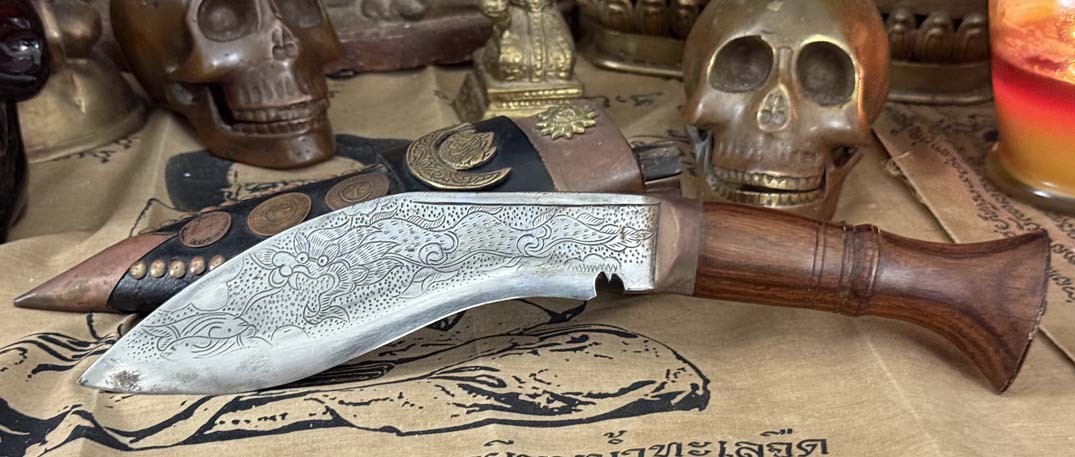
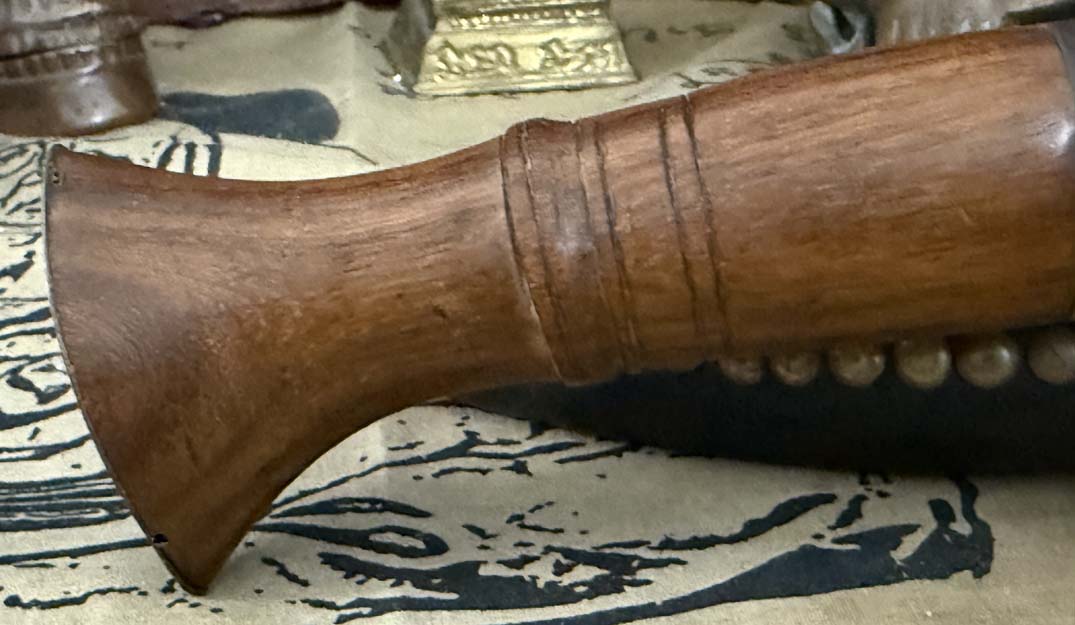
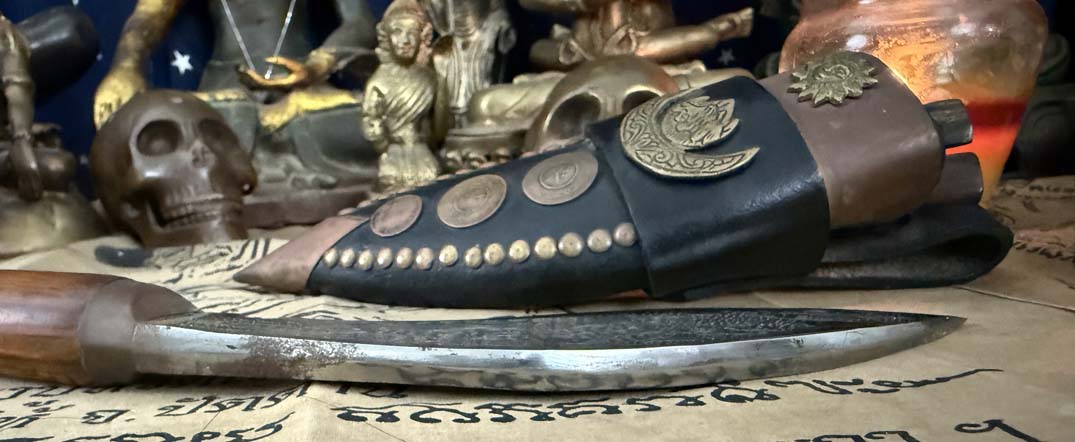
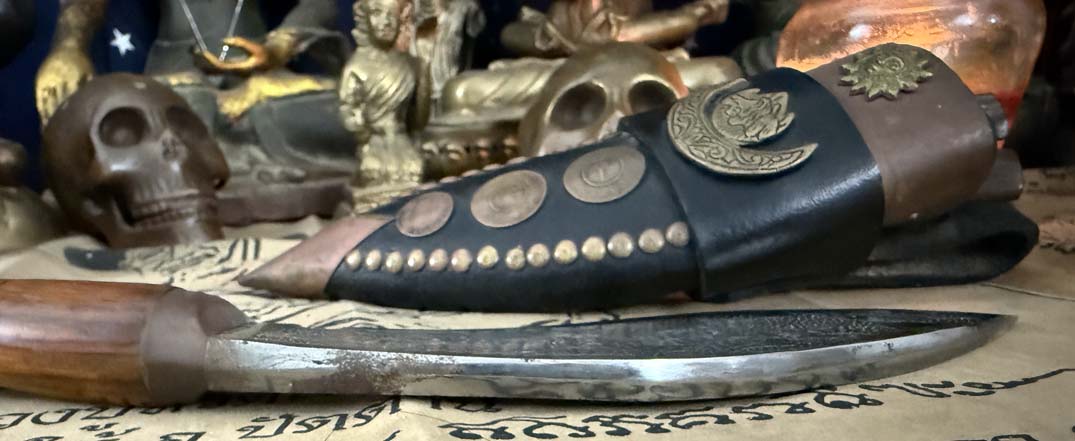
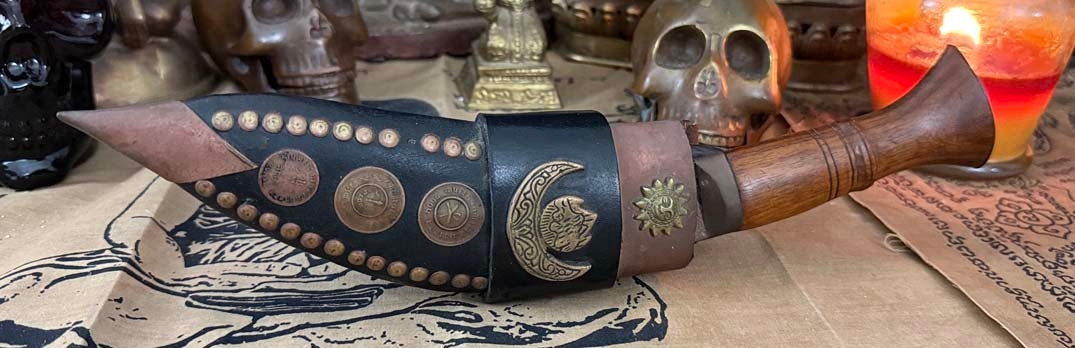
Much is already written on these subjects, so there is no need to elaborate here in this already overly long text, but we wholeheartedly recommend a cursory search for some very interesting reading.Examination reveals a miniature kukri measuring approximately 11" in overall length with a 6 3/4" forged and engraved high carbon steel blade with a 5/16" thick spine and a 4 1/4" rosewood handle and copper fittings.
The kukri weighs 9 ounces.
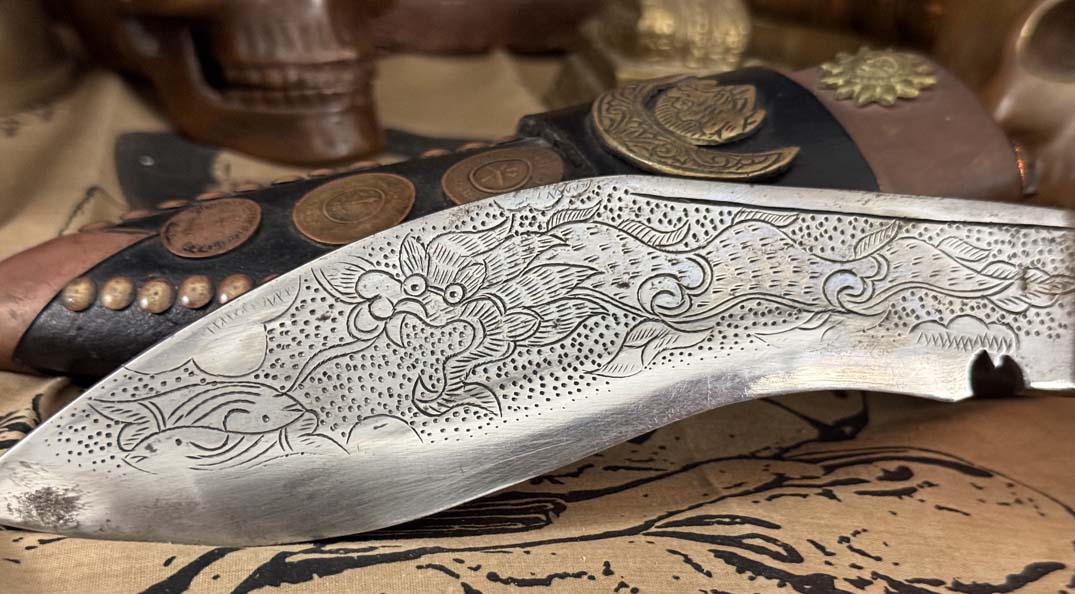
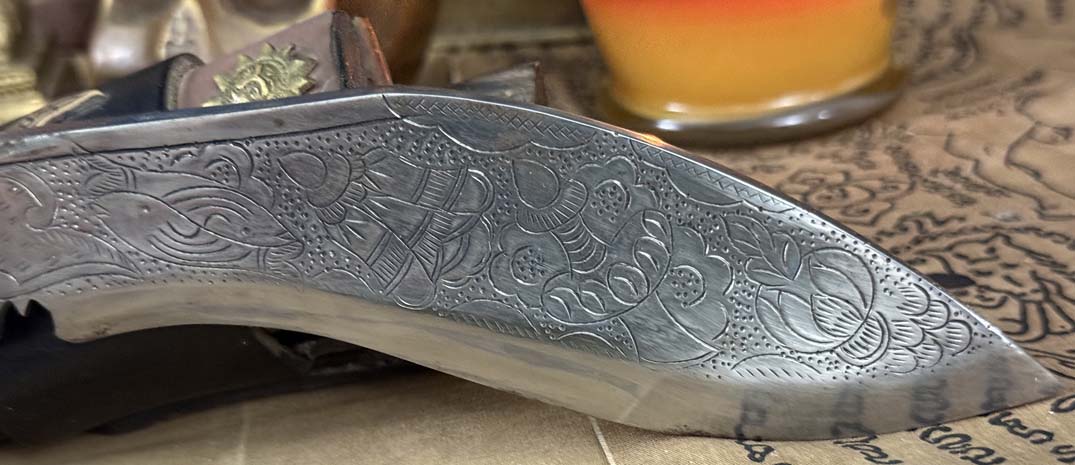
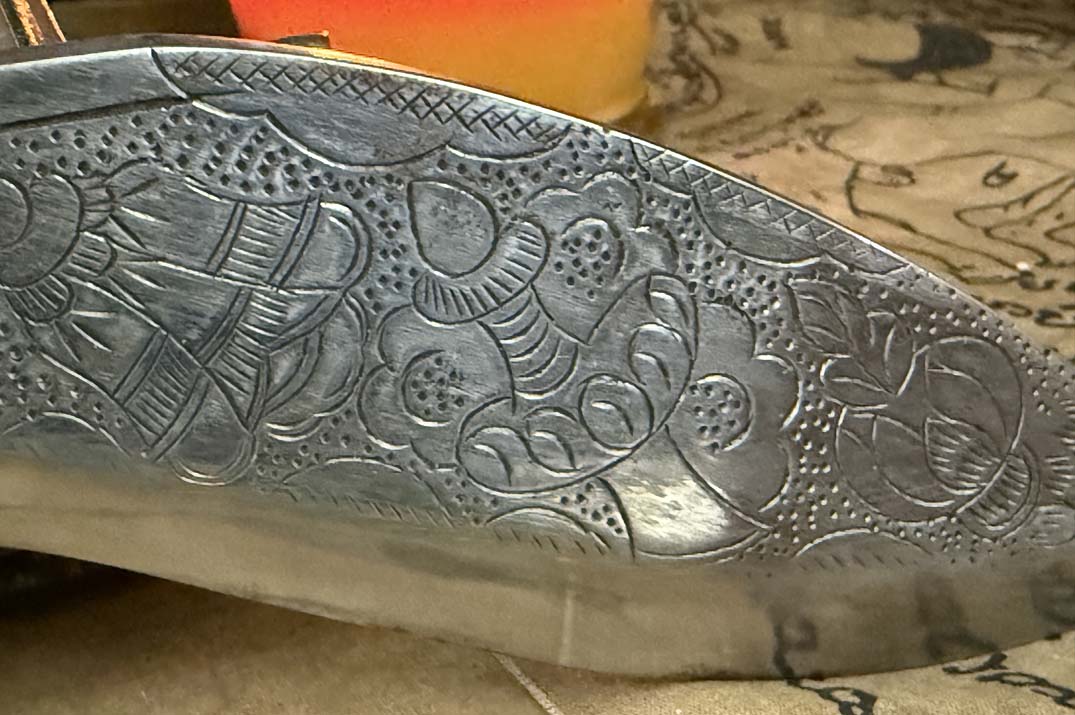
The engraving on one side of the blade depicts a water dragon (Naga) about to feed on a koi while the opposite side of the blade depicts more koi, a parasol, a vase of treasure and lotus flower. These are auspicious signs used in Buddhism.
The blade displays some rust along the spine where the thumb would come into contact and a spot near the tip, most likely from blood, along with an area near the tang from exposure to the air. The copper fittings are also oxidized. Our resident blade expert tells us these areas will clean up with a bit of elbow grease, fine grit sandpaper and a Nagura stone. As much as we were tempted to repolish the blade and sheath, we were loathe to destroy it's As Found condition and our blade polisher charges $100 an inch! He did however agree to provide one of his precious postage stamp sized stones and instruct you in its use at no additional charge (bless his heart).~!~

The Sheath
Made from heavy (10/12 oz) water buffalo leather covered wood with a copper throat, tip and 1950's Nepalese coinage, along with a brass sun face, Hindu God Surya, an engraved crescent moon and Mt Everest and twenty-five of the original twenty six, 6.35 mm brass border studs (one is missing).
The belt loop will accommodate a belt up to 2" in width.
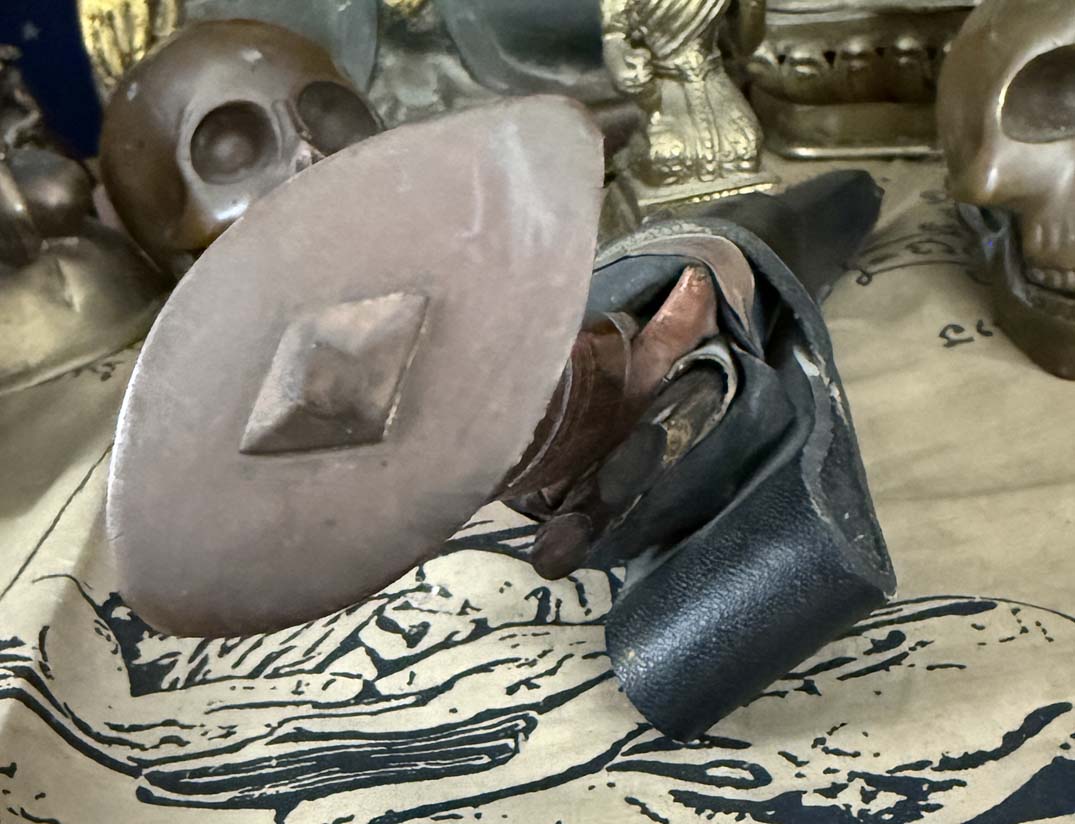
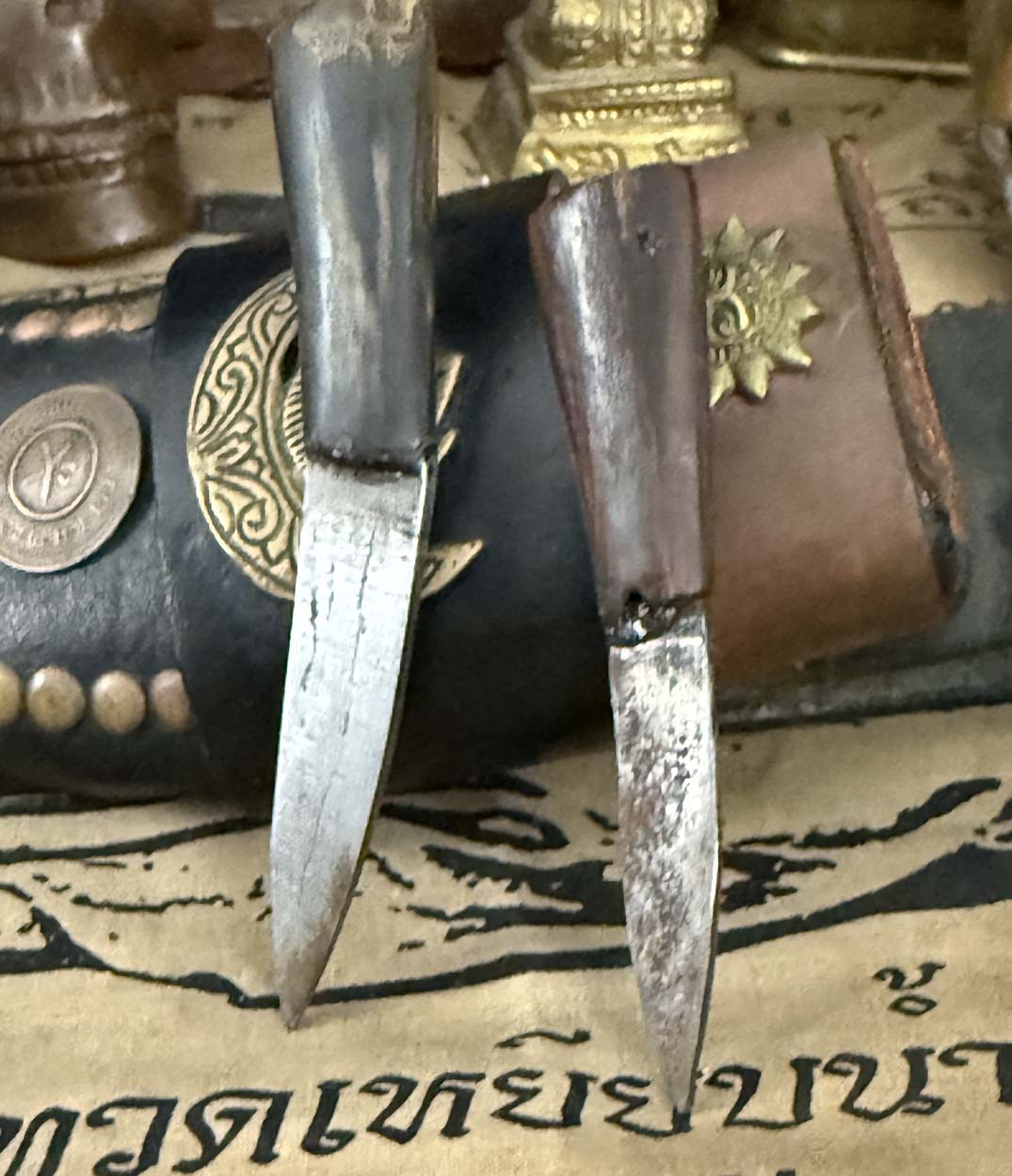
The two small tools tucked into a traditional kukri sheath are the Karda and the Chakmak. The Karda is a small, utility knife designed for fine cutting too precise for the large kukri blade. The Chakmak is a blunt steel tool with an unsharpened edge used to hone and maintain the main blade's edge, or to strike against flint to create sparks for a fire.
Both are crude, unpolished and unsharpened, one with a wood handle and the other with a buffalo horn handle. Both show surface rust and tool marks.
One measures approximately 3 5/8" and the other 3 1/8" in overall length.
The kukri is tight in the sheath and needs to be broken in. It is meant to be a friction fit for safety, but this one is tight.
~!~
Small Kukri Knives are compact versions of the main weapon itself. Small kukris typically feature blades ranging from 3 to 8 inches in length. These smaller fixed-blade versions are used for everyday carry, bushcraft, and camping tasks where a full-sized machete-length kukri is too heavy or large.
They are highly regarded as a compact version of the historic Nepalese military design, balancing field utility with collector appeal.
~!~
Some of their ledger entries indicate it was used at altar in love and luck ceremonies as a knife to chop and cut herbs and other ingredients and as a pointer, a magic wand of sorts, in which focused energy would be directed out through the point while sighting along the spine of the blade. This is a fairy common use of a blade in combat with ritual magic.
~!~
New Guardian is to pay $0.00 for Insured Ground Shipping with Tracking, handling and lagniappe.

International Buyer's, please email us for a shipping quote.
Payment is due at listing end.
Check our other listings, and sign up for our newsletter as new items are usually listed daily.
©Text and Photos Copyright 2001-2026 bushidobuce, all rights reserved.~!~
The props are not part of the deal, but you knew that already.
~!~