Loading... Please wait...
Categories
 New Products
-
 $129.90
-
 $229.90
-
 $249.90
-
 $69.90
-
 $229.90
Our Newsletter
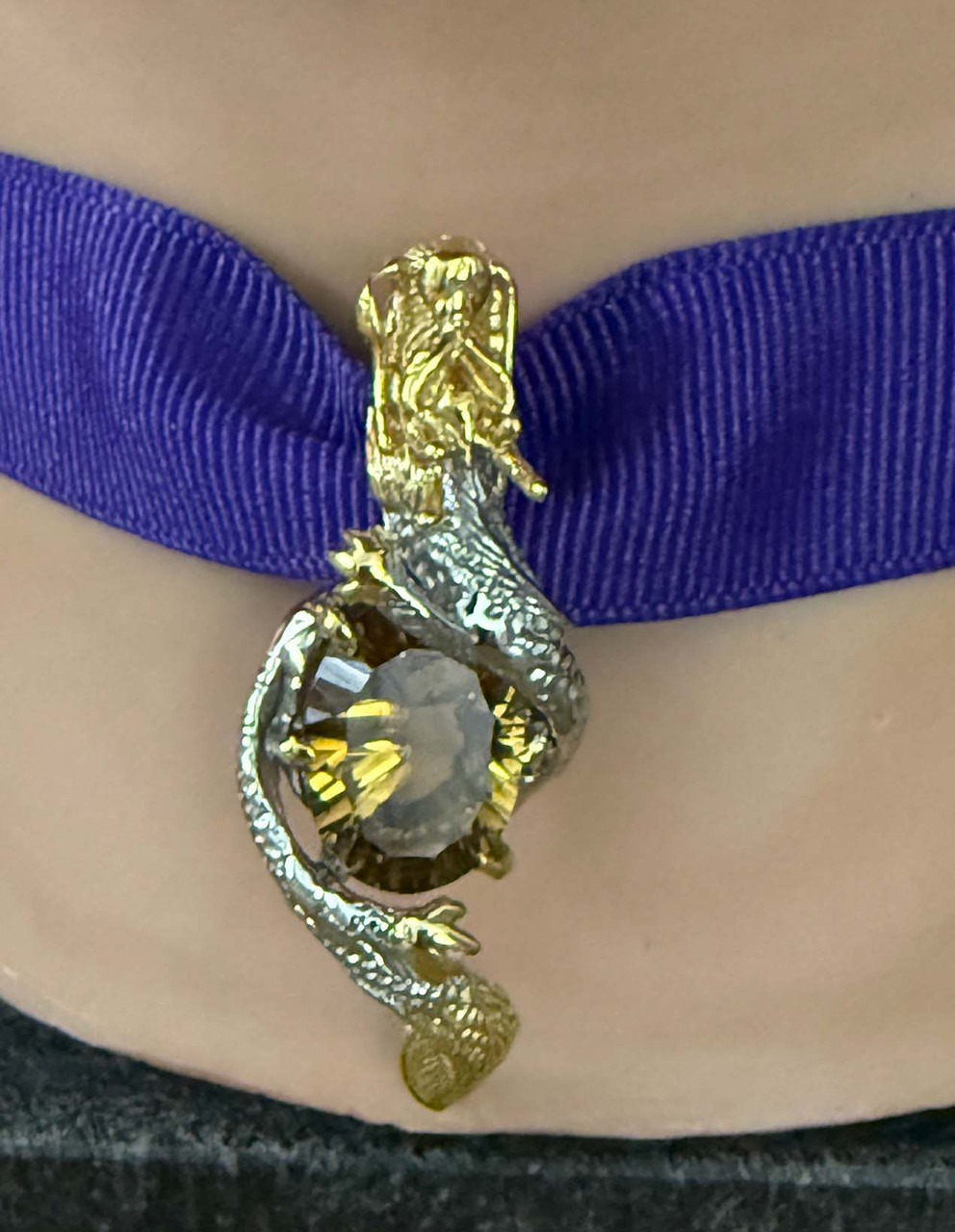
Aunt Nadiene's Thai 22K White and Yellow Gold Vermeil, Citrine and Garnet Gems, Naga, Chinese Dragon Pendant - A Travel Wardrobe Find - The Voodoo Estate ~!~ ~!~ SOLD! ~!~ ~!~


)
Sorry but this item is currently unavailable.
Please check back at a later stage.
Product Description
|
 ~!~ The Voodoo Estate!This type of call usually gets us excited as they are a treasure trove. Located here in Florida, there was no electricity or running water so we rigged our own lighting and in we went. If you have ever seen the Adams Family you will have some idea as to what we were greeted with! Then the attorney handling the liquidation gave us some background.Our research has shown that this woman was what she claimed and was indeed descended from a long line of well known Voodoun family originating in New Orleans in the early 1800's. We were pretty unnerved by this until we discovered they were also devout Catholics! Although I have to admit this was unlike any Catholic home we have ever been in and some of the items found inside were a little more than disturbing. Some Back StoryWhile there, she purchased a sizable quantity of jewelry to be sent home for resale to their clients. Often times claiming to cast spells or attach spirits to a piece of jewelry at a client's request. Aunt Nadiene Although not a blood Aunt, she had been "taken into the fold as a child found" by her "mother" as she was said to refer to Marie Glapion. Further chronological investigation revealed her to be the daughter of a prostitute that was in her mother's (Marie Glapion) employ. Other notes found might lead one to believe her mother was an Algul. Described as a vampiric jinn like creature they claimed to have encountered in remote desert regions. Our own research has not revealed very much other than Algul literally translates to "horse-leech," or "blood-sucking Jinn." An example was found in the 'Thousand and One Nights' as Amine. Although a drinker of blood, it is a Jinn, or demon that was never human. Unkillable by most means, it can be destroyed by fire and sometimes magic. ~!~ It is not clear if Aunt Nadiene was abandoned by her mother or if the mother died, orphaning the girl, but she was apparently treated and referred to as a family member, indoctrinated along with her "niece," and for many years she was her traveling companion and guardian. Her journals note of Aunt Nadiene's passing in 1966. She also notes of wearing Aunt Nadiene's jewelry, "Connected to her so closely in life, it awakens psychic qualities with a feeling of devotional joy to wear them."
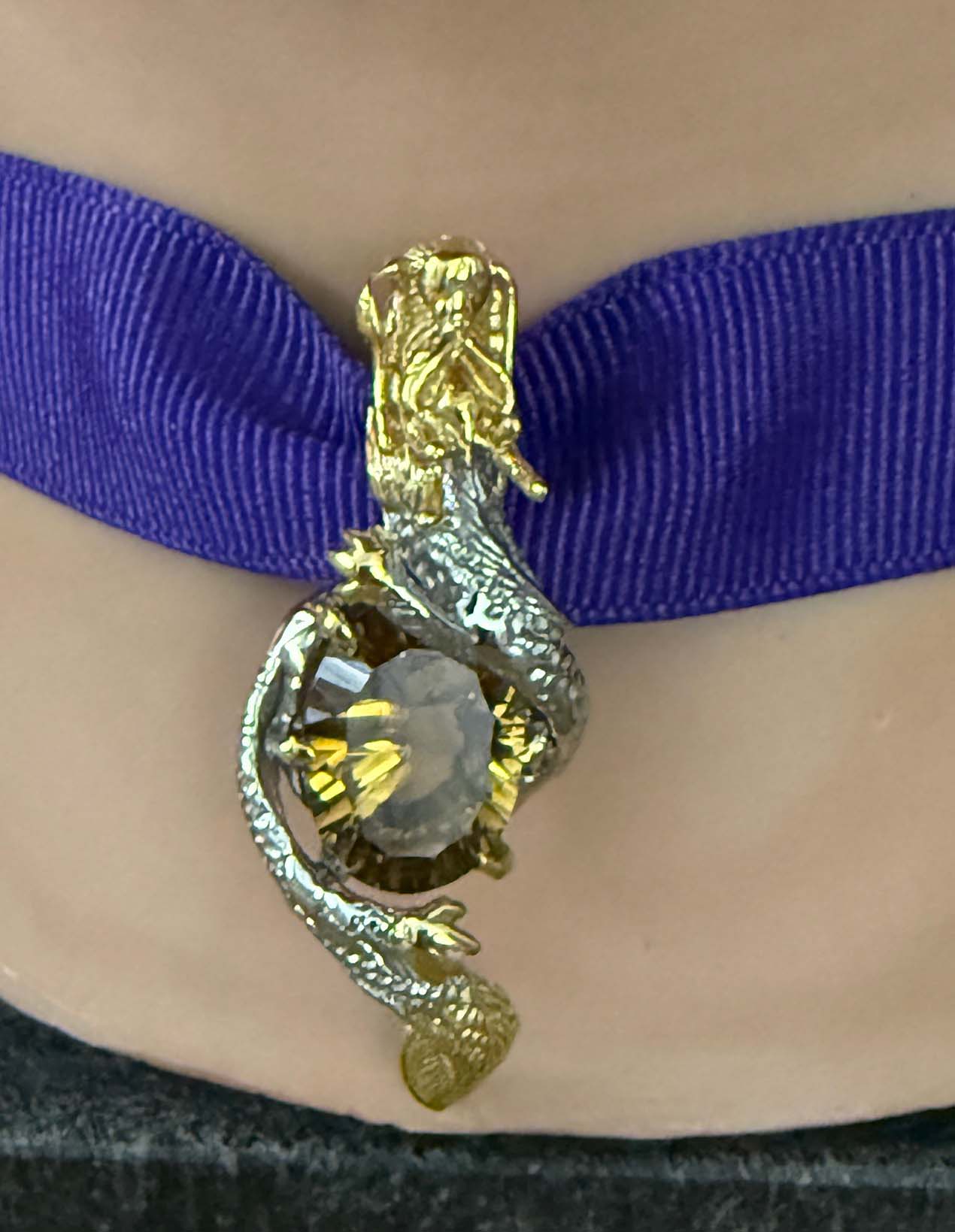
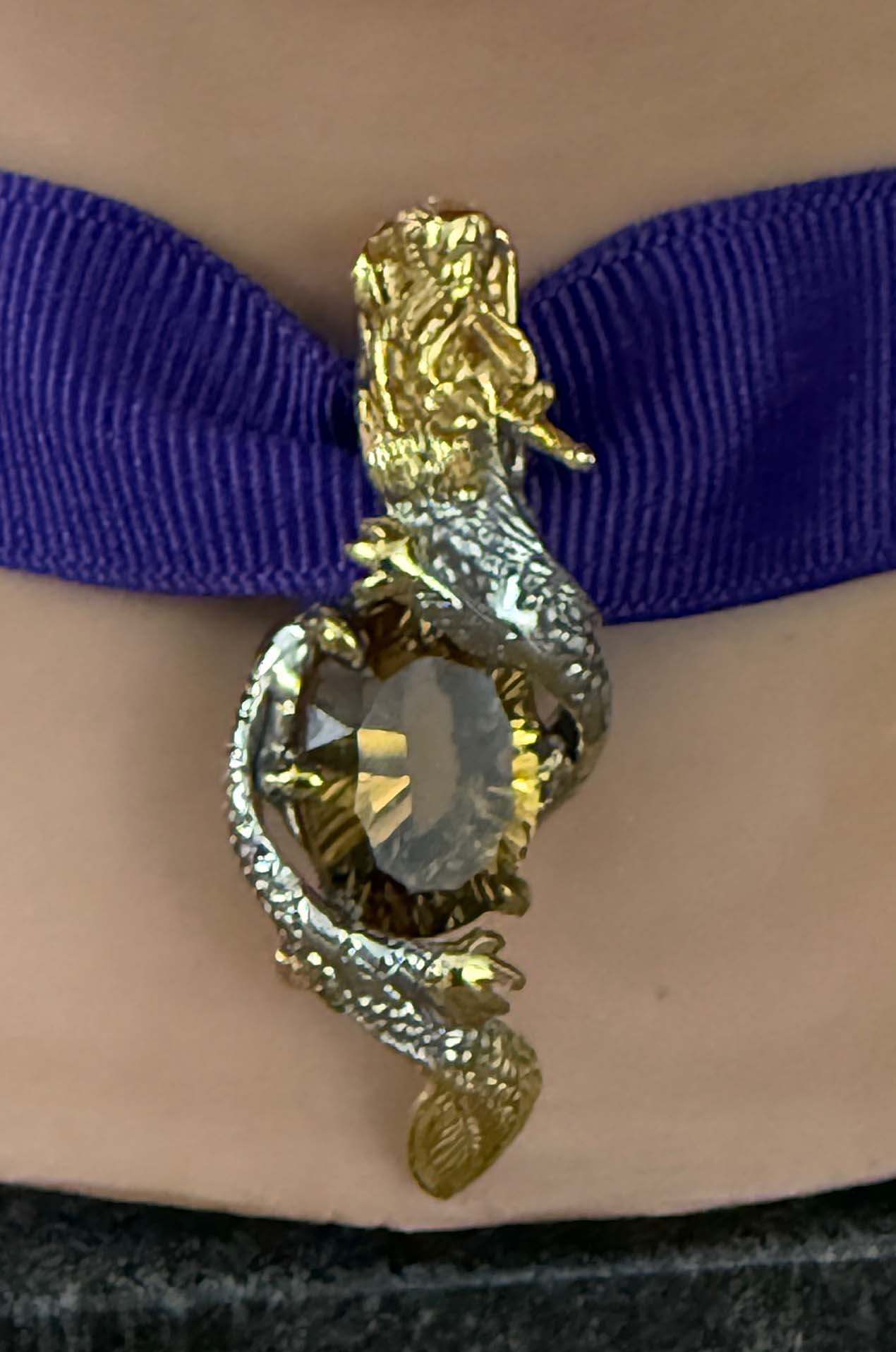
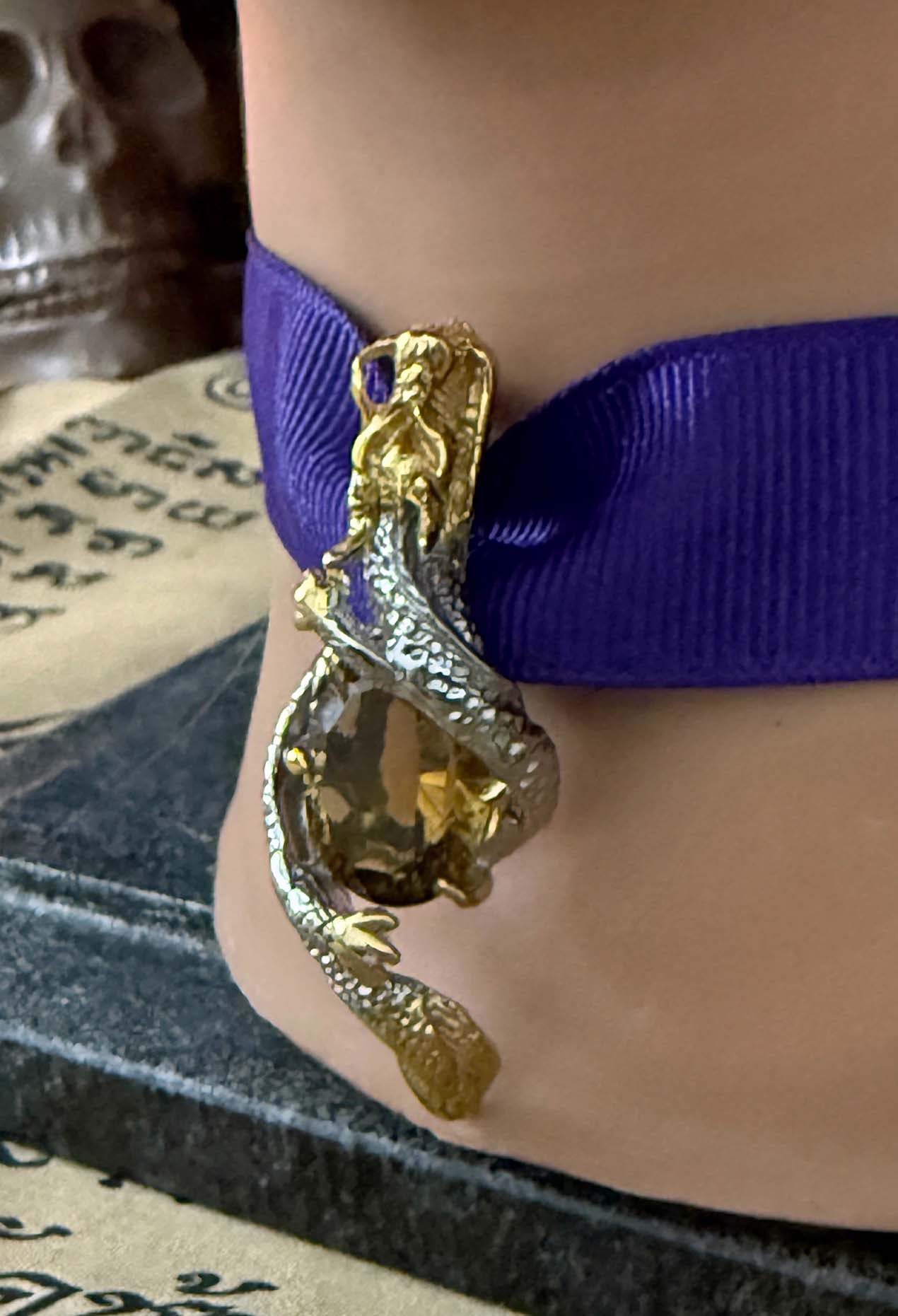
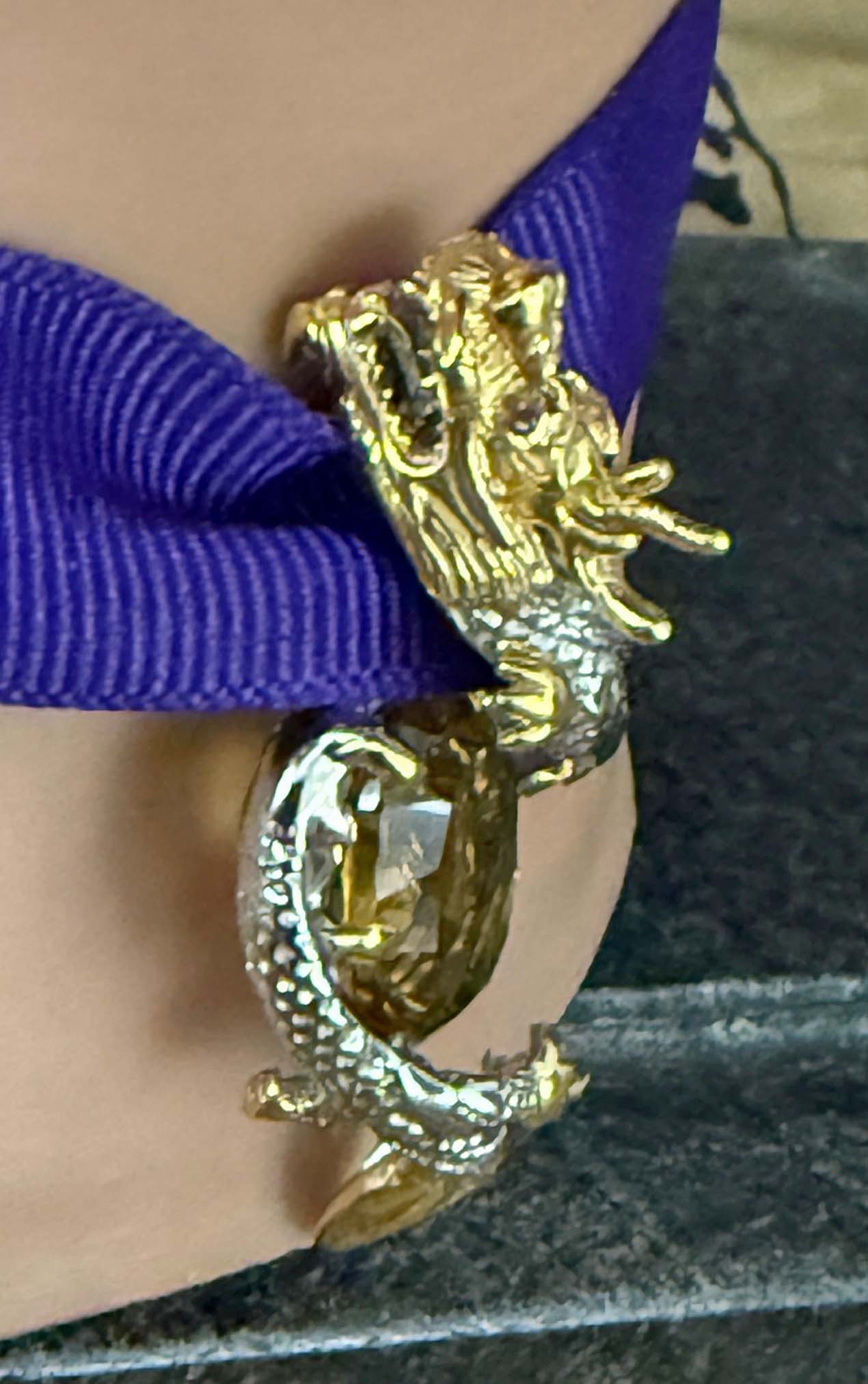
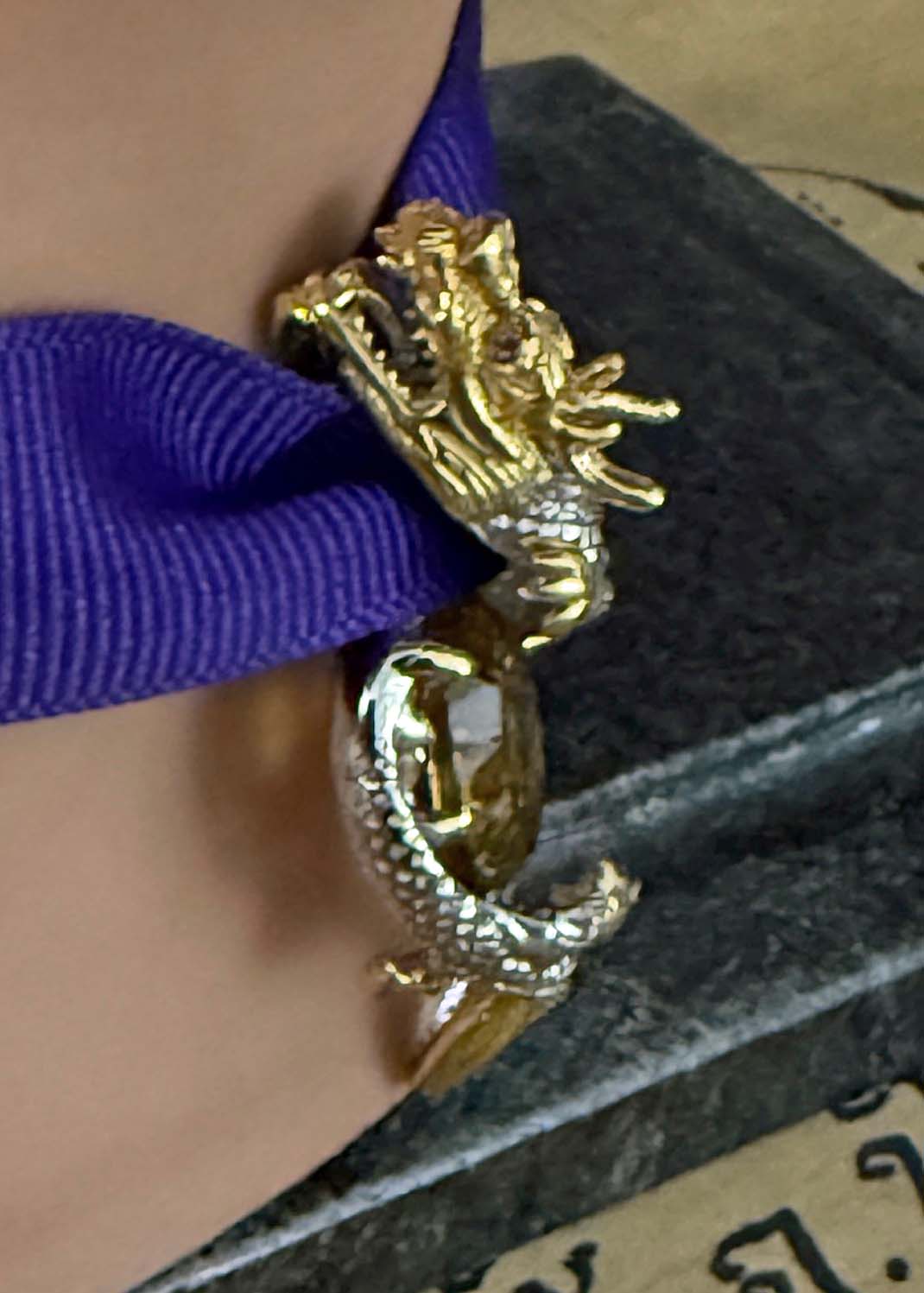
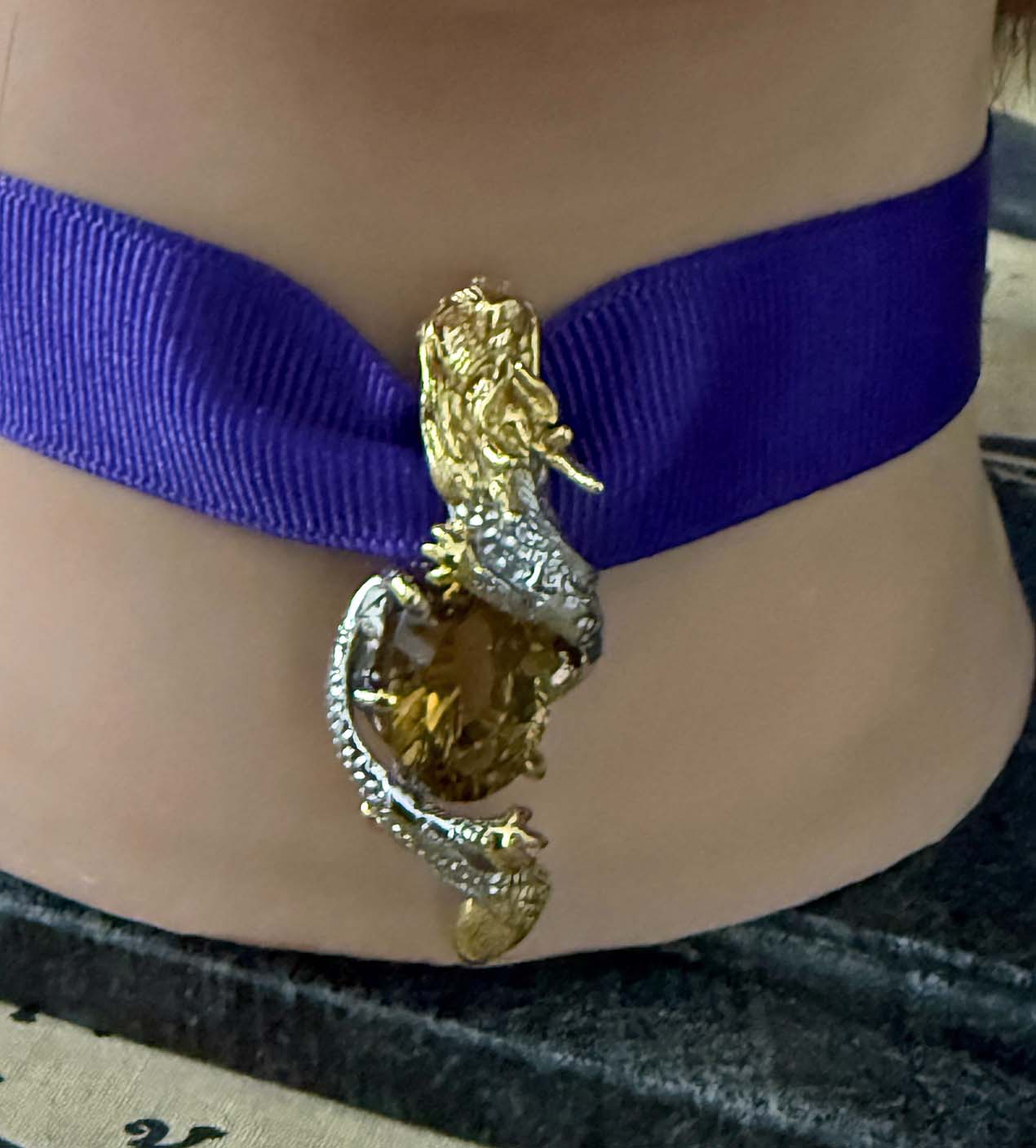
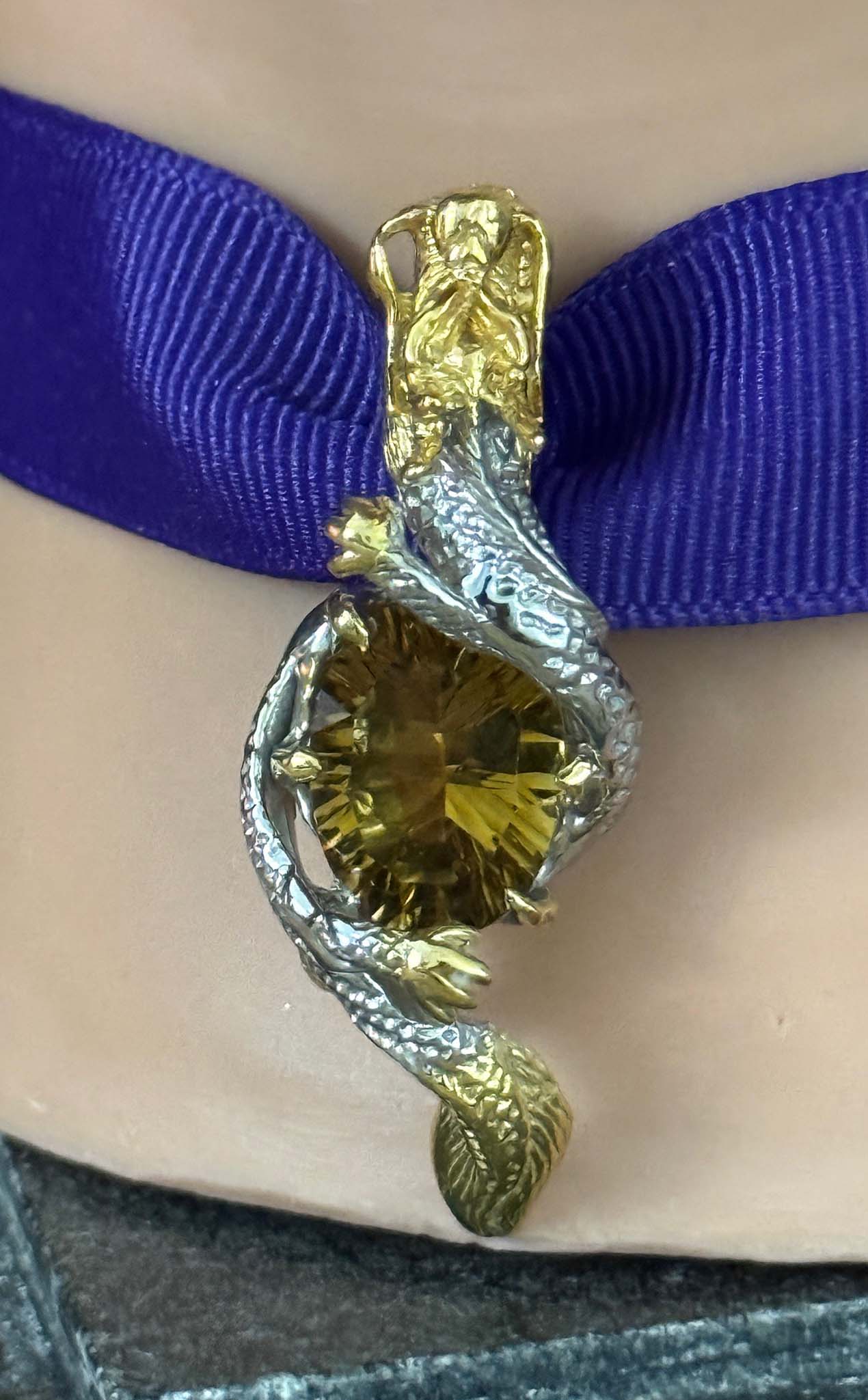
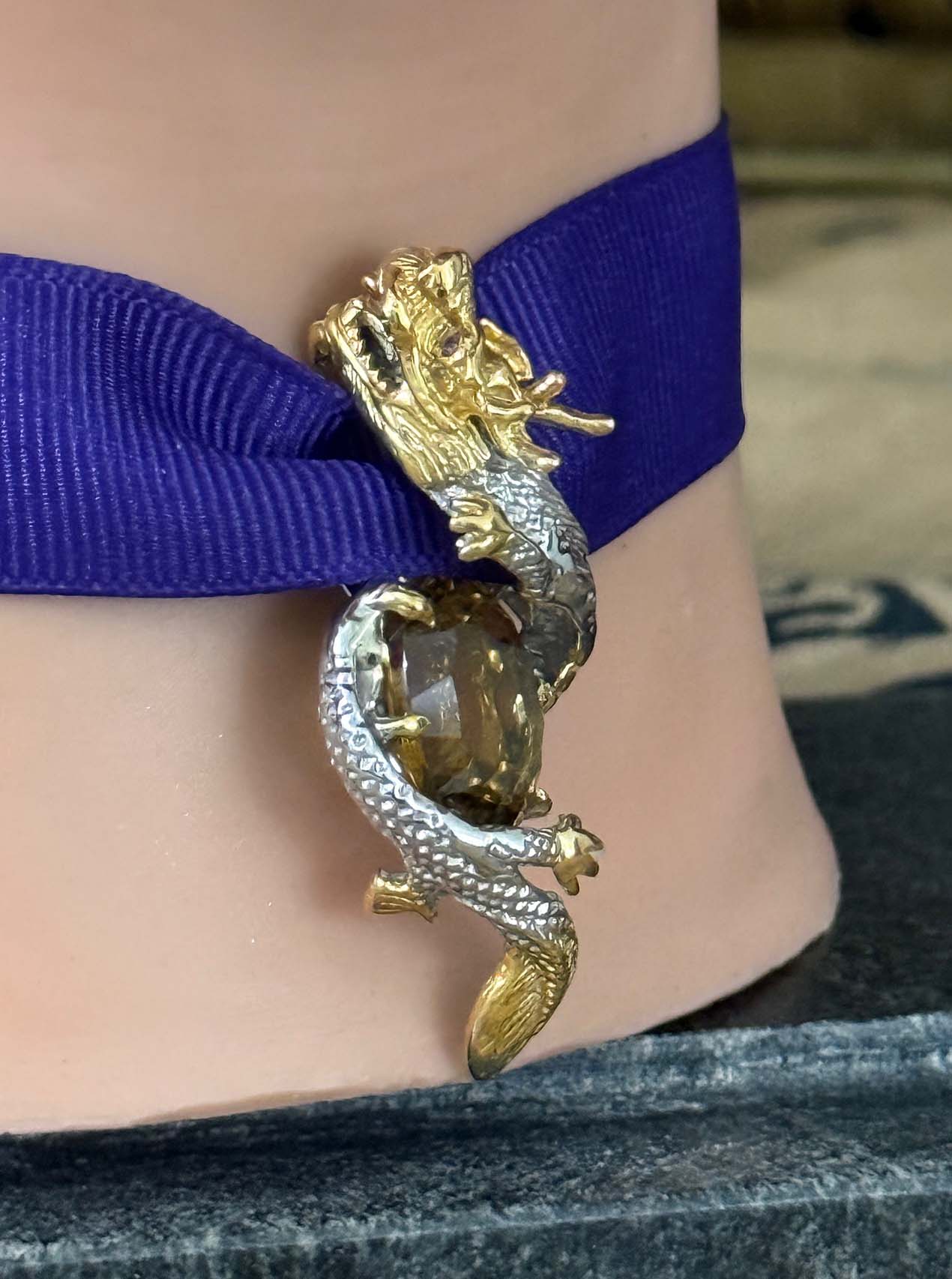
Other journal entries allege incidents of Aunt Nadiene, "owl shape shifting" claiming the Great Horned Owl as being her spirit guide or token spirit animal, and because of this, her taking due care in the handling of owls in her bird and reptile ceremonies, not submitting them to the torturous ceremonial deaths many other species endured during these ceremonies. She also notes of a number of dreams in which a Great Horned Owl wearing her aunt's jewelry would appear to her. They also go into detail of her gazing into her stones (sphere's), to draw upon Aunt Nadiene's power to help her in this life. ~!~ The Pendant, Its Components and Commentary Examination reveals an unusual and well made 22k white and yellow gold vermeil, figural Chinese dragon pendant that has been set with an outstanding faceted oval citrine and a pair of faceted round rhodolite garnet gems, all further described in detail below. Gold Vermeil
Gold Vermeil refers to electroplated silver (described below), using gold of different fineness. The US. minimum required karatage is 10K (42% of pure gold) and with a thickness of at least 2.5 microns (0.0025 millimeters) and being made up entirely of two precious metals (silver and gold). Vermeil jewelry therefore has a greater intrinsic value than gold plated jewelry with a thicker plating of the gold over sterling silver.
Gold plating is a method of depositing a layer of gold onto a conductive surface. The piece in base metal to be gold plated is immerged in an electrolyte solution with particles of gold which are deposited onto the surface of the base metal thanks to a current. This is the same technique used to form gold vermeil; in vermeil a layer of at least 2.5 microns of gold (also referred to as “heavy gold plating”) is deposited onto silver.
~!~
More often than not, their metal of choice was silver as she notes, "Silver is the mirror of the soul related to the moon energies. It strengthens connections of the astral and physical bodies. A metal unmatched in its psychic energies and healing abilities, I have used it as a spell medium, to heal the speech impaired and to help public speakers achieve eloquence. Induced into the drink, it has expelled the toxins that caused headaches, arthritis, intestinal and blood disorders. More importantly it attracts, enhances and stores energies of gemstones, driving out negative energies the stone may have absorbed." The Citrine Gem
Some of her journal entries concerning citrine read; "This stone has very strong, positive vibrations that are readily available. Its energies intensify with use which is enhanced by their cutting." "The stone has proven useful in calming all associated with them. A proven aid for those seeking spiritual growth. The meditations and healing's that I have administered with these stones have been most rewarding." "Power crystals that are to be used wisely and with respect. They are ever manifesting one's wants and needs. Look to them in healing as these are ancient ceremonial crystals for use high in the order which allows their energy to be configured and directed." ~!~ Of rhodolite garnet she writes; "vivid dream stones of past life remembrance. These are energies of love and life that enhance these within us. It cleanses and renews, comforts and protects, doing well for those in need of self respect and courage." "Assuredly dream work stones that have been aggressive in past life recall with strong tendencies to formulate love and bonding."
"The stone draws happiness and is an aid to sexuality sharpening perceptions to allow creative energies to whet the sexual appetite. If worn during cycle it will help to control a bad months flow."
~!~ But Back to the Pendant It's Chinese dragon depiction is heaped in regional folklore.
~!~ Chinese Dragon
From Wikipedia, the free encyclopedia for the most part...
Chinese dragons, also known as East Asian dragons, are legendary creatures in Chinese mythology, Chinese folklore, and East Asian culture at large. Chinese dragons have many animal-like forms such as turtles and fish, but are most commonly depicted as snake-like with four legs. They traditionally symbolize potent and auspicious powers, particularly control over water, rainfall, typhoons, and floods. The dragon is also a symbol of power, strength, and good luck for people who are worthy of it in East Asian culture. During the days of Imperial China, the Emperor of China usually used the dragon as a symbol of his imperial strength and power.
In Chinese culture, excellent and outstanding people are compared to a dragon, while incapable people with no achievements are compared to other, disesteemed creatures, such as a worm. A number of Chinese proverbs and idioms feature references to a dragon, such as "Hoping one's son will become a dragon."
Historically, the Chinese dragon was associated with the Emperor of China and used a symbol to represent imperial power. The founder of Han dynasty Liu Bang claimed that he was conceived after his mother dreamt of a dragon . During the Tang dynasty, Emperors wore robes with dragon motif as an imperial symbol, and high officials might also be presented with dragon robes. In the Yuan dynasty, the two-horned five-clawed dragon was designated for use by the Son of Heaven or Emperor only, while the four-clawed dragon was used by the princes and nobles . Similarly during the Ming and Qing dynasty, the five-clawed dragon was strictly reserved for use by the Emperor only. The dragon in the Qing dynasty appeared on the first Chinese national flag.
The dragon is sometimes used in the West as a national emblem of China though such use is not commonly seen in the People's Republic of China or the Republic of China. Instead, it is generally used as the symbol of culture. In Hong Kong, the dragon was a component of the coat of arms under British rule. It was later to become a feature of the design of Brand Hong Kong, a government promotional symbol.
The Chinese dragon has very different connotations from the European dragon – in European cultures, the dragon is a fire-breathing creature with aggressive connotations, whereas the Chinese dragon is a spiritual and cultural symbol that represents prosperity and good luck, as well as a rain deity that fosters harmony. It was reported that the Chinese government decided against using the dragon as its official 2008 Summer Olympics mascot because of the aggressive connotations that dragons have outside of China, and chose more "friendly" symbols instead.
Naga
More from Wikipedia, the free encyclopedia, for the most part...
Naga (IAST: naga; Devanagari) or Nagi (f. of naga; IAST: nagi; Devanagari ) is a Sanskrit word which basically refers to a "serpent" or "snake", especially the King cobra. The term Naga in Hinduism, Buddhism and Jainism denotes divine, semi-divine deities, or a semi-divine race of half-human half-serpent beings that resides in the heavenly Patala (netherworld) and can occasionally take human form. They are principally depicted in three forms: wholly humans with snakes on the heads and necks; common serpents or as half-human half-snake beings. A female naga is a "nagi", "nagin", or "nagini." Nagaraja is seen as the king of nagas and naginis. They are common and hold cultural significance in the mythological traditions of many South Asian and Southeast Asian cultures.
In Sanskrit, a nagá is a cobra, the Indian cobra (Naja naja). There are several words for "snake" in general, and one of the very commonly used ones is sarpá. Sometimes the word nagá is also used generically to mean "snake." The word is cognate with English 'snake', Germanic: *snek-a-, Proto-IE: *(s)neg-o- (with s-mobile).
The mythological serpent race that took form as cobras often can be found in Hindu iconography. The nagas are described as the powerful, splendid, wonderful and proud semidivine race that can assume their physical form either as human, partial human-serpent or the whole serpent. Their domain is in the enchanted underworld, the underground realm filled with gems, gold and other earthly treasures called Naga-loka or Patala-loka. They are also often associated with bodies of waters — including rivers, lakes, seas, and wells — and are guardians of treasure. Their power and venom made them potentially dangerous to humans. However, they often took beneficial protagonist role in Hindu mythology, such as in Samudra manthan mythology, Vasuki, a nagaraja who abides on Shiva's neck, became the churning rope for churning of the Ocean of Milk. Their eternal mortal enemies are the Garudas, the legendary semidivine birdlike-deity.
Vishnu is originally portrayed in the form sheltered by naga or reclining on one, but the iconography has been extended to other deities as well. The serpent is a common feature in Ganesha iconography and appears in many forms: around the neck, use as a sacred thread (Sanskrit: yajñyopavita) wrapped around the stomach as a belt, held in a hand, coiled at the ankles, or as a throne. Shiva is often shown garlanded with a snake. Maehle (2006: p. 297) states that "Patanjali is thought to be a manifestation of the serpent of eternity."
As in Hinduism, the Buddhist naga generally has the form of a great cobra, usually with a single head but sometimes with many. At least some of the nagas are capable of using magic powers to transform themselves into a human semblance. The naga is sometimes portrayed as a human being with a snake or dragon extending over his head. One naga, in human form, attempted to become a monk; and when telling it that such ordination was impossible, the Buddha told it how to ensure that it would be reborn a human, and so able to become a monk.
In the "Devadatta" chapter of the Lotus Sutra, the daughter of the dragon king, an eight year old longnü (naga), after listening to Mañjusri preach the Lotus Sutra, transforms into a male Bodhisattva and immediately reaches full enlightenment. This tale appears to reinforce the viewpoint prevalent in Mahayana scriptures that a male body is required for Buddhahood, even if a being is so advanced in realization that they can magically transform their body at will and demonstrate the emptiness of the physical form itself.
Nagas are believed to both live on Mount Meru, among the other minor deities, and in various parts of the human-inhabited earth. Some of them are water-dwellers, living in streams or the ocean; others are earth-dwellers, living in underground caverns.
The nagas are the followers of Virupakkha, one of the Four Heavenly Kings who guards the western direction. They act as a guard upon Mount Sumeru, protecting the devas from attack by the asuras.
Among the notable nagas of Buddhist tradition is Mucalinda, Nagaraja and protector of the Buddha. In the Vinaya Sutra (I, 3), shortly after his enlightenment, the Buddha is meditating in a forest when a great storm arises, but graciously, King Mucalinda gives shelter to the Buddha from the storm by covering the Buddha's head with his seven snake heads. Then the king takes the form of a young Brahmin and renders the Buddha homage.
It is noteworthy that the two chief disciples of the Buddha, Sariputta and Moggallana are both referred to as Mahanaga or "Great Naga." Some of the most important figures in Buddhist history symbolize nagas in their names such as Dignaga, Nagasena, and, although other etymons are assigned to his name, Nagarjuna.
In the Vajrayana and Mahasiddha traditions, nagas in their half-human form are depicted holding a naga-jewel, kumbhas of amrita, or a terma that had been elementally encoded by adepts.
According to tradition, Prajñaparamita sutras had been given by the Buddha to a great Naga who guarded them in the sea, and were conferred upon Nagarjuna later.
In Thailand and Java, the naga is a wealthy underworld deity. For Malay sailors, nagas are a type of dragon with many heads. In Laos they are beaked water serpents.
The seven-headed nagas often depicted as guardian statues, carved as balustrades on causeways leading to main Cambodian temples, such as those found in Angkor Wat. Apparently they represent the seven races within naga society, which has a mythological, or symbolic, association with "the seven colors of the rainbow." Furthermore, Cambodian naga possess numerological symbolism in the number of their heads. Odd-headed naga symbolize the Male Energy, Infinity, Timelessness, and Immortality. This is because, numerologically, all odd numbers come from One. Even-headed naga are said to be "Female, representing Physicality, Mortality, Temporality, and the Earth."
In Javanese and Balinese culture, Indonesia, a naga is depicted as a crowned, giant, magical serpent, sometimes winged. It is similarly derived from the Shiva-Hinduism tradition, merged with Javanese animism. Naga in Indonesia mainly derived and influenced by Indic tradition, combined with the native animism tradition of sacred serpents. In Sanskrit the term naga literally means snake, but in Java it normally refer to serpent deity, associated with water and fertility. In Borobudur, the nagas are depicted in their human form, but elsewhere they are depicted in animal shape.
Early depictions of circa-9th-century Central Java closely resembled Indic Naga which was based on cobra imagery. During this period, naga serpents were depicted as giant cobras supporting the waterspout of yoni-lingam. The examples of naga sculpture can be found in several Javanese candis, including Prambanan, Sambisari, Ijo, and Jawi. In East Java, the Penataran temple complex contain a Candi Naga, an unusual naga temple with its Hindu-Javanese caryatids holding corpulent nagas aloft.
The later depiction since the 15th century, however, was slightly influenced by Chinese dragon imagery—although unlike its Chinese counterparts, Javanese and Balinese nagas do not have legs. Naga as the lesser deity of earth and water is prevalent in the Hindu period of Indonesia, before the introduction of Islam.
In Balinese tradition, nagas are often depicted battling Garuda. Intricately carved naga are found as stairs railings in bridges or stairs, such as those found in Balinese temples, Ubud monkey forest, and Taman Sari in Yogyakarta.
In a wayang theater story, a snake (naga) god named Sanghyang Anantaboga or Antaboga is a guardian deity in the bowels of the earth. Naga symbolize the nether realm of earth or underworld.
Naga are believed to live in the Laotian stretch of the Mekong or its estuaries. Lao mythology maintains that the naga are the protectors of Vientiane, and by extension, the Lao state. The naga association was most clearly articulated during and immediately after the reign of Anouvong. An important poem from this period San Leupphasun discusses relations between Laos and Thailand in a veiled manner, using the naga and the garuda to represent the Lao and the Thai, respectively. The naga is incorporated extensively into Lao iconography, and features prominently in Lao culture throughout the length of the country, not only in Vientiane.
In Malay and Orang Asli traditions, the lake Chini, located in Pahang is home to a naga called Sri Gumum. Depending on legend versions, her predecessor Sri Pahang or her son left the lake and later fought a naga called Sri Kemboja. Kemboja is the Malay name for Cambodia. Like the naga legends there, there are stories about an ancient empire in lake Chini, although the stories are not linked to the naga legends.
~!~
Once Again, Back to the Pendant!
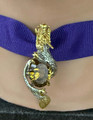
It is a well made dragon motif pendant done in white and yellow gold vermeil and set with citrine and rhodolite garnet gems as described above. It is marked "925" with no maker's or assay marks and tests as .925 Sterling Silver Standard. The pendant measures approximately 2" x 3/4" x 13/16" and weighs 14 grams.
When found, it was attached to a strip of purple grosgrain ribbon similar to the one shown. The original was in poor condition, then discarded and replaced with the ribbon shown which is not original to the estate. It is certainly a nicely aged vintage pendant with an extraordinary provenance that is much nicer than our photographer has been able to depict. Rest assured your order will be carefully packed to withstand the onslaught of the most deranged of parcel carriers.  ©Text and Photos Copyright 2001-2026 bushidobuce, all rights reserved. ~!~
|