Loading... Please wait...
Categories
 New Products
-
 $89.90
-
 $129.90
-
 $89.90
-
 $149.90
-
 $49.90
Our Newsletter
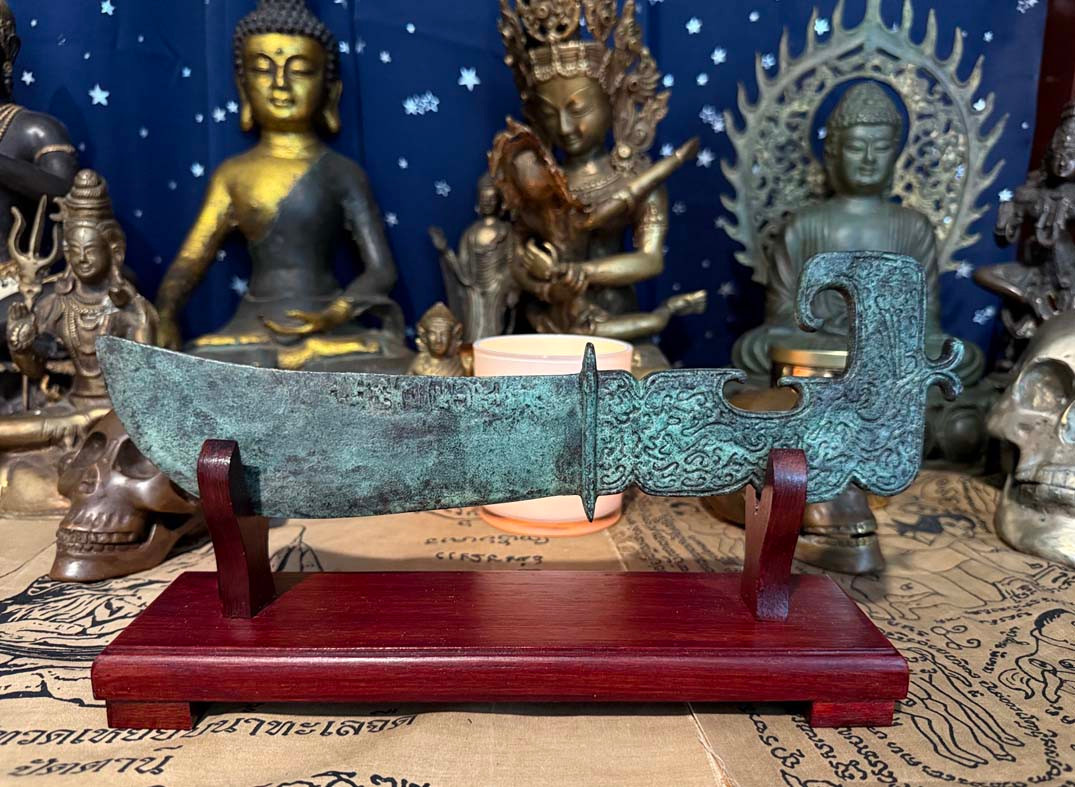
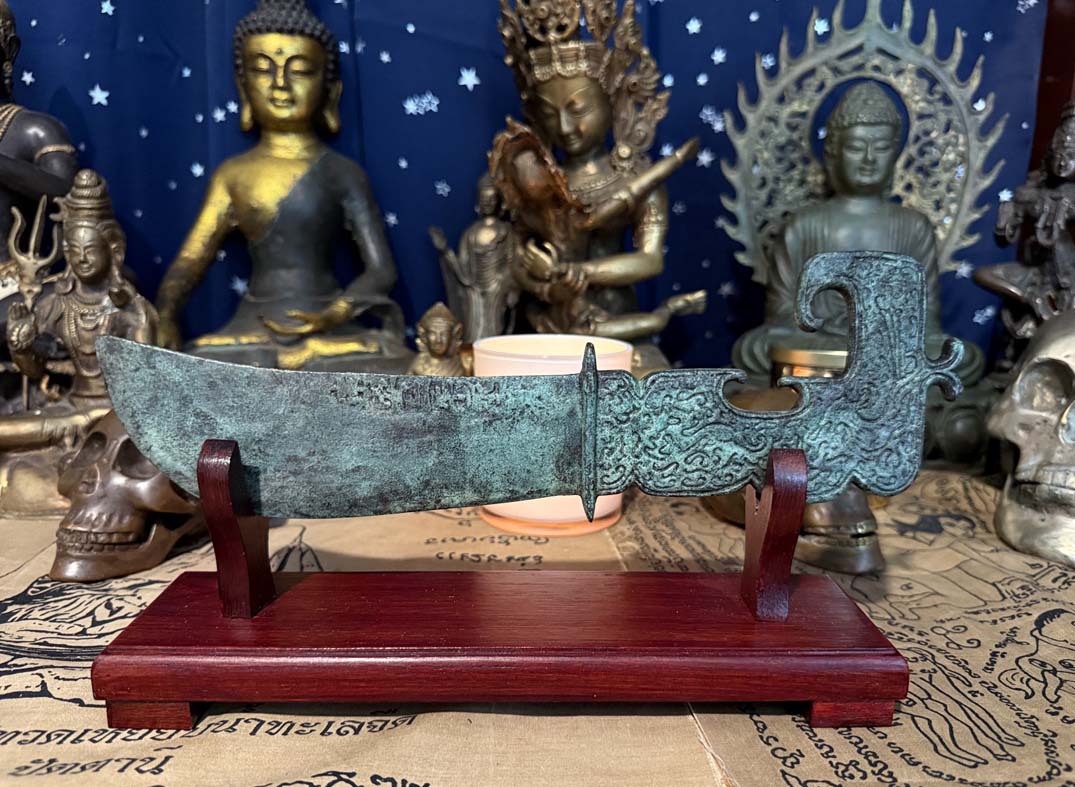
12" Antique Reproduction Bronze Shang Dynasty Ge Dagger Axe with Stand - Circa 1980 - A Main Library Find - The Voodoo Estate


)
Product Description
Circa 1980
with Stand
A Main Library Find
~!~
It has now been nearly twenty-five years ago since we were called to do an estate that had been closed up for seventeen years!
The Voodoo Estate!
This type of call usually gets us excited as they are a treasure trove. Located here in Florida, there was no electricity or running water so we rigged our own lighting and in we went. If you have ever seen the Adams Family you will have some idea as to what we were greeted with! Then the attorney handling the liquidation gave us some background.The estate had belonged to an alleged powerful Voodoo Priestess/JooJoo Exorcist, grand daughter of a Marie Laveau, and favored daughter of a Marie Glapion. These names meant nothing to us, but the late night talk of Voodoo and exorcism in the old mansion did cause some uneasy feelings so we decided to spend the night in a hotel and return in the morning to assess the estate. The rest is history.
We were pretty unnerved by this until we discovered they were also devout Catholics! Although I have to admit this was unlike any Catholic home we have ever been in and some of the items found inside were a little more than disturbing.
There was no feeling of dread or unwelcome in the mansion, however there was quite a bit of contraband and other items we can or will not sell here.This is one of a few pieces from this estate we will be listing this week, so check our other listings!
We will, upon the new guardian's request, issue a named Letter of Authenticity with each lot from this estate, complying with the terms set forth to us by the estate's attorney.
~!~
Some Back Story
Her 1980 dated inventory entry lists this lot as a "12" Antique Reproduction Bronze Shang Dynasty Ge Dagger Axe" as the title implies. It also tells us it is part of a small group of four similar pieces brought to the estate by a shop owner she names as Moses, but she leaves us hanging there, offering no further information to us.
It was found and recovered from a museum cabinet display of Shang Dynasty Chinese Bronze and jade weapons in the Main Library of this estate.
Shang Dynasty
Excepts from Wikipedia, the Free Encyclopedia, for the most part...
Several of the Chinese classics discuss the history of the Shang, including the Book of Documents, the Mencius and the Zuo Zhuan. From the sources available to him, the Han dynasty historian Sima Qian assembled a chronological account of the Shang as part of the Shiji official history. Sima describes some Shang-era events in detail, while others are only mentioned as taking place during the reign of a particular king. A slightly different account of the Shang is given in the Bamboo Annals, a text whose history is complex: while originally interred in 296 BC, the authenticity of the manuscripts that have survived is controversial.
Throughout history, the Shang have also been referred to as "Yin", The Shiji and the Bamboo Annals each use this name for both the dynasty, as well as its final capital. Since Huangfu Mi's Records of Emperors and Kings in the 3rd century AD, "Yin" has been frequently used to refer specifically to the latter half of the Shang. It is also the name predominantly used for the dynasty in Japan, Korea, and Vietnam, being rendered as In, Eun and Ân in Japanese, Korean, and Vietnamese respectively. The name seems to have originated during the subsequent Zhou dynasty; it does not appear in oracle bone inscriptions—which refer to the state as "Shang" and to its capital as "Great Settlement of Shang" nor does it appear in any bronze inscriptions securely dated to the Western Zhou (c.1046 – 771 BC).
Founding Myth
The founding myth of the Shang is described by Sima Qian in the Annals of the Yin. In the text, a woman named Jiandi, who was the second wife of Emperor Ku, swallowed an egg dropped by a black bird and subsequently gave birth miraculously to Xie. Xie is said to have helped Yu the Great to control the Great Flood and for his service to have been granted a place called Shang as a fief. The period before the Shang dynasty was established is known as the "Predynastic Shang" (or "Proto-Shang").
Tomb Bronzeware
Many Shang royal tombs had been tunnelled into and ravaged by grave robbers in ancient times, but in the spring of 1976, the discovery of Tomb 5 at Yinxu revealed a tomb that was not only undisturbed, but one of the most richly furnished Shang tombs that archaeologists had yet come across. With over 200 bronze ritual vessels and 109 inscriptions of Fu Hao's name, Zheng Zhenxiang and other archaeologists realized they had stumbled across the tomb of Fu Hao, Wu Ding's most famous consort also renowned as a military general, and mentioned in 170 to 180 oracle bone inscriptions. Along with bronze vessels, stoneware and pottery vessels, bronze weapons, jade figures and hair combs, and bone hairpins were found. The assortment of weapons and ritual vessels in her tomb correlate with the oracle bone accounts of her military and ritual activities.
The Shang believed that their ancestors held power over them and performed divination rituals to secure their approval for planned actions. Divination involved cracking a turtle carapace or ox scapula to answer a question, and to then record the response to that question on the bone itself. It is unknown what criteria the diviners used to determine the response, but it is believed to be the sound or pattern of the cracks on the bone.
The Shang also seem to have believed in an afterlife, as evidenced by the elaborate burial tombs built for deceased rulers. Often "carriages, utensils, sacrificial vessels, [and] weapons" would be included in the tomb. A king's burial involved the burial of up to a few hundred humans and horses as well to accompany the king into the afterlife, in some cases even numbering four hundred. Finally, tombs included ornaments such as jade, which the Shang may have believed to protect against decay or confer immortality.
Chinese bronze casting and pottery advanced during the Shang, with bronze typically being used for ritually significant, rather than primarily utilitarian, items. As early as c.?1500 BC, the early Shang dynasty engaged in large-scale production of bronzeware vessels and weapons. This production required a large labor force that could handle the mining, refining, and transportation of the necessary copper, tin, and lead ores. This in turn created a need for official managers that could oversee both laborers and skilled artisans and craftsmen. The Shang royal court and aristocrats required a vast number of different bronze vessels for various ceremonial purposes and events of religious divination. Ceremonial rules even decreed how many bronze containers of each type a noble of a certain rank could own. With the increased amount of bronze available, the army could also better equip itself with an assortment of bronze weaponry. Bronze was also used for the fittings of spoke-wheeled chariots, which appeared in China around 1200 BC.
Bronze weapons were an integral part of Shang society. Shang infantry were armed with a variety of stone and bronze weaponry, including spears, pole-axes, pole-based dagger-axes, composite bows, and bronze or leather helmets.
Although the Shang depended upon the military skills of their nobility, Shang rulers could mobilize the masses of town-dwelling and rural commoners as conscript laborers and soldiers for both campaigns of defense and conquest. Aristocrats and other state rulers were obligated to furnish their local garrisons with all necessary equipment, armor, and armaments. The Shang king maintained a force of about a thousand troops at his capital and would personally lead this force into battle. A rudimentary military bureaucracy was also needed in order to muster forces ranging from three to five thousand troops for border campaigns to thirteen thousand troops for suppressing rebellions.
~!~
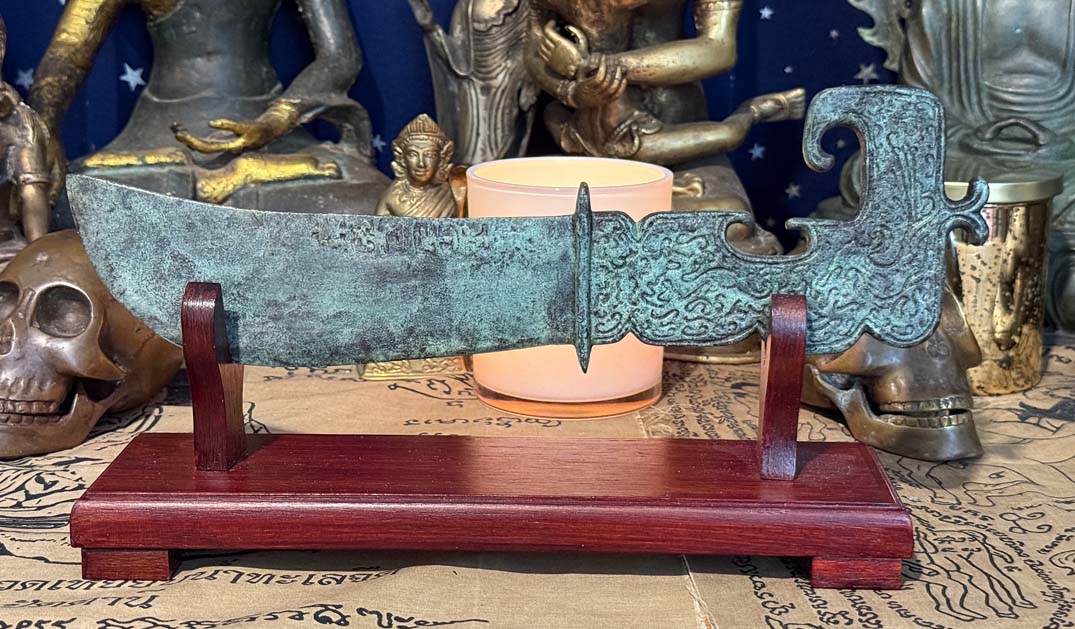
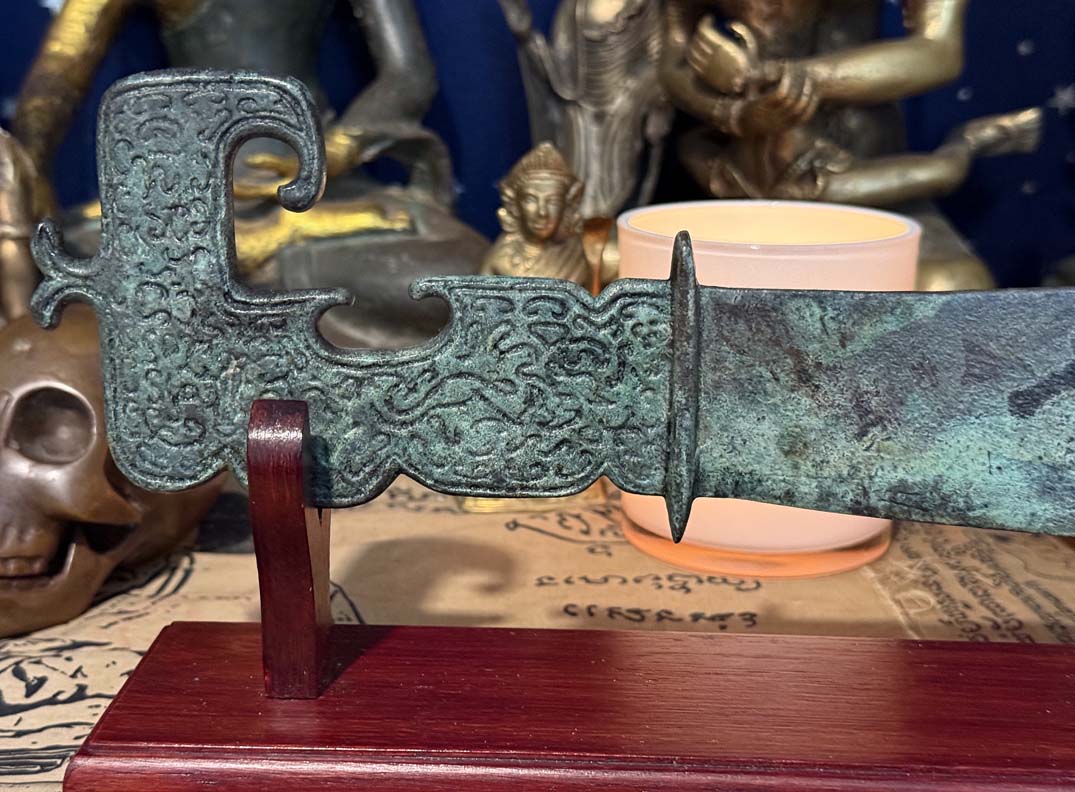
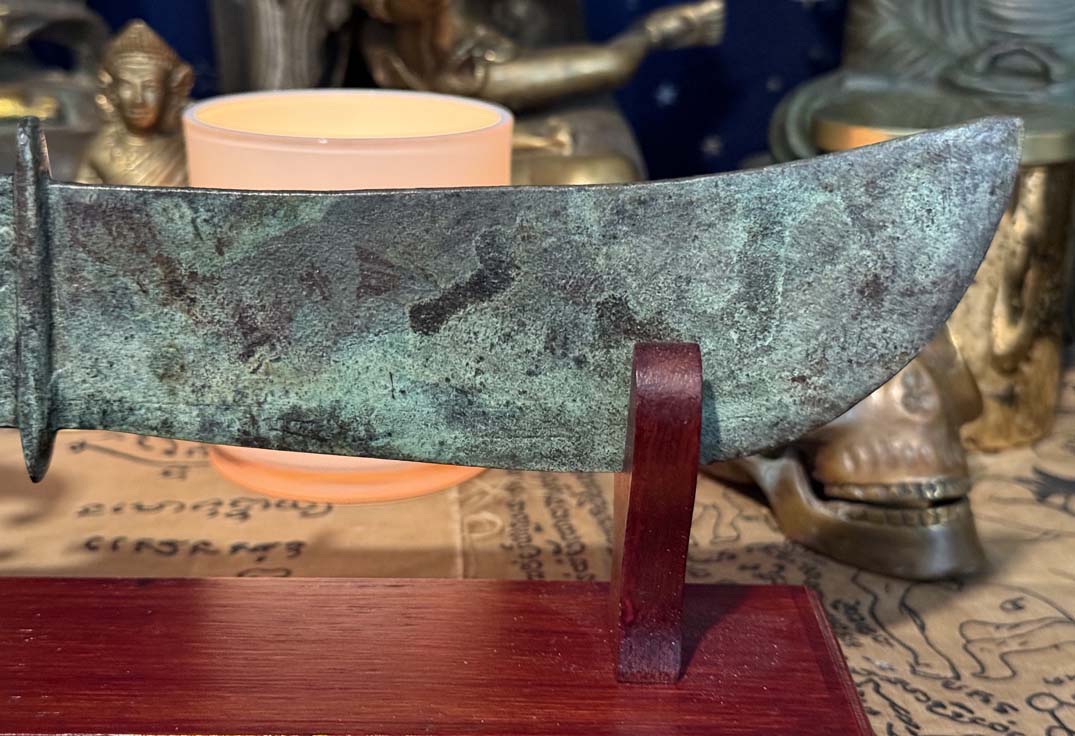
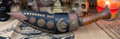
Ge Dagger Axe, Circa 1980 with Stand
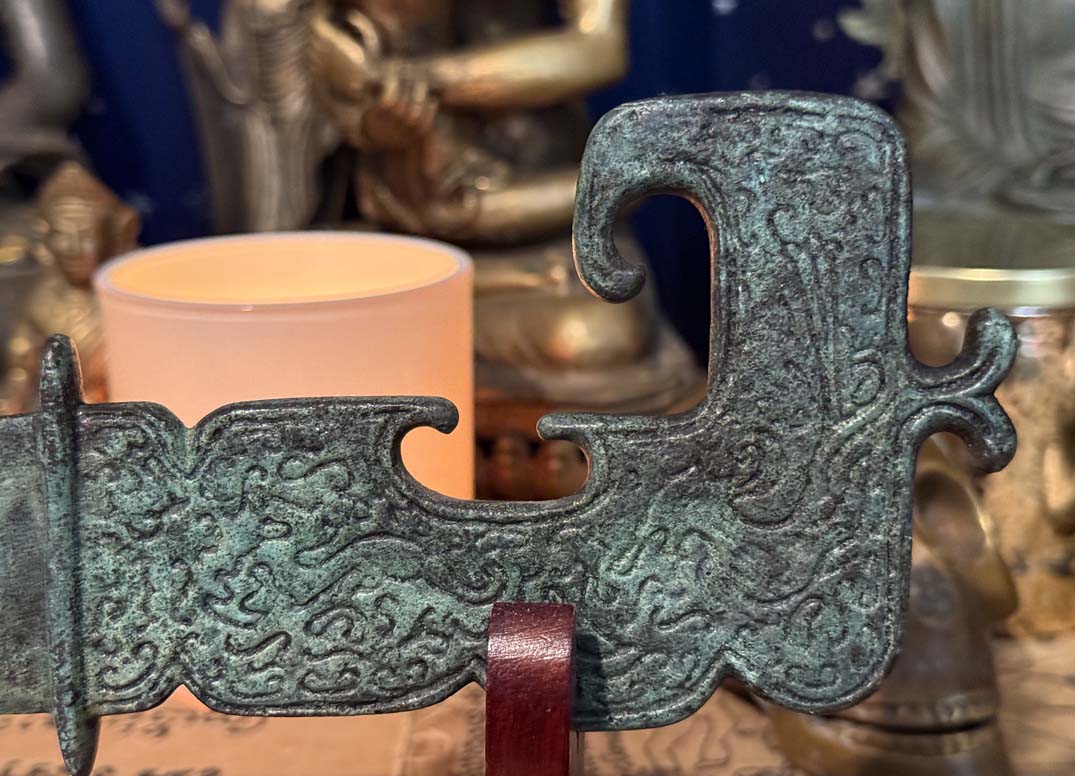
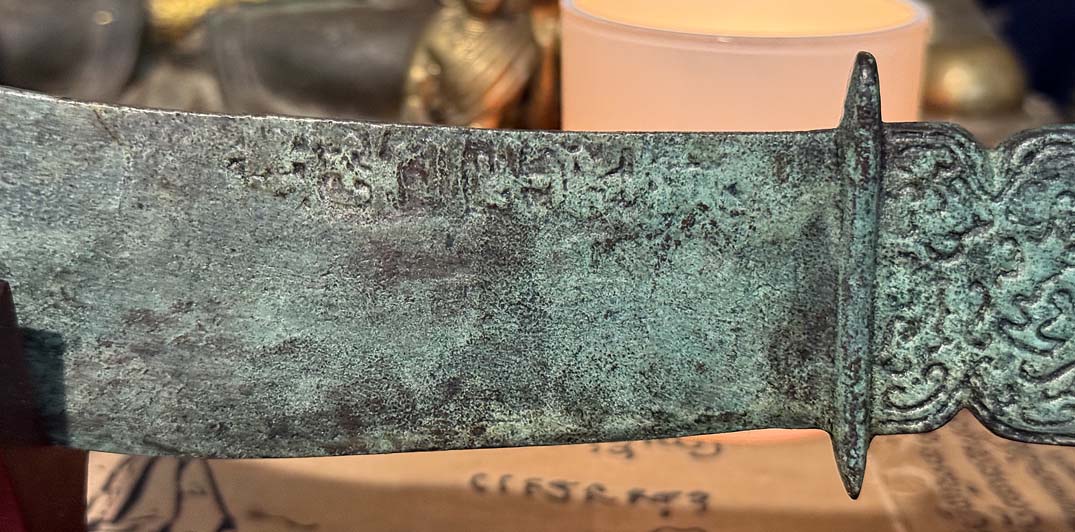
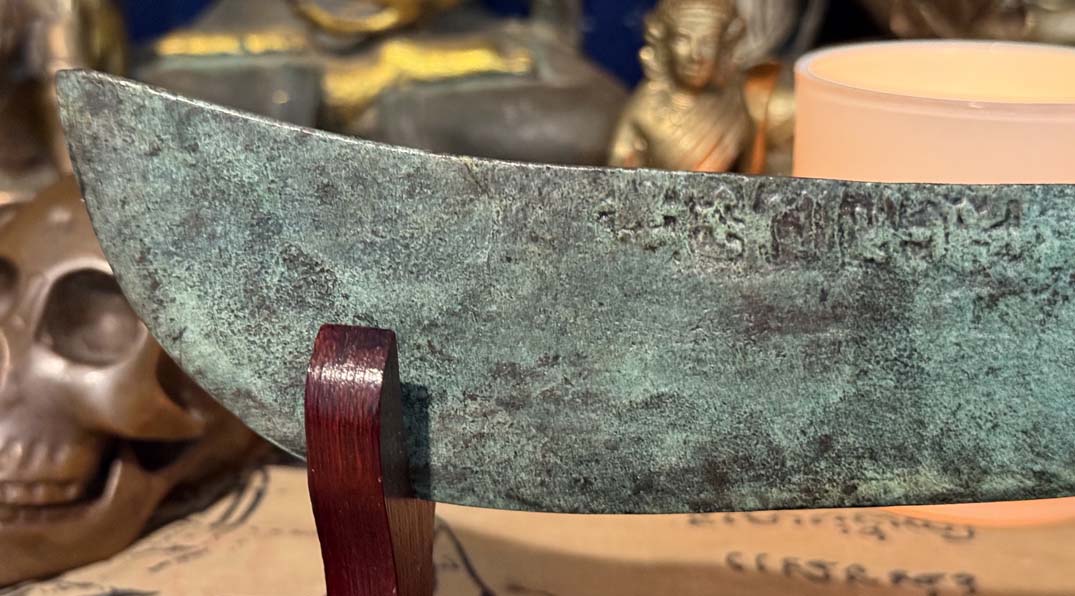
This dagger-axe measures approximately 12" x 3.5" x 5/16" and weighs 1lb., 5 oz. It has a heavy applied patina while the tang displays a primitive dragon and smoke motif and undeciphered kanji on the blade. Assuredly a vintage reproduction of a ceremonial piece to be used to fill a collection or interior decor.
The stand appears to be original to the axe-dagger
And once more we turn to Wikipedia, the free encyclopedia in our research which revealed;
The dagger-axe is a type of polearm that was in use from the Longshan culture until the Han dynasty in China. It consists of a dagger-shaped blade, mounted by its tang to a perpendicular wooden shaft. The earliest dagger-axe blades were made of stone. Later versions used bronze. Jade versions were also made for ceremonial use. There is a variant type with a divided two-part head, consisting of the usual straight blade and a scythe-like blade.
The dagger-axe was the first weapon in Chinese history that was not also a dual-use tool for hunting (such as the bow and arrow) or agriculture. Lacking a point for thrusting, the dagger-axe was used in the open where there was enough room to swing its long shaft. Its appearance on the Chinese battlefield predated the use of chariots and the later dominance of tightly packed infantry formations.
During the Zhou dynasty, the ji or Chinese halberd gradually became more common on the battlefield. The ji was developed from the dagger-axe by adding a spear head to the top of the shaft, thereby enabling the weapon to be used with a thrusting motion as well as a swinging motion. Later versions of the ji, starting in the Spring and Autumn period, combined the dagger-axe blade and spear head into a single piece.
By the Han dynasty, the more versatile ji had completely replaced the dagger-axe as a standard infantry weapon. The ji was later replaced by the spear as the primary polearm of the Chinese military. By the Warring States period, large masses of infantry fighting in close ranks using the spear or ji had displaced the small groups of aristocrats on foot or mounted in chariots who had previously dominated the battlefield.
~!~
It is certainly an unusual vintage display that is much nicer than the photographs are able to depict.
~!~
We have been contacted and visited by a number of people who were interested in the items from this estate since our first batch was listed. Among the buyers have been known psychics and practitioners. More than one, after adorning themselves or handling their purchase, stated "this is a woman of power!" Many of our clients, after receiving items from this estate have reported dream contacts and other unexplained phenomenon.
Unusual, authentic Voodoo Priestess Estate piece and at a bargain price!
This is truly a rare opportunity to own anything with attributes to this estate. The majority of this estate is now gone. Most of what we had left, and it was considerable, has been split up and sold to a couple of private, foreign collector practitioners and will never be available to the public again. We made the decision to do this as we have had some pretty strange visits from even stranger individuals and there have been enough unexplained phenomenon going on in the warehouse where her things were kept that many of our employees refused to go in there.
The pieces offered and sold here are some of the few remaining that will ever be offered to the public.
Nice addition to any collection, altar or decor that displays really well.
Really doesn't get any better than this.
There are 7 photographs below to tell the rest of this tale and we hope yo enjoyed the listing.
Buyer to pay $0.00 for Insured Ground Shipping with Tracking, handling and lagniappe.
Rest assured your order will be carefully packed to withstand the onslaught of the most deranged of parcel carriers.
International Buyer's Please email us for a Shipping Quote.
Payment is due at listing end.
Check our other listings and sign up for our newsletter as new items are usually posted daily.
©Text and Photos Copyright 2001-2026 bushidobuce, all rights reserved.
Axe-Dagger and Stand Only, Not the Props, but you knew that already.