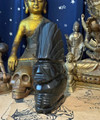
Loading... Please wait...
Categories
 New Products
-
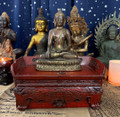 $849.90
-
 $119.90
-
 $209.90
-
 $229.90
-
 $62.90
Our Newsletter
- Home
- Thai Amulets
- 8.25" Mixed Metals Medicine Buddha on Portable Shrine Altar Box with Contents - A Main Healing Altar Find - The Voodoo Estate - ~!~ ~!~ SOLD! ~!~ ~!~
- Home
- Spell Boxes
- 8.25" Mixed Metals Medicine Buddha on Portable Shrine Altar Box with Contents - A Main Healing Altar Find - The Voodoo Estate - ~!~ ~!~ SOLD! ~!~ ~!~
- Home
- Buddha Depictions
- 8.25" Mixed Metals Medicine Buddha on Portable Shrine Altar Box with Contents - A Main Healing Altar Find - The Voodoo Estate - ~!~ ~!~ SOLD! ~!~ ~!~
- Home
- Crystals
- 8.25" Mixed Metals Medicine Buddha on Portable Shrine Altar Box with Contents - A Main Healing Altar Find - The Voodoo Estate - ~!~ ~!~ SOLD! ~!~ ~!~
- Home
- Opium Weights
- 8.25" Mixed Metals Medicine Buddha on Portable Shrine Altar Box with Contents - A Main Healing Altar Find - The Voodoo Estate - ~!~ ~!~ SOLD! ~!~ ~!~
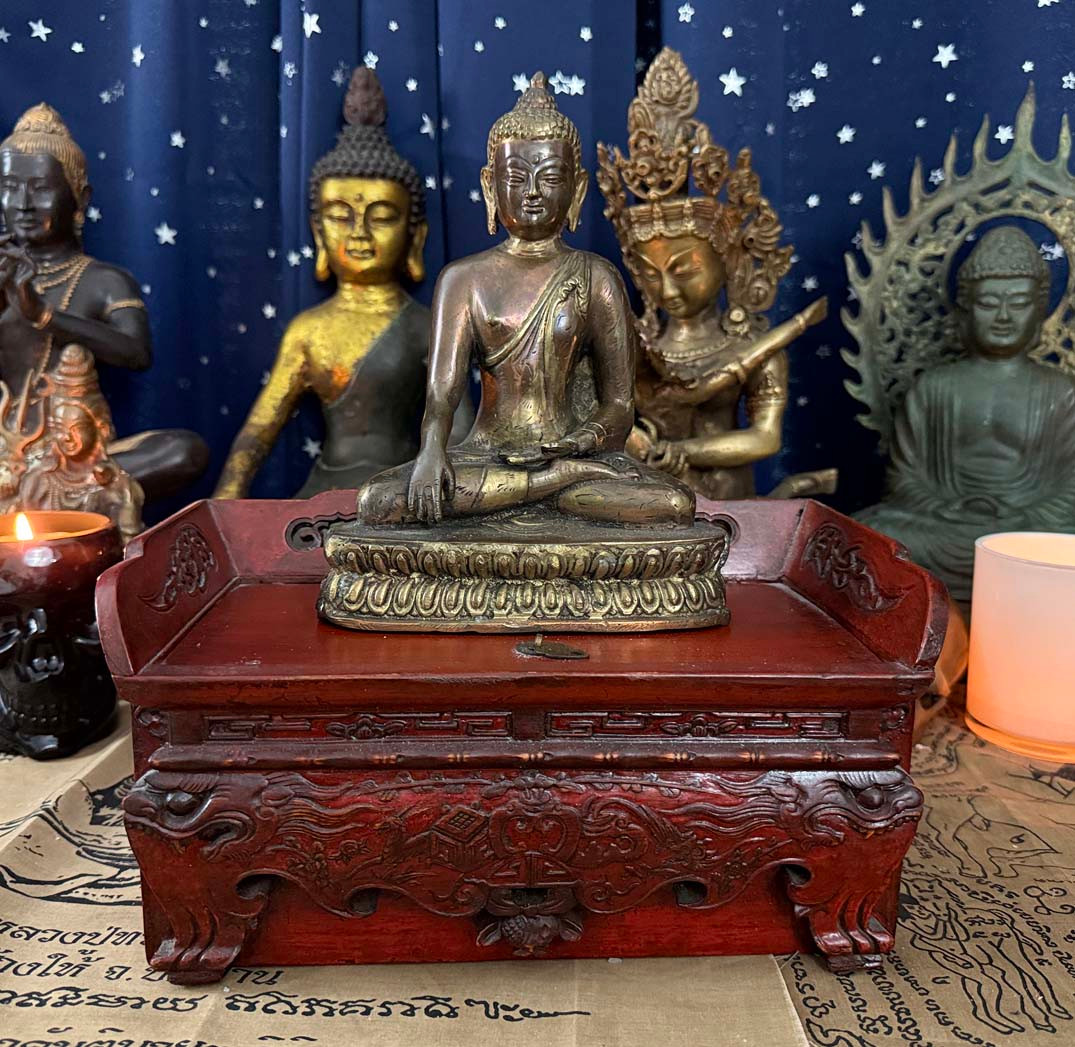
8.25" Mixed Metals Medicine Buddha on Portable Shrine Altar Box with Contents - A Main Healing Altar Find - The Voodoo Estate - ~!~ ~!~ SOLD! ~!~ ~!~


)
Sorry but this item is currently unavailable.
Please check back at a later stage.
Product Description

8.25" Mixed Metals Medicine Buddha
on Portable Shrine Altar Box
with Contents
A Main Healing Altar Find
~!~
This is another of our very long listings with an abundant text and 61 photographs, so please be patient and give them time to load.
It has now been well over twenty-four and a half years (12/06/2001) since we were called to do the estate that had been closed up for seventeen years!
The Voodoo Estate
This type of call usually gets us excited as they are a treasure trove. Located here in Florida, there was no electricity or running water so we rigged our own lighting and in we went. If you have ever seen the Adams Family you will have some idea as to what we were greeted with!
Then the attorney handling the liquidation gave us some background. The estate had belonged to an alleged powerful Voodoo Priestess/JooJoo Exorcist, grand daughter of a Marie Laveau, and favored daughter of a Marie Glapion. These names meant nothing to us, but the late night talk of Voodoo and exorcism in the old mansion was enough to make us decide to spend the night in a hotel and return in the morning to assess the estate. The rest is history.
Our research has shown that this woman was what she claimed and was indeed descended from a long line of well known Vodoun family originating in New Orleans in the early 1800's. We were pretty unnerved by this until we discovered they were also devout Catholics! Although I have to admit this was unlike any Catholic home we have ever been in and some of the items found inside were a little more than disturbing.
There was no feeling of dread or unwelcome in the mansion, however there was quite a bit of contraband and other items we can or will not sell here.
This is one of a few pieces from this estate we will be listing this week, so check our other listings.
We will, upon the new guardian's request, issue a named Letter of Authenticity with each lot from this estate, complying with the terms set forth to us by the estate's attorney.
Main Altar of Healing
Found at her, "Main Altar of Healing," this Main Altar of Healing was what amounted to a small infirmary...of sorts. Located in an east facing porched hall on the first floor it contained many unusual artifacts with alleged healing attributes. She does indeed record some dramatic, if not always successful treatments that she performed. Although, we must add, her record of successful treatment, although bizarre to many, had better than a 90% cure ratio, which, if true, is rather impressive.
~!~

The Buddha
This is one of the sixteen Buddha Depictions that she had assembled for use as prescribed remedies for a host of physical, psychological, and metaphysical disorders that were recovered from this altar room.
They were well inventoried and indexed for use, which would seem by her journal entries that they would be, "prescribed" to her patients along with certain, "healing mantra or khata (prayers) to assist in the cure of their malady." What she prescribed is a mixture of Buddhist, Hindu, Christian, Native American, Hebrew, Muslim, (and a host of other), but assuredly a set of traditional religious healing practices that originated from the African diaspora.
Her journaled inventory tells us it is one of the four deity figures that were purchased for, and shipped to her from a New York antique collector and dealer by her associates, believed to have been the LiDiex, but this has not been corroborated. They were delivered, and entered into her inventory in June of 1954. It is our opinion, that it was already vintage at that time, most likely circa post WWII and said to have been brought to the United States from Vietnam via France.
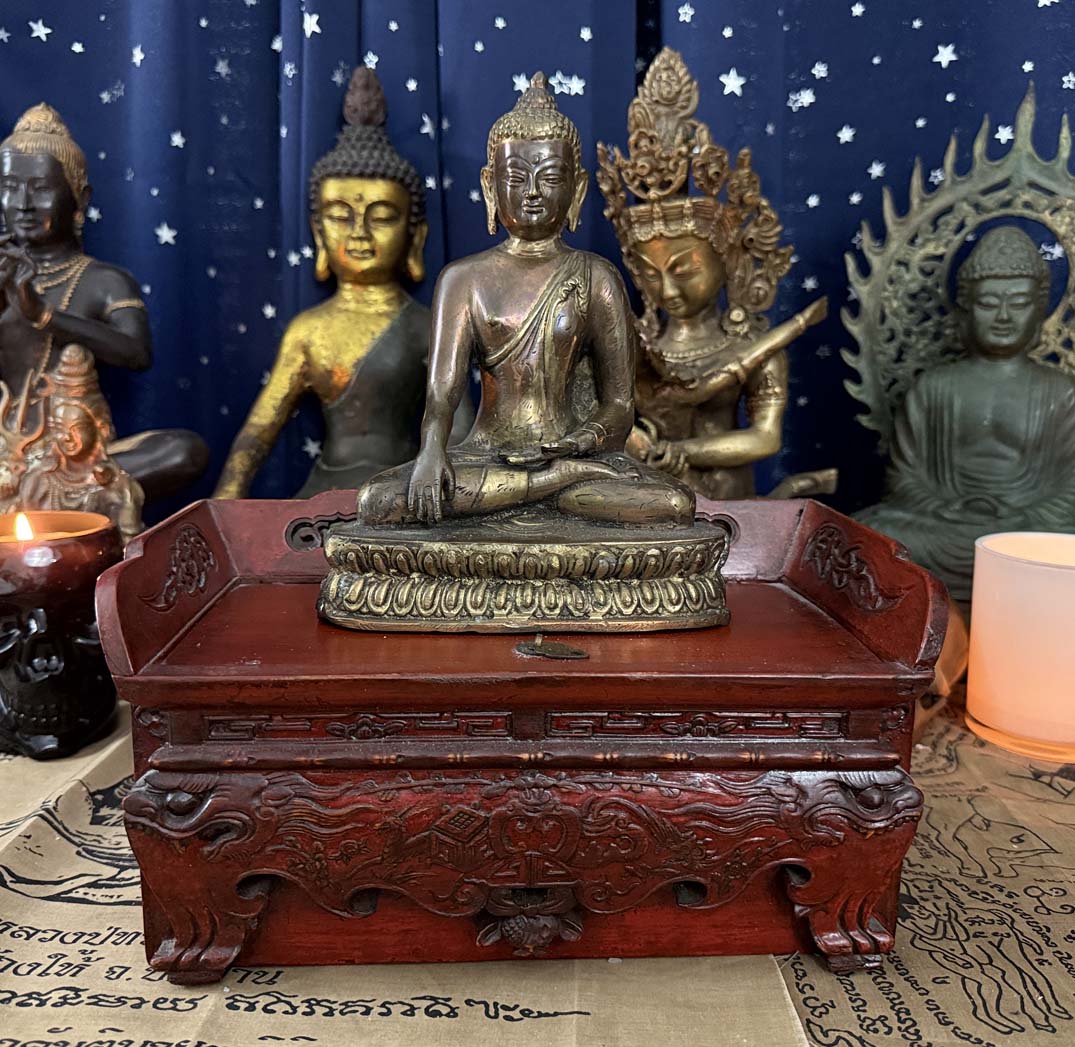
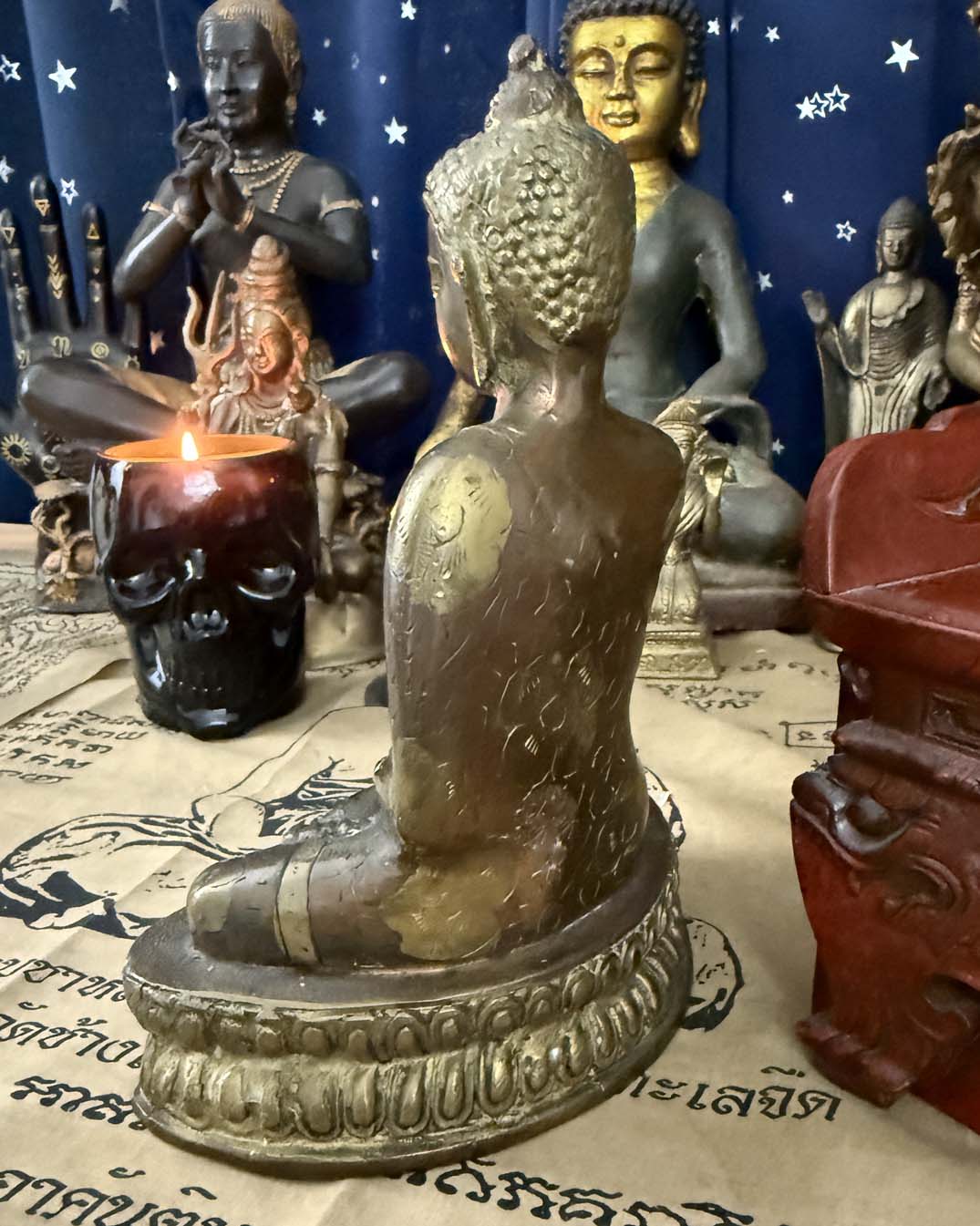
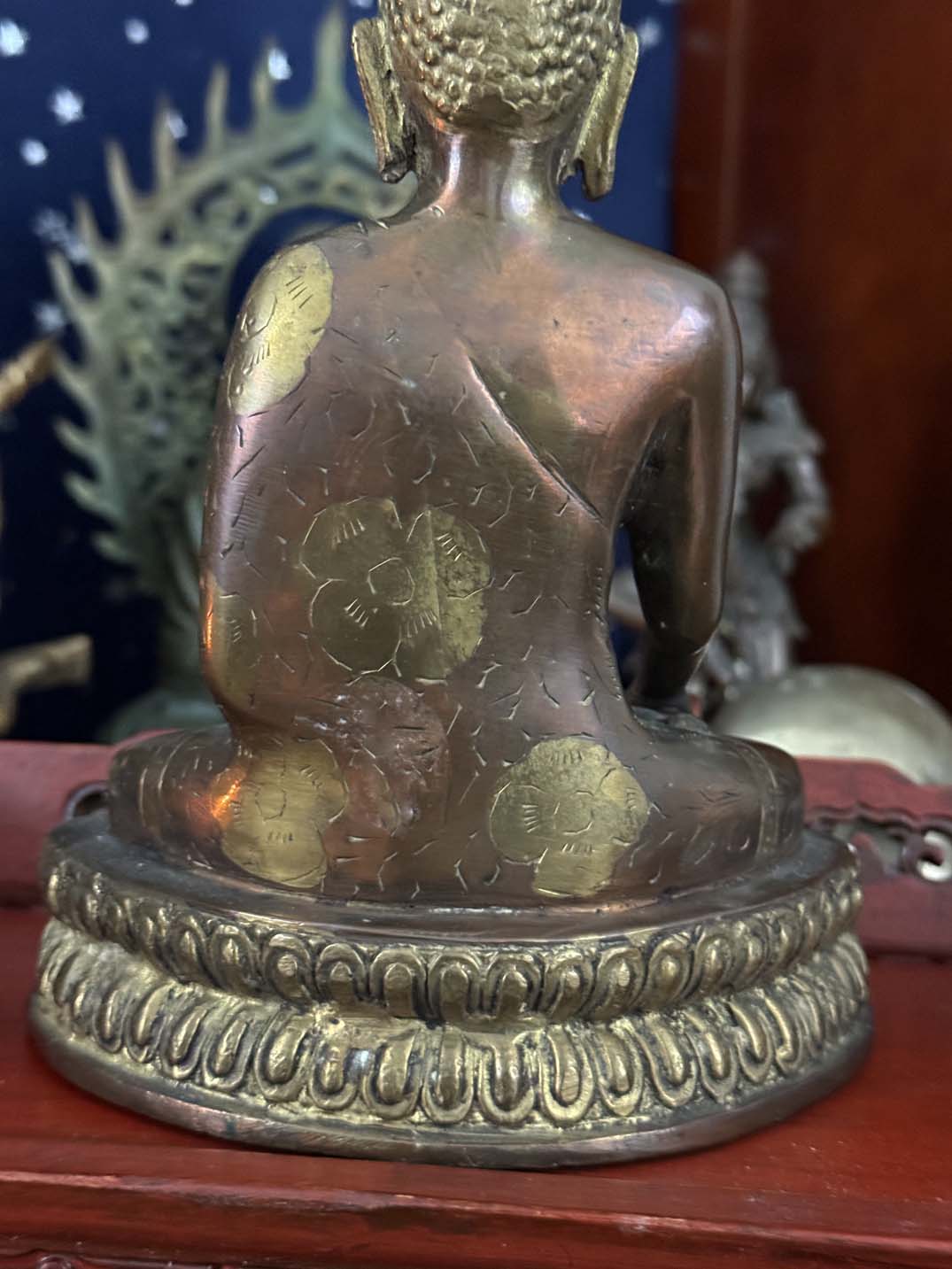
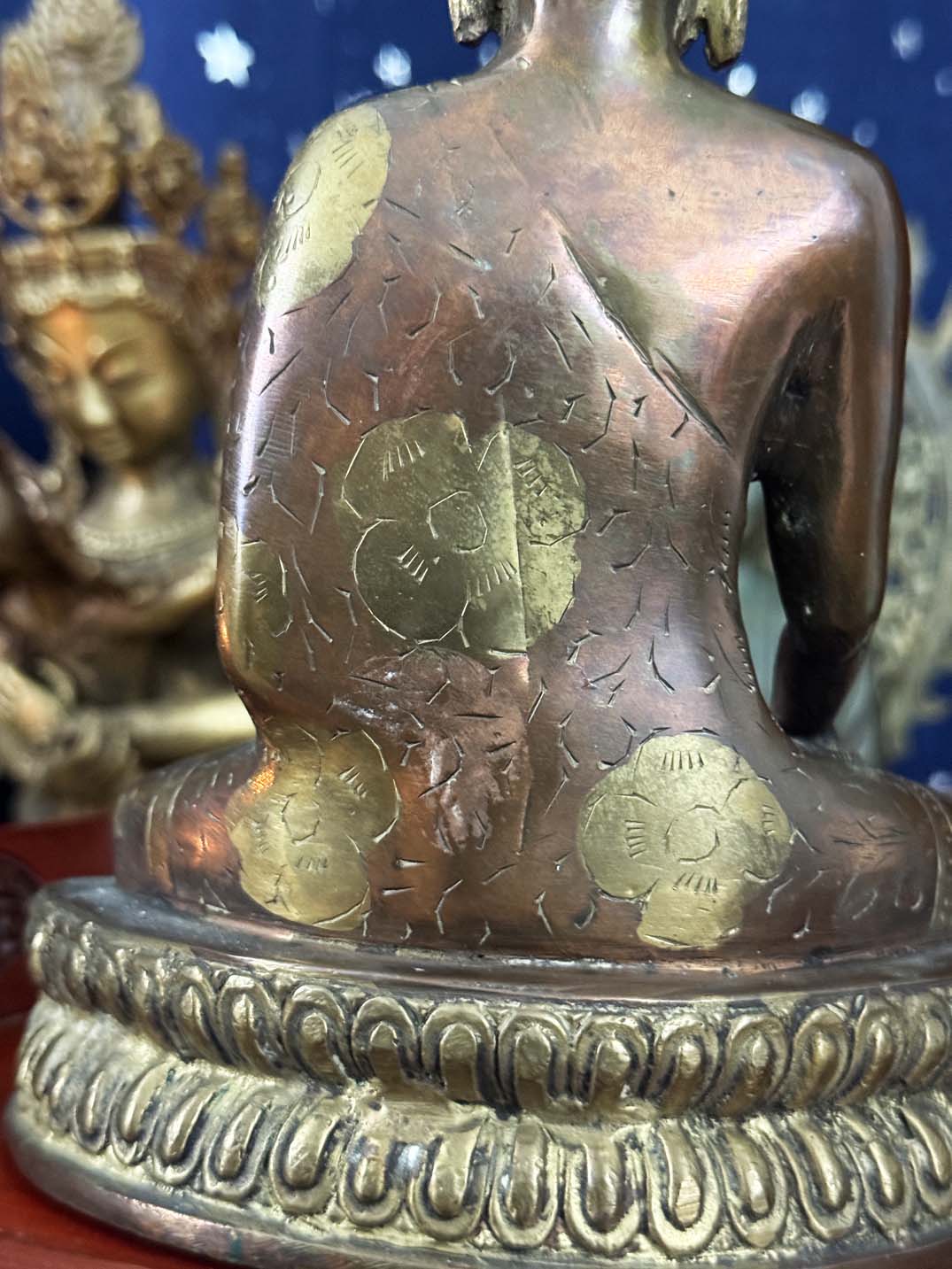
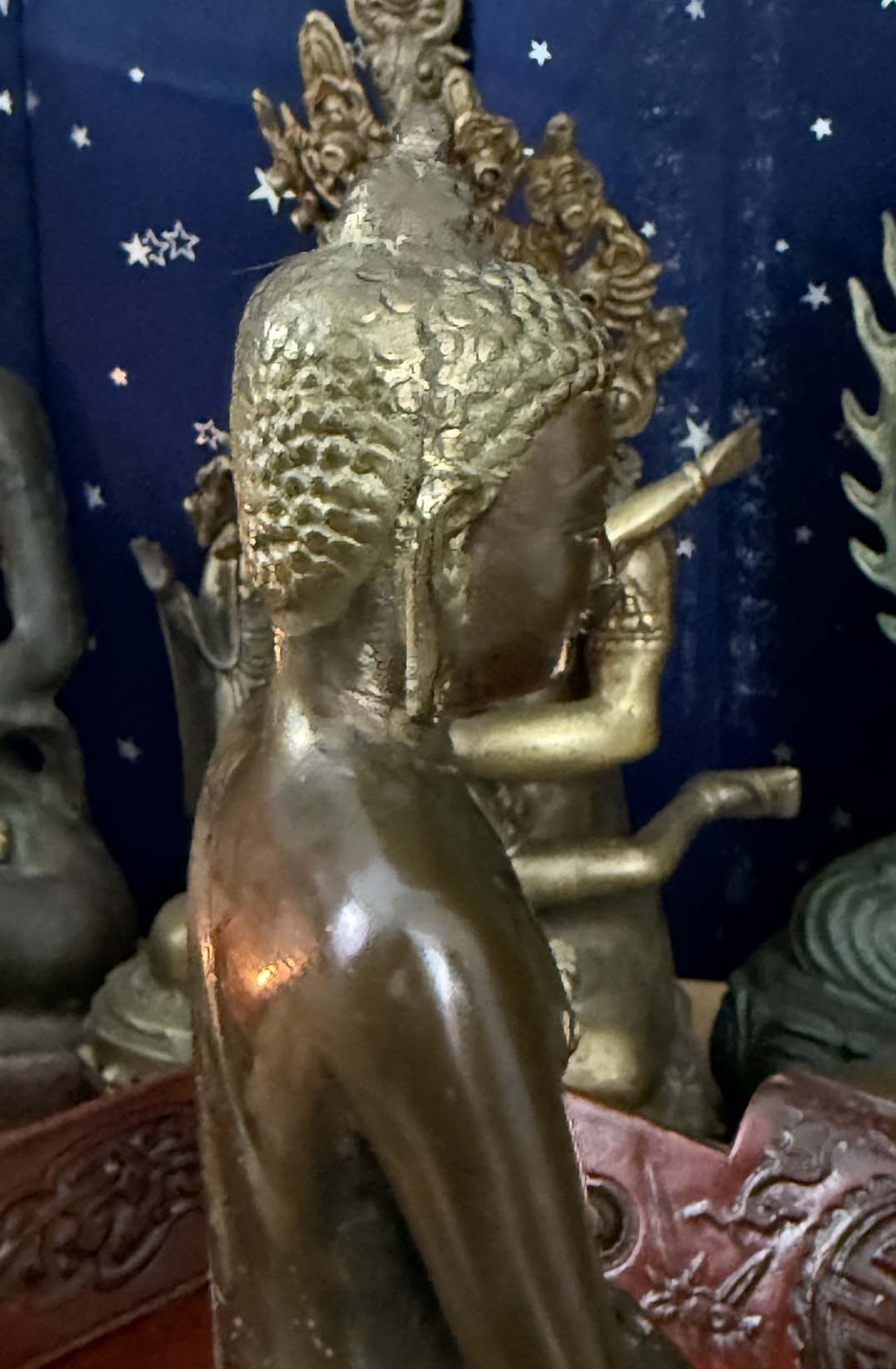
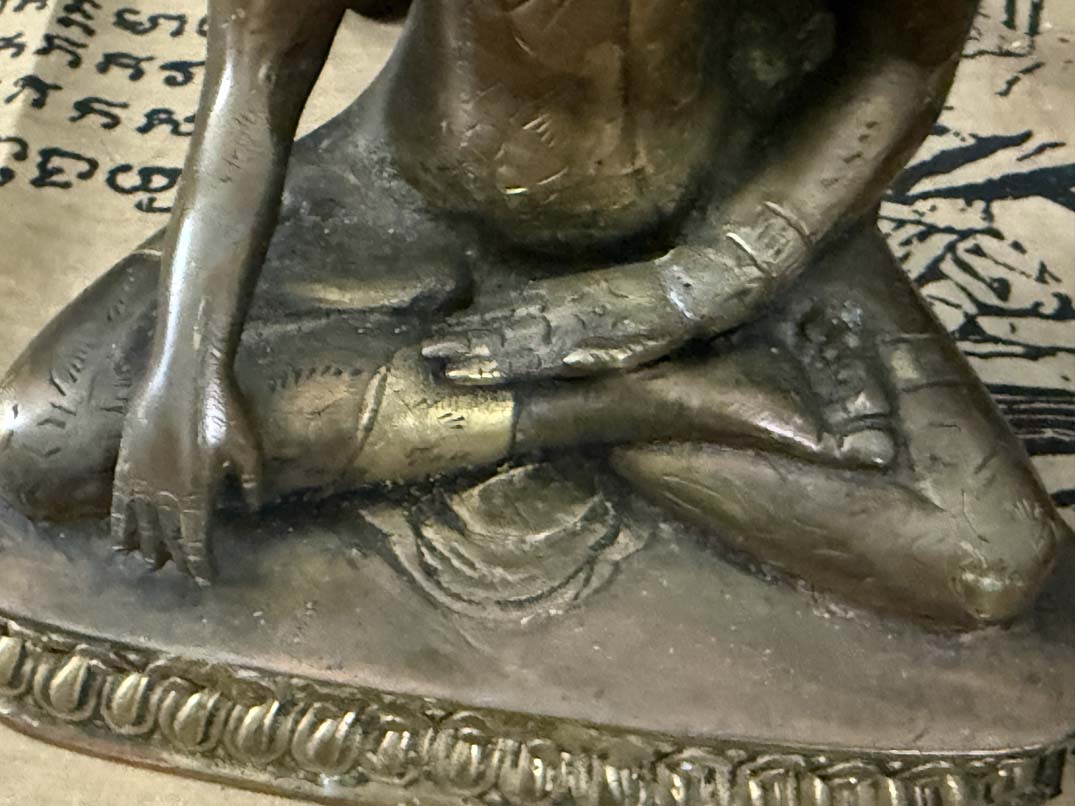
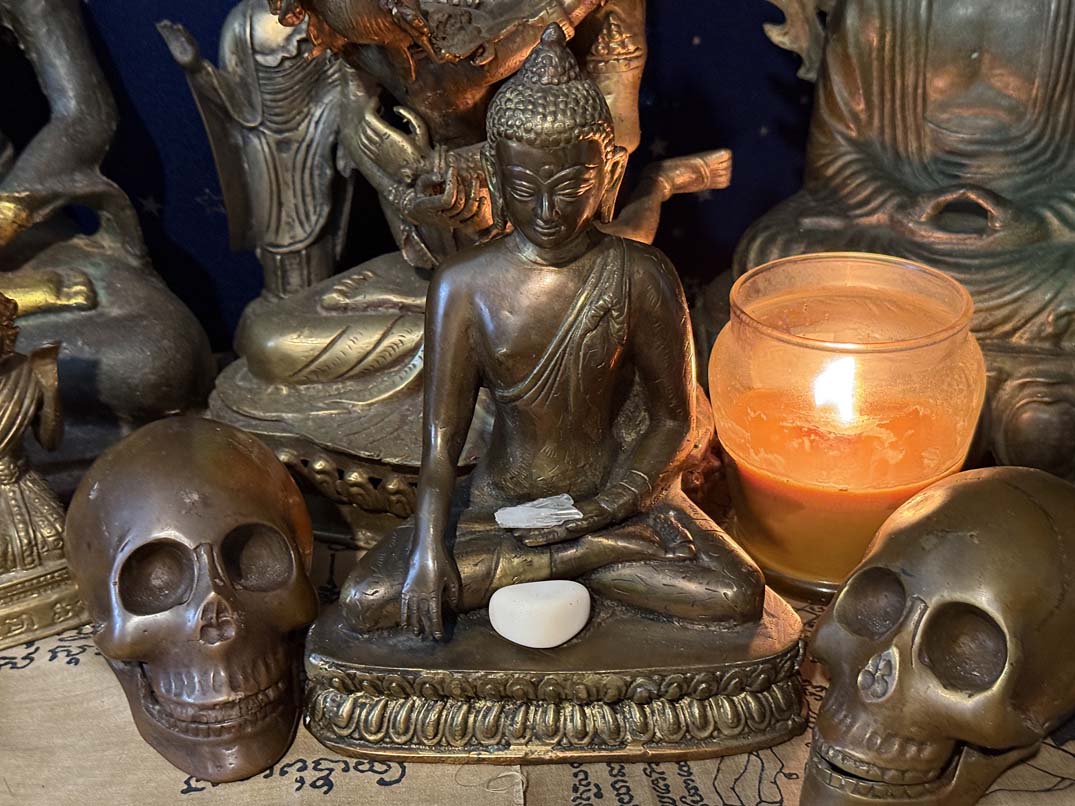
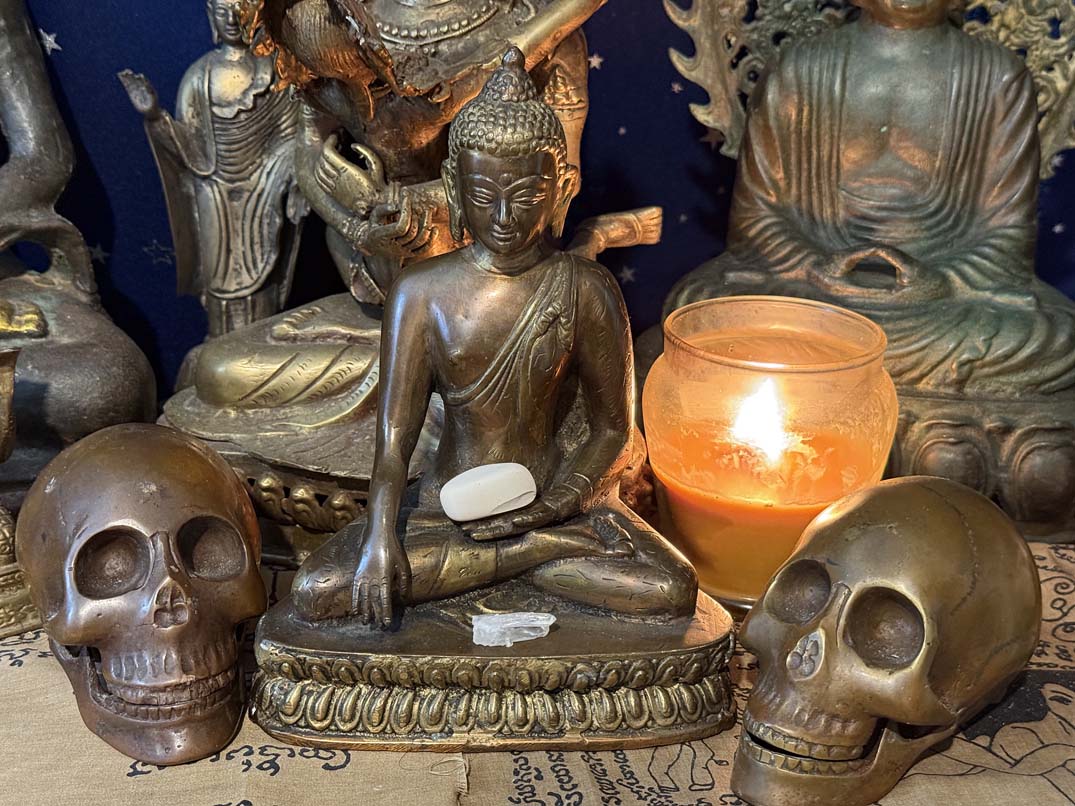
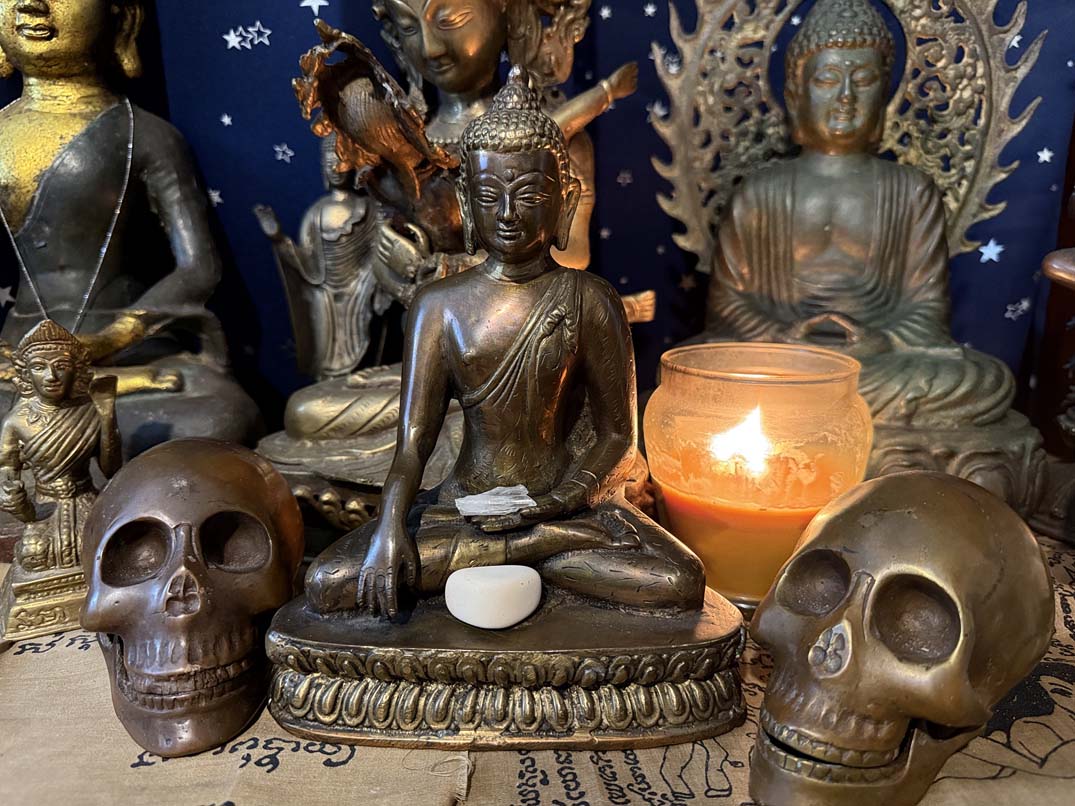
Examination reveals a hollow, copper, brass and lead mixed metal casting measuring approximately 8.25 x 6 3/16" x 3 9/16", weighing 2 lbs., 14 oz. and further described in detail below.~!~
Magic Mixed-Metal
Buddhist artifacts often blend powerful spiritual iconography with sacred metallurgical traditions. This one is a combinations of copper, brass and lead, alloyed together to create this depiction's energetic frequencies. In Southeast Asian, the crafting of precise blends of various metals is referred to as alchemical or "magic" alloy, blessed to harness protective and healing properties.
This is a sacred alchemical mixed alloy traditional Buddha depiction with a deliberate combination of multiple sacred metals, blessed to maximize internal energy, healing and spiritual shielding.
~!~
In Buddhist tradition, a Buddha's hands and feet are adorned with auspicious marks, most notably the thousand-spoked wheel (Dharmachakra). When a Buddha is depicted with the left hand resting in the lap or holding an alms bowl, the upturned palm symbolizes the gaining of wisdom
~!~
Their journals instruct us in the mystical use, of this Buddha which they claim, "begins with visualization of the symbolism of the depictions."
Some of their entries read, "Early in their existence they achieved canonical status among their monks. Seated in a lotus posture and Bhumisparsha Mudra on a lotus throne."
They also point out the robe, not being the monastic robe worn by monks today, but the raiment of a fighting King, indicative of his warrior prince origins.
~!~
Their journals tell us, "Repetitious gazing, chanting of mantra and offerings, are proven methods to increase faith and receive the blessings of the Buddha.”
“The depictions of Buddha's body, mind, and speech are blessed, so even those without faith, just by seeing them are blessed.”
“Do not regard this as an object made of metal. Do not focus on the artistic merits or faults, and you will feel the experience of being in the presence of a living Buddha and through this develop the deep faith.”
“Gaze here at his image, regard it as the actual Buddha for he is supremely kind to all living beings.”
"To gaze upon the Buddha in this way, opens the passage in our mind through which the blessings of holy beings enter. This way of viewing is based on wisdom, not ignorance, and serves to increase our faith and receive blessings.”
“To view the Buddha serves the same function as seeing an actual living Buddha. Just as making offerings and prostrations in front of Buddha images has the same affect as making offerings and prostrations in front of a living Buddha. For know that this is, a living Buddha, and to do so will accumulate blessings.
~!~
The right hand of the Medicine Buddha usually extends downward with the palm facing out in the Varada mudra. The open palm and extended fingers declare unconditional offering of healing, allowing the spiritual intent to be conveyed even if the bowl is absent from the left hand. Because the alms bowl is a central identifier, statues that omit it are frequently misidentified and commonly attributed as an Amitabha or Shakyamuni Buddha once again.
Meditation on the Medicine Buddha involves visualizing healing energy and repeating the Medicine Buddha Mantra to relieve physical and emotional suffering, a practice that relies on internal focus rather than the presence of specific physical artifacts.
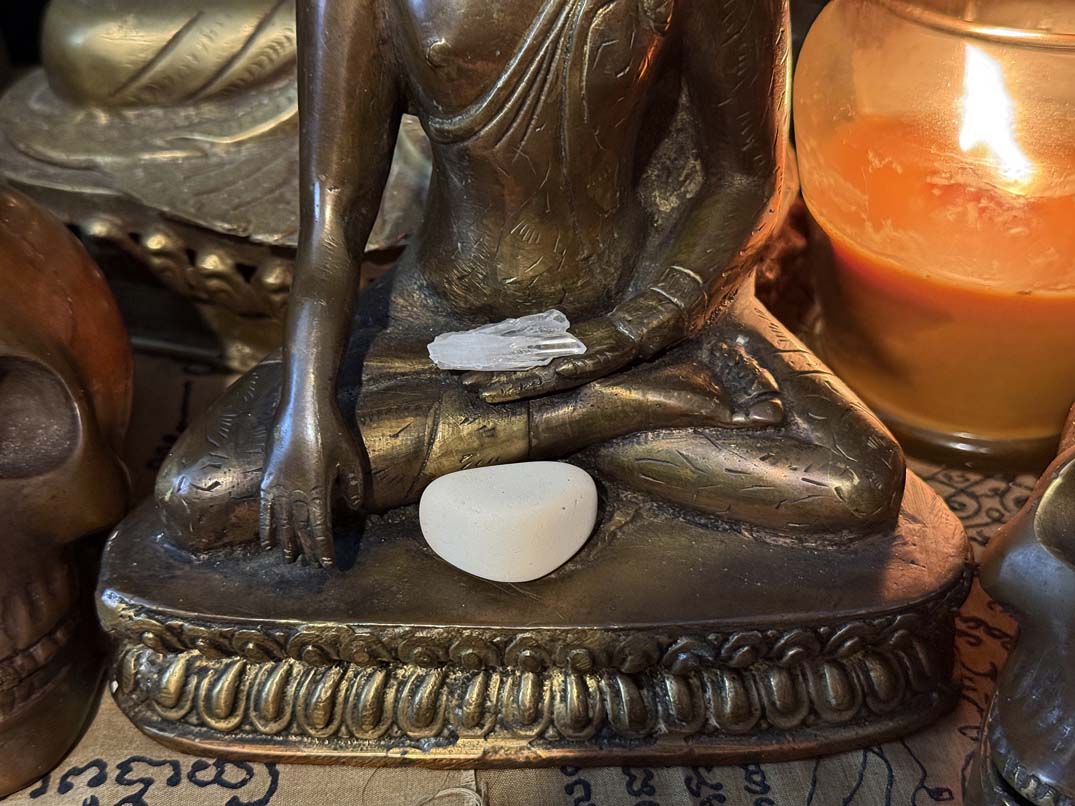
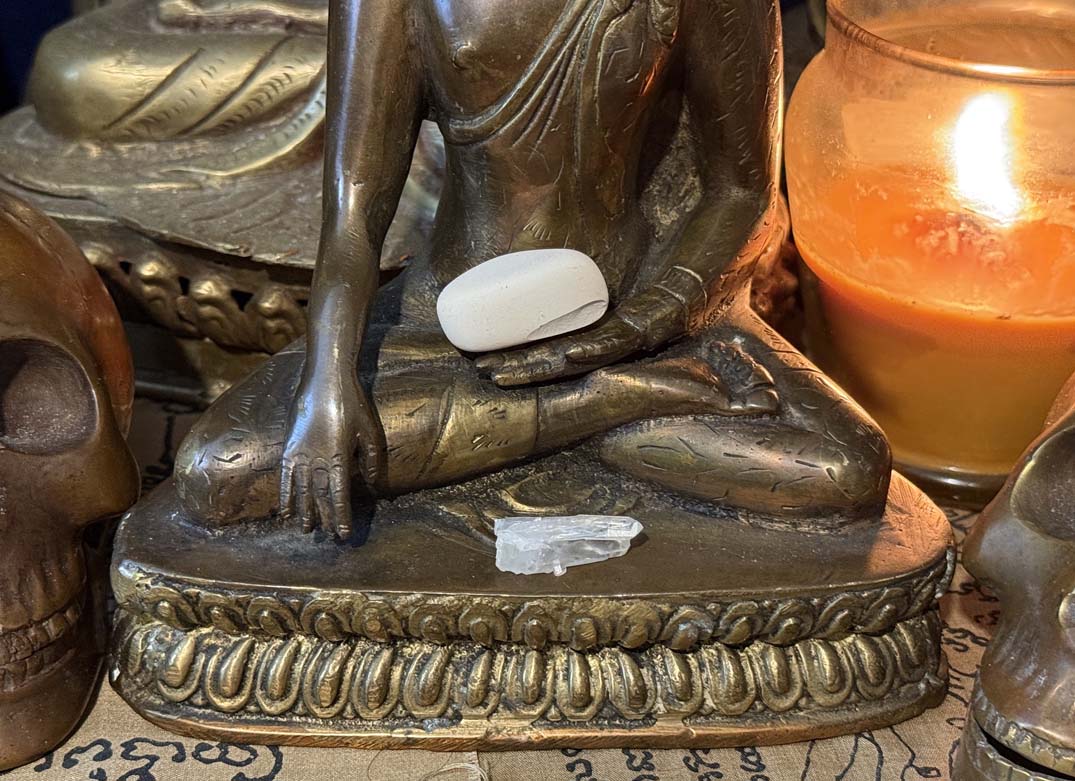
The inward placement of the palm, where the right fingertips point down, indicates the Bhumisparsha Earth-Touching mudra associated with the historical Buddha's enlightenment.
In this case they positioned the "Healing White Stones and Crystals" contained in the drawer of the shrine on the lap in lieu of an alms bowl.
Bhumisparsha Mudra
Literally Bhumisparsha translates into, "touching the earth." Commonly known as the "earth witness mudra.” This mudra is formed with all five fingers of the right hand extended to touch the ground. It symbolizes the Buddha's enlightenment under the bodhi tree, when he summoned the Earth Goddess, Sthavara, to bear witness to his attainment of enlightenment.
In this posture he is the embodiment of, “mirror knowledge,” the knowledge of what is real, and what is illusion, or a mere reflection of actual reality. The mirror is the mind itself, it is clear like the sky, empty, yet luminous. Holding all the images of space and time, yet untouched by them.
Represented here is the eternal mind, and the Vajra family that is connected with reason and intellect. Its brilliance illuminates the darkness of ignorance, its sharpness cuts through confusion.
This is a water element Buddha, and although water may seem ethereal and weightless, it is, in truth, extremely heavy. Water flows into the lowest place and settles there. It carves through solid rock, but calmly, without violence. When frozen, it is hard, sharp, and clear like the intellect, but to reach its full potential, it must also be fluid and adaptable like a flowing river. These are all the essential qualities of the Buddha.
The original function of the ushnisha was probably intended to symbolize a crown on the top of the head of the Buddha. It is an important feature of many depictions of the Buddha yet it is not clear whether he actually had an ushnisha however, it is rare for a depiction to have one along with a flame finial. There is much textual evidence which clearly states the Buddha had a completely shaved head.
In one textual account, a hunter stumbled upon the Buddha in the forest. When he saw the former prince sitting in the middle of the forest, he noticed the bald head of the Buddha and took this as a bad omen and ended his hunt for the day because of it. Convinced this was a brahmana until he approached and noticed the ascetic was missing the usual shikha, or a tuft of hair on the back of the head, that brahmanas usually wore. This evidences leads one to question whether the Buddha had an ushnisha or not.
This image also bears a third eye.
Third Eye
From Wikipedia, the free encyclopedia, for the most part.
The third eye (also called the mind's eye or inner eye) is a mystical invisible eye, usually depicted as located on the forehead, which provides perception beyond ordinary sight.
In Indian spiritual traditions, the third eye refers to the ajna (or brow) chakra.
The third eye refers to the gate that leads to the inner realms and spaces of higher consciousness. In spirituality, the third eye often symbolizes a state of enlightenment. The third eye is often associated with religious visions, clairvoyance, the ability to observe chakras and auras, precognition, and out-of-body experiences. People who are said to have the capacity to use their third eyes are sometimes known as seers. In Hinduism and Buddhism, the third eye is said to be located around the middle of the forehead, slightly above the junction of the eyebrows, representing the enlightenment one achieves through meditation. Hindus also place a "tilaka" between the eyebrows as a representation of the third eye which is also seen on expressions of Shiva. Buddhists regard the third eye as the "eye of consciousness" representing the vantage point from which enlightenment beyond one's physical sight is achieved, and use an urna to the same effect as Hindus.
In Taoism and many traditional Chinese religious sects such as Chan (called Zen in Japanese), "third eye training" involves focusing attention on the point between the eyebrows with the eyes closed, and while the body is in various qigong postures. The goal of this training is to allow students to tune into the correct "vibration" of the universe and gain a solid foundation on which to reach a more advanced meditative state. Taoism teaches that the third eye, also called the mind's eye, is situated between the two physical eyes, and expands up to the middle of the forehead when opened. Taoism asserts that the third eye is one of the main energy centers of the body located at the sixth Chakra, forming a part of the main meridian, the line separating left and right hemispheres of the body. In Taoist alchemical traditions, the third eye is the frontal part of the "Upper Dan Tien" (upper cinnabar field) and is given the evocative name "muddy pellet".
Adherents of theosophist H. P. Blavatsky have suggested that the third eye is in fact the partially dormant pineal gland, which resides between the two hemispheres of the brain. Reptiles and amphibians sense light via a third parietal eye—a structure associated with the pineal gland—which serves to regulate their circadian rhythms, and for navigation, as it can sense the polarization of light. C. W. Leadbeater thought that by extending an "etheric tube" from the third eye, it is possible to develop microscopic and telescopic vision. It has been asserted by Stephen Phillips that the third eye's microscopic vision is capable of observing objects as small as quarks. According to this belief, humans had in far ancient times an actual third eye in the back of the head with a physical and spiritual function. Over time, as humans evolved, this eye atrophied and sunk into what today is known as the pineal gland. Rick Strassman has hypothesized that the pineal gland, which maintains light sensitivity, is responsible for the production and release of DMT (dimethyltryptamine), an entheogen which he believes possibly could be excreted in large quantities at the moments of birth and death.
The use of the phrase mind's eye does not imply that there is a single or unitary place in the mind or brain where visual consciousness occurs. Philosopher Daniel Dennett has critiqued this view.
In Popular Literature
The 1956 novel The Third Eye by Lobsang Rampa (born Cyril Henry Hoskin, 1910–1981, a native of Plympton, Devonshire) introduced a fictional account of the third eye for the first time to a wide popular audience of English-speaking readers.
In the Dragon Ball series, the character Tien Shinhan is depicted with a third eye. Tien himself is based on Erlang Shen—a three-eyed Taoist deity and character in the Chinese classic Journey to the West. Tien obtained his third eye from years of intense meditation, but lost most of its powers due to being raised and corrupted by the villainous Master Shen.
In the Japanese anime / manga series YuYu Hakusho, one of the protagonist's core allies, a demon named Hiei has a physical third eye / Evil Eye (Jagan, referred to as the "Jagan Eye" in the English anime), surgically implanted into his forehead in order to use its psychic powers to aid in his search for his lost sister. The Jagan gives him clairvoyance and allows him to control lesser demons and humans with only a glance. The procedure is depicted as being extremely painful with few being able to withstand the pain of both the surgery and accompanying psychic adjustment to control the power of the Jagan.
~!~

Portable Shrine Altar Box
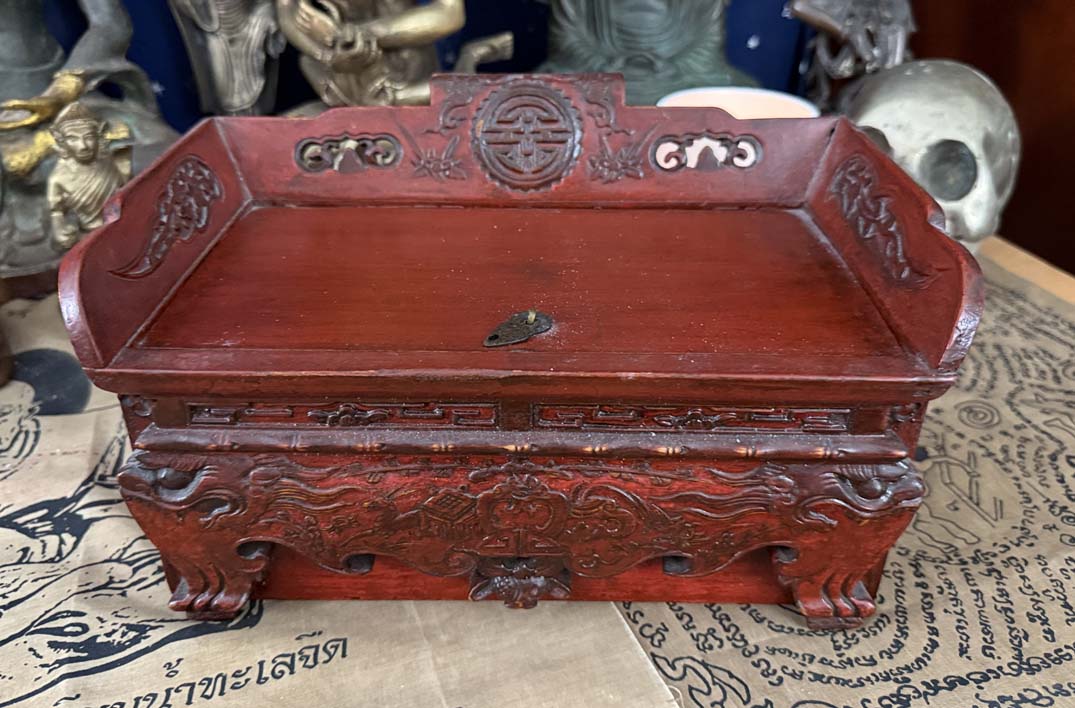
Her journals tell us this is one of a set of four matching rosewood boxes of varying size that were given to her on her birthday in 1957 by unnamed staff members. All were utilized and recovered from this room.
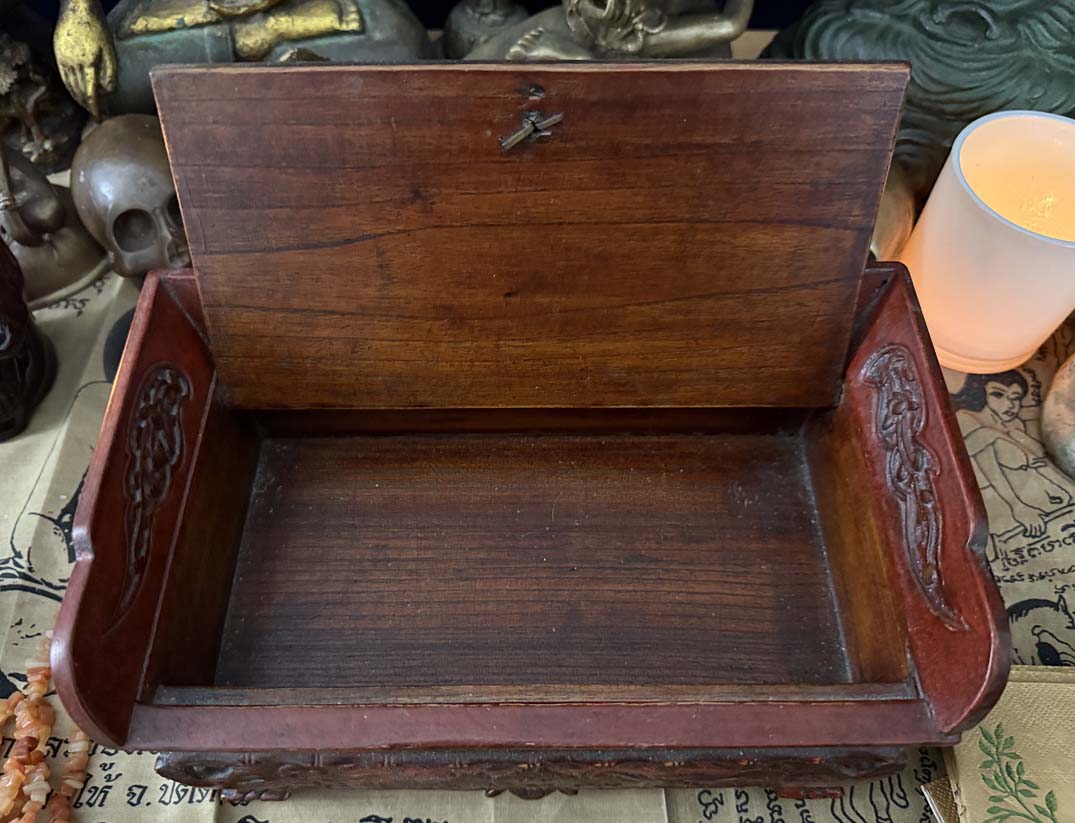
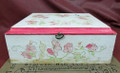
Examination reveals a well made portable red stained rosewood shrine or altar box measuring approximately 10.5" in length x 6 5/'8" in width x 5 3/4" in height.
It has a dragon motif front panel, a hinged, lidded top revealing a storage compartment and a full length drawer in the bottom, the contents of which are described below.
The box is unmarked, in excellent overall condition with no signs of damage or repair.
~!~

The Shrine Box Contents and Commentary
~!~
She goes on to chronicle a ten day visit with a pair of Tzotzil women at the pueblo San Lorenzo Zinacantán in 1947 in which she details much of their belief system, “is based in sacrificial sun worship, and an infinite number of gods.”
It is a 35" continuous strand which weighs 72.7 grams.
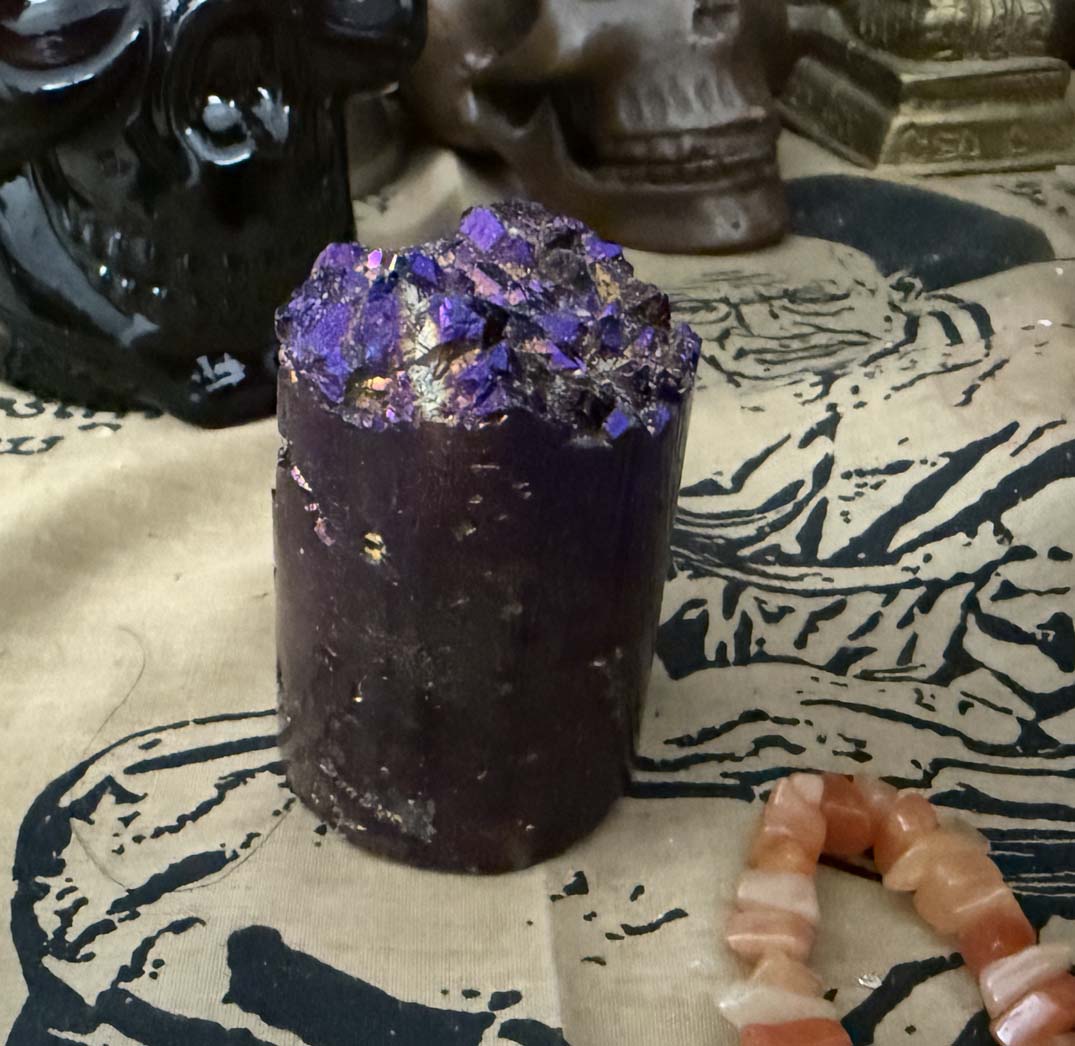
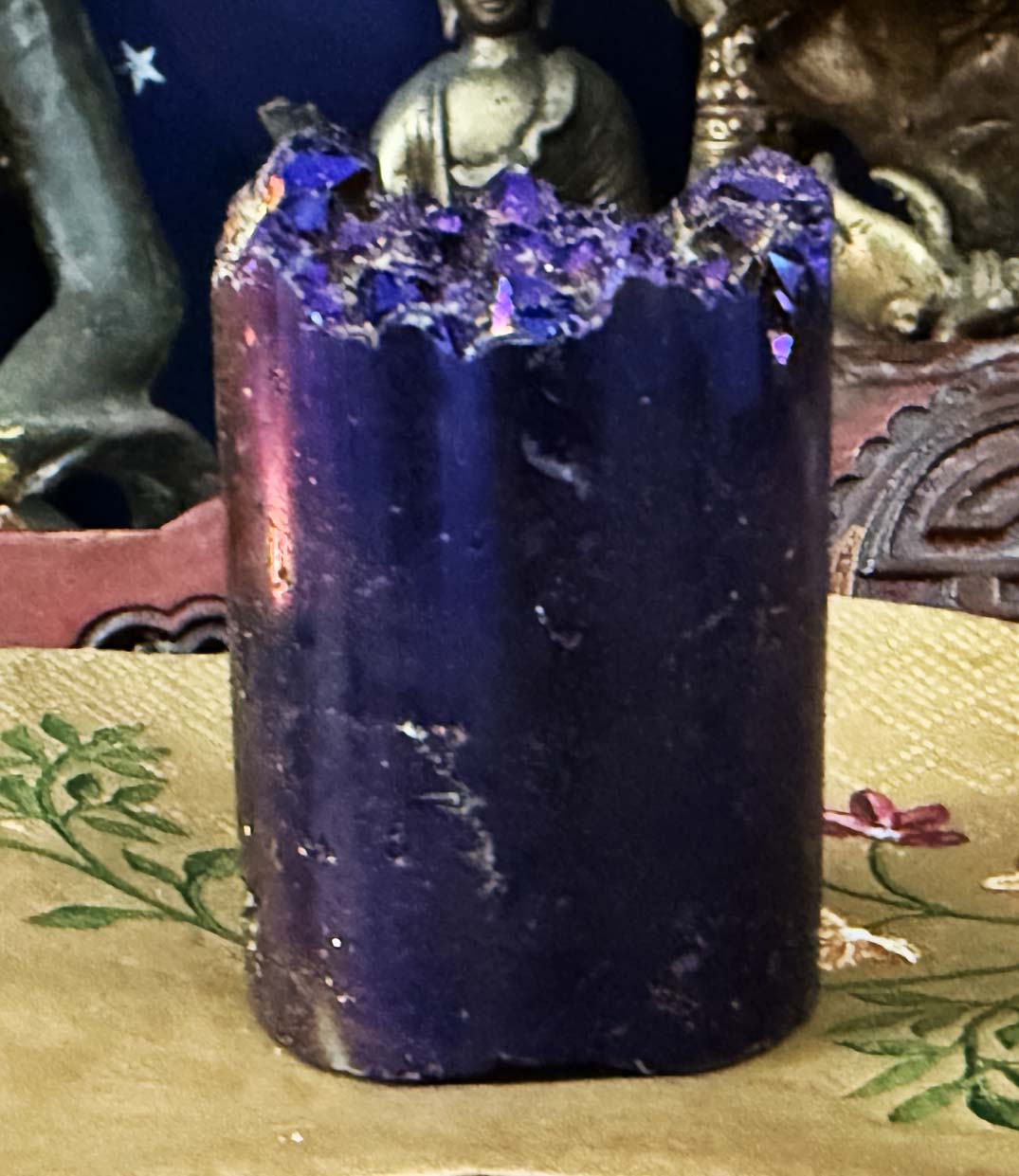
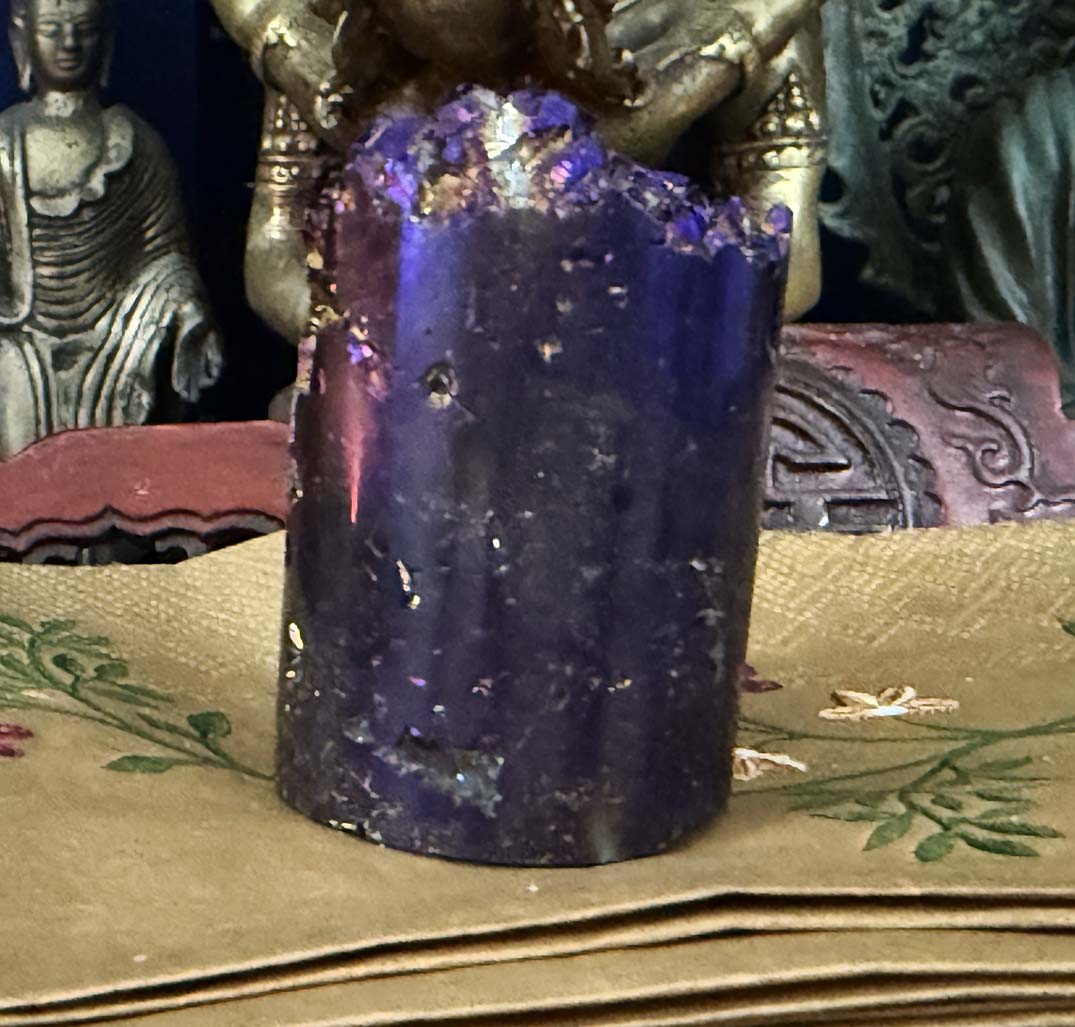
El Diablo's Aura Quartz Drill Core Sample
This quartz, drill core sample is a natural quartz crystal that has been put through a specialized process that gave it its, metallic iridescent purple sheen. This process is called vacuum deposition:The Base: Natural clear quartz crystals are placed inside a high-temperature vacuum chamber. Pure titanium molecules are heated until they vaporize. Then the vaporized metal permanently bonds to the surface of the quartz at an atomic level. This thin layer changes how light reflects off the crystal, generating a deep, color-shifting oil-slick palette of color that cannot be scraped off.
In crystal healing communities, combining natural quartz (the "master healer") with titanium (the "metal of power") is believed to produce a highly energized stone which is highly valued for boosting physical energy, mental fortitude, and a zest for life.
Aura Rainbow Quartz is scientifically recognized as being first created in the 1980s, utilizing a specialized laboratory bonding process. Yet, here we have a demon human hybrid creating it in Mexico, post WWII.
Comparing this core sample with a modern example one can easily tell the difference. El Diablo's samples lack the color spectrum and glossy, oil like finish of its modern counterparts
~!~

Here we have a lot of sixteen, luxurious, golden, floral print paper dinner napkins of unknown origin. The only references we have been able to cross reference of these napkins alludes to their being used as their intended purpose, napkins!
They measure approximately 16.5" x 12 5/8" and are white on the obverse.
~!~

Antique Burmese Bronze Hintha Bird Opium Weight
According to her journals, her first encounter with opium weights in the early 1930's which was the beginning of a sizable collection in its own right, and a group we are still selling off today!
This one however does not have the colorful attributes of makers and end users as the others, although their procurement did trigger her desire to obtain more of them, as evidenced by the dozens of others recovered throughout this estate, such as this one. Her journals and inventory tall us it was purchased at the Thunderbird Flea Market in Sunrise, Florida in 1966 from a Cambodian refugee vendor who she continued to have dealings with for close to three years.
It is assuredly an antique Burmese Bronze Hintha Bird Opium Weight, most likely circa late 19th. century. Although incised, there are no maker's marks. It measures approximately 17/16" x 13/16" x 3/4" and weighs 31.3 grams with no signs of damage or repair. It displays an honest polished patina from over a century of handling.
Hamsa (bird)
From Wikipedia, the free encyclopedia
Hamsa is thought to refer to the bar-headed goose found in India or a species of swan. The Hansa or Hamsa is an aquatic migratory bird, referred to in ancient Sanskrit texts which various scholars have interpreted as being based on the goose, the swan, or even the flamingo. Its image is used in Indian and Southeast Asian culture as a spiritual symbol and a decorative element. It is also used in a metaphorical sense with the bird attributed with the mythical ability to extract milk from a mixture of milk and water or good from evil. In Hindu iconography, hamsa is the vahana (or vehicle) of Brahma, Gayatri, Saraswati, and Vishvakarma.
Identification
Asian language professor Monier Williams translates the term from Sanskrit as "a goose, gander, swan, flamingo (or other aquatic bird, considered as a bird of passage [migratory bird] ...)." The word is also used for a mythical or poetical bird with knowledge. In the Rig Veda, it is the bird which is able to separate Soma from water, when mixed; in later Indian literature, the bird separates milk from water when mixed. In Indian philosophical literature, Hamsa represents the individual soul or spirit (typified by the pure sunlight-white like color of a goose or swan), or the "Universal Soul or Supreme Spirit."
The word Hamsa is cognate with Latin "(h)anser", Greek, German "Gans", Dutch "gans", English "goose", Spanish "ganso" and Russian.
Swan or Goose Controversy
Jean Vogel, in 1952, questioned if hamsa is indeed a swan, because according to Dutch ornithologists George Junge and E.D. van Oort he consulted, swans were rare in modern India while bar-headed geese (Anser indicus) were common. According to Vogel, Western and Indian scholars may have preferred translating hamsa from Sanskrit to swan as the indigenous goose appears plump while the swan (and, Vogel adds, the flamingo) appears more graceful.
Some have criticized Vogel's view as being over-reliant on artistic representations from south India and Sri Lanka, where the white swan is rare. American ornithologist Paul Johnsgard, in 2010, stated that mute swans (Cygnus Olor) do migrate to the northwestern Himalayan region of India every winter, migrating some 1000 miles each way. Similarly, the British ornithologist Peter Scott, in his Key to the Wildfowl of the World (1957), states that northwestern India is one of the winter migration homes for mute swans, the others being Korea and the Black Sea. Grewal, Harvey and Pfister, in 2003, state that the mute swan is "a vagrant mainly in Pakistan but also northwestern India" and include a map marking their distribution. Asad Rahmani and Zafar-ul Islam, in their 2009 book, describe the three species of swans and 39 species of ducks and geese found in India.
Dave stated, "the present position according to Hume is that Swans do not occur anywhere within Indian limits outside the Himalayas except in the extreme North-West", and suggested that they were perhaps more common in the "hoary past."
The hymns of Rigveda, verses in Hindu epics and Puranas, as well as other early Indian texts, states KN Dave, mention a variety of birds with the root of hamsa, such as Maha-hamsa, Raj-hamsa, Kal-hamsa and others. These should be identified as members of the Anatidae family, namely swans, geese or ducks. This identification is based on the details provided in the Sanskrit texts about the changes in plumage over the bird's life, described call, migratory habits, courtship rituals and flying patterns. Specific examples where "hamsa" should be interpreted as "swan" include hymns 1.163, 3.8, 4.45, 8.35, 9.32 and others in the Rigveda, verse 7.339 of Ramayana manjari, chapter 30.56 of Skanda Purana, chapter 101.27 of the Padma Purana, and others. Dave also lists examples of Indian texts where "hamsa" should be interpreted as "goose." Some Sanskrit texts, states Dave, distinguish between "hamsa" and "kadamb" the former according to him being a swan and the latter a bar-headed goose.
The Indian ornithologist Salim Ali stated in his Azad Memorial Lecture of 1979 that Sanskrit names for birds were based on their calls, coloration, habits, gait, method of feeding or other observed traits. However, these are sometimes difficult to assign unambiguously to species. He mentions 4th to 5th-century Kalidasa's poem about Lake Manasa. This Manasa, assumes Salim Ali, is Lake Manasarovar and then states that the hamsa birds therein should be interpreted as bar-headed geese that do migrate over the Himalayas from Tibet. The historic Sanskrit and Prakrit literature of India does not mention the location of the lake Manasa that they consider the natural abode of the hamsa.
Ethno-ornithologists Sonia Tidemann and Andrew Gosler in Ethno-ornithology: Birds, Indigenous Peoples, Culture and Society state that hamsa has been identified as "swans" in early Indian texts, and that titles such as Raja-hamsa were applied to ascetics and holy-men in Indian culture because ancient Hindu and Buddhist stories ascribed the ability to separate good from evil to the hamsa.
The birds painted at the Ajanta Caves in central India (Maharashtra) on the Hamsa Jataka, as well as those in Sanchi resemble a swan (and a series of swans in one panel), states the art historian C. Sivaramamurti. These early Buddhist arts can be dated between the 3rd century BCE and 5th century CE. The text of the Jataka itself clearly describes white swans that are like clouds in a blue sky.
According to Nanditha Krishna, the hamsa in the early north Indian tradition is best identified as a swan as the mythical symbol of wisdom. However, the hamsa became a popular motif included in temple artwork, textile prints and other artworks. It became a highly stylized mythical bird, with a plump body and short neck, along with flowery beak and tail, one that looks more like a goose.
In Hinduism
The hamsa is often identified with the Supreme Spirit, Ultimate Reality or Brahman in Hinduism. The flight of the hamsa symbolizes moksha, the release from the cycle of birth, death, and reincarnation known as samsara.
The hamsa is also the vahana (mount) of Saraswati, the goddess of knowledge and creative arts, Brahma, the god of creation and one of the Trideva (Hindu trinity), and Gayatri, the goddess of vedas.
Paramahamsa
In view of the association of the hamsa with several attributes as indicated above, Hindu rishis (sages) and sadhus (Hindu ascetic or holy person) have been given the title of paramahamsa, that is, the supreme hamsa. It connotes a particular person who has reached a high level of spirituality.
For example, Paramahamsa Upanishad calls that yogi a Paramahamsa who is neither opinionated nor affected by defamation, nor jealous, not a show off, is humble, and is oblivious to all the human frailties. He is immune to the existence of his body, which he treats as a corpse. He is beyond false pretensions and lives realizing the Brahman. In chapter 3, the Paramahamsa Upanishad states that the one who understands the difference between "staff of knowledge" and "staff of wood", is a Paramahamsa.
He does not fear pain, nor longs for pleasure.
He forsakes love. He is not attached to the pleasant, nor to the unpleasant.
He does not hate. He does not rejoice.
Firmly fixed in knowledge, his Self is content, well-established within.
He is called the true Yogin. He is a knower.
His consciousness is permeated with that, the perfect bliss.
That Brahman I am, he knows it. He has that goal achieved.
—Paramahamsa Upanishad, Chapter 4 (Abridged),
In Indian Text
Hamsa, or hansa, are part of Indian text. Arayanna, or heavenly hamsa (swans), are said to live in Manasasaras in the Himalayas. They are mentioned in the Hindu epic, the Ramayana. Hamsa, the swan, is part of the mythical love story of Nala and Damayanti, where it carries the stories, historical information and messages between the two strangers.
In Indian text, it is said to eat pearls and separate milk from water from a mixture of the two. Charles Lanman states that the references to hamsa being able to separate or discriminate is used primarily in a metaphorical sense in Sanskrit poetry. One possibility is the belief that the milk refers to the sap exuded from the stems of lotuses (kshira). The other, states Lanman, is that "the swan, goose, duck and flamingo have a series of lamellae which serve as a sieve for straining their food from the water that they take in." Thus, it may be referring to the bird's ability to extract the nourishing part from a mixture.
Buddhism
The hamsa was also used extensively in the art of Gandhara, in conjunction with images of the Shakyamuni Buddha. Nanditha Krishna translates this as swan, in the Gandharan context. Martin Lerner and Steven Kossak identify a 2nd-century BCE Gandharan relief now in the collection of the Metropolitan Museum of Art (New York, item 1987.142.212) that shows a swan with a rider.
The hamsa is deemed sacred in the Buddhism, as a symbol of wisdom. Some scholars such as Donald Swearer translate it as swan, others such as Thien Chou as goose. In historic Nepalese art, hamsa are either sketched as a swan or goose-like bird, while in historic Tibetan artwork it appears as goose-like bird likely reflecting the Indian region from where the Tibetan monks borrowed their iconography.
The hintha (equivalent to hamsa) is widely depicted in Burmese art, considered to be a ruddy shelduck in its culture, and has been adopted as the symbol of the Mon people. In parts of Myanmar, the hintha iconography is more like a hen than a duck, reflecting the local fauna.
~!~
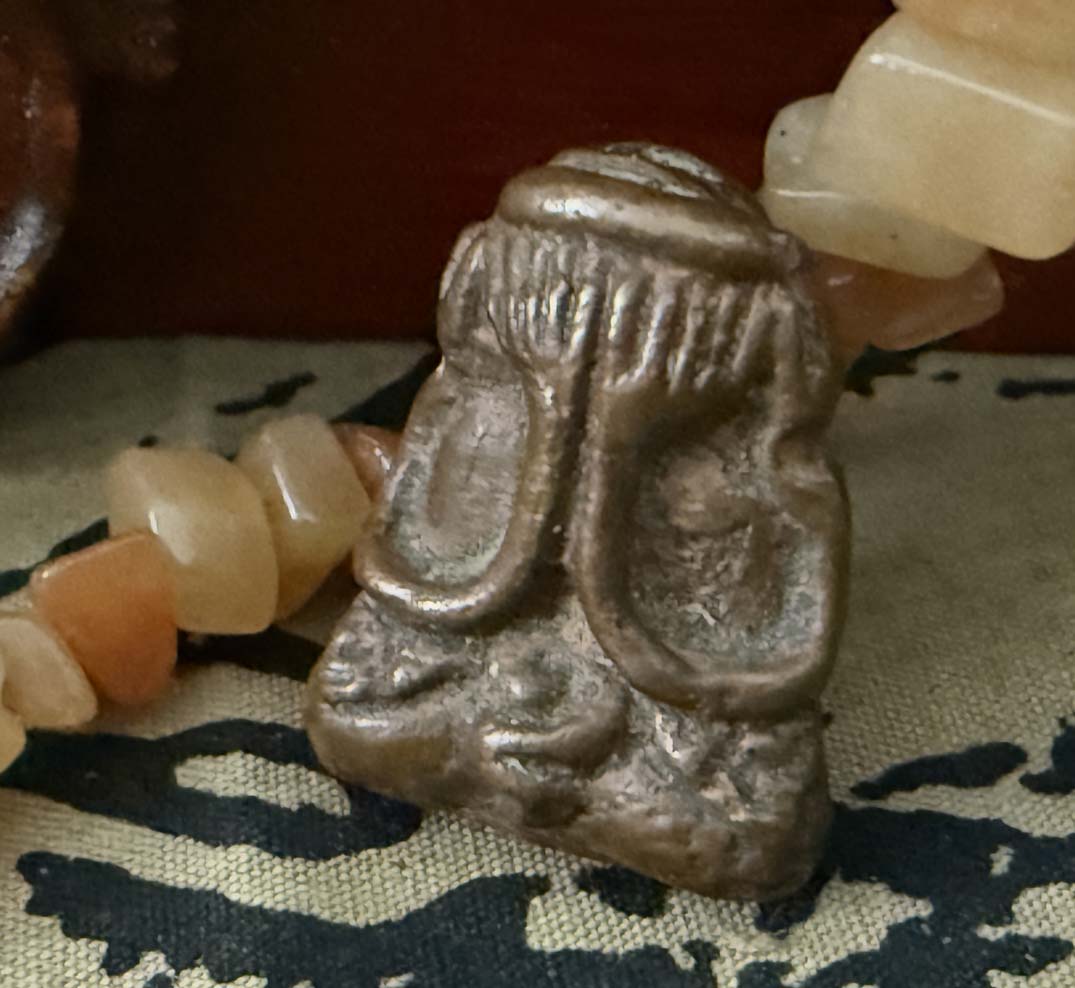
Death Worn Phra Pidta
The amulet shown here was brought to the estate by the 1898 LiDiex.
The 1898 LiDiex
~!~
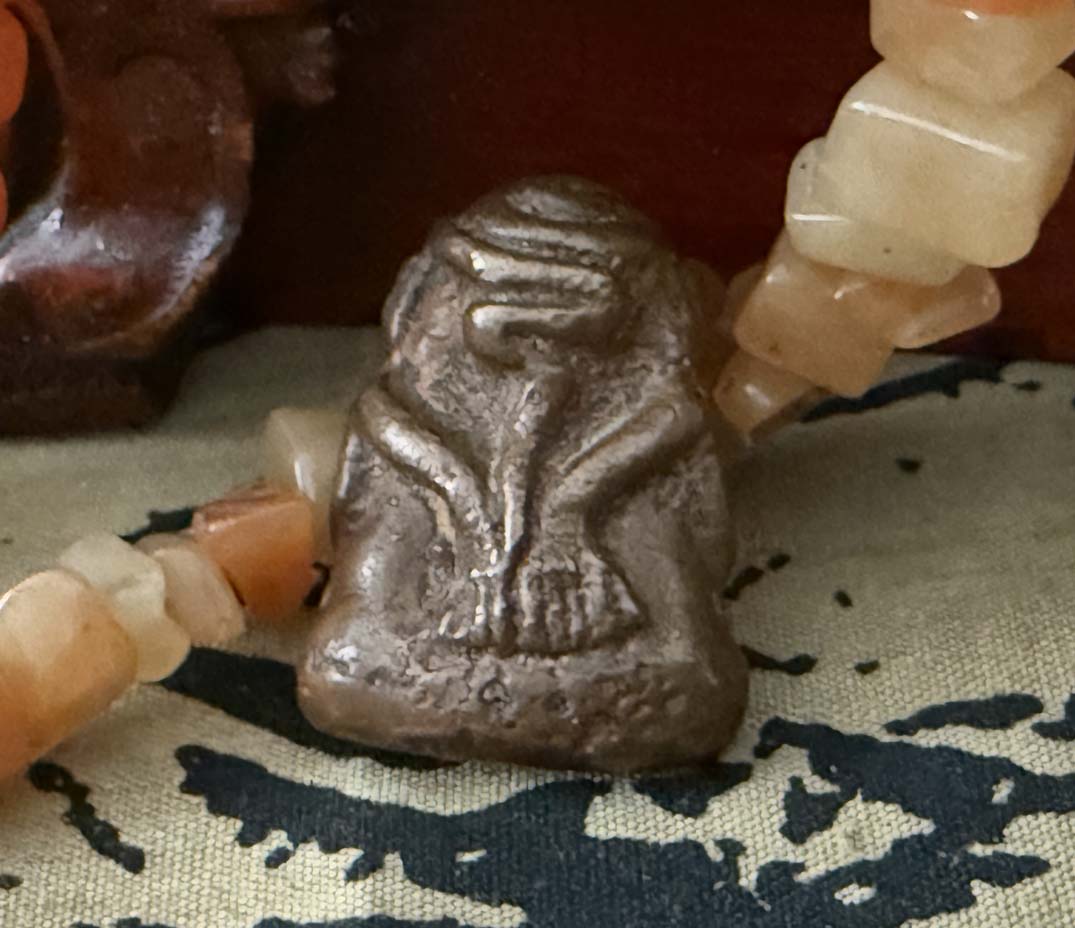
This Phra Pidta amulet is a fascinating study of Southeast Asian Buddhism, its worshipers and their sorcerer monks. The journals recovered from this estate tell us it was recovered by the 1898 LiDiex, "clutched in the hand of a *murdered Forest Monk, one of eight massacred by the Communists." This entry is dated July 9th., 1960. This story begins a year earlier with a secret meeting of King Rama IX at Wat Mai in Bangkok, Thailand in 1959.
*compiling and comparing the notes of the parties involved, we conclude the monk died of serious wounds obtained weeks prior to his death, which they classified as murder in their notes.
This LiDiex was apparently known to King Rama IX, having been introduced by a group of former high ranking military men he considered friends who now wore the Theravada robes. Nine of these monks would take off their robes and join three of the LiDiex to essentially become hired killers under the pretext of being military advisers for the King to stem the tide of communist insurgency in Thailand.
By the late 1980's, armed insurgency had become a national problem that had plagued a series of Thai governments and dominated police and army activities for more than twenty years, had been virtually eliminated.
Former student leader Thirayuth Bunmee's surrender after five years with the CPT gained wide publicity for the amnesty program, as did the mass defection of 250 armed insurgents and hundreds of unarmed family members and supporters at Mukdahan in December of 1982. At the same time, the Thai armed forces conducted selective but increasingly aggressive and effective operations against longtime guerrilla bases in the Northeast and North.
But Back to this Phra Pidta
Despite the extensive knowledge compiled by dealers, collectors, worshipers and the internet, we have not been able to definitively identify the maker of this amulet. To our knowledge, it is one of a kind, indicationg the possibility of it being made by what is termed a cemetery monk.
Examination of this amulet reveals it is a Yant Yun, Closed Eye Phra Pidta in a bronze alloy that measures approximately 1" x 13/16" x 7/16" and weighs 19.6 grams.
Phra Pidta
Our own research has shown all Yant, fall into the amulet category known as Kruang Reang i.e. Objects of Magic. These are sacred images of high age from past guru masters that are highly collectible and can command a high price on today’s market. The symbolism they display are usually seen as tattoos known as Sak Yant, of the Khmer Sorcerer Monks, Muay Tai fighters, mixed martial artists and some celebrities today. When this intricate script is written on cloth it is known as 'Pha Yant'. It is also etched on the soft metals used in Takruts and on the many Thai amulets.

According to her journals, she acquired this Ganesh and the Vishnu that follows, in the late 1970's from a Cambodian woman in Ft. Lauderdale Florida. Newly arrived to this country she would go on to become a recognized dealer in Buddhist artifacts in the areas open air markets and eventually opened a shop in Wilton Manors, Florida that is now closed we are sorry to say as we missed the chance of meeting and commiserating with her.
Her journals and inventory go on to tell us this is antique from the merchant's family personal collection, said to be pre-Buddhism and made from Mercury Lead.
~!~
Mercury LeadMany of those associated with this estate were no strangers to alloys containing mercury. One regional alchemic alloy called mekapat had already been brought to the estate, This is an ancient recipe for material used to make sacred objects. It was made by alloying lead, LekLai, copper, cave minerals, herbs, mercury, silver, gold, etc. or any combination thereof. It is said to be holy material that once hardened into its permanent shape begins a maturing process of supernatural power. Already powerful at birth, it becomes stronger with age and these amulets are well known to protect one from bodily harm or mishaps.
~!~
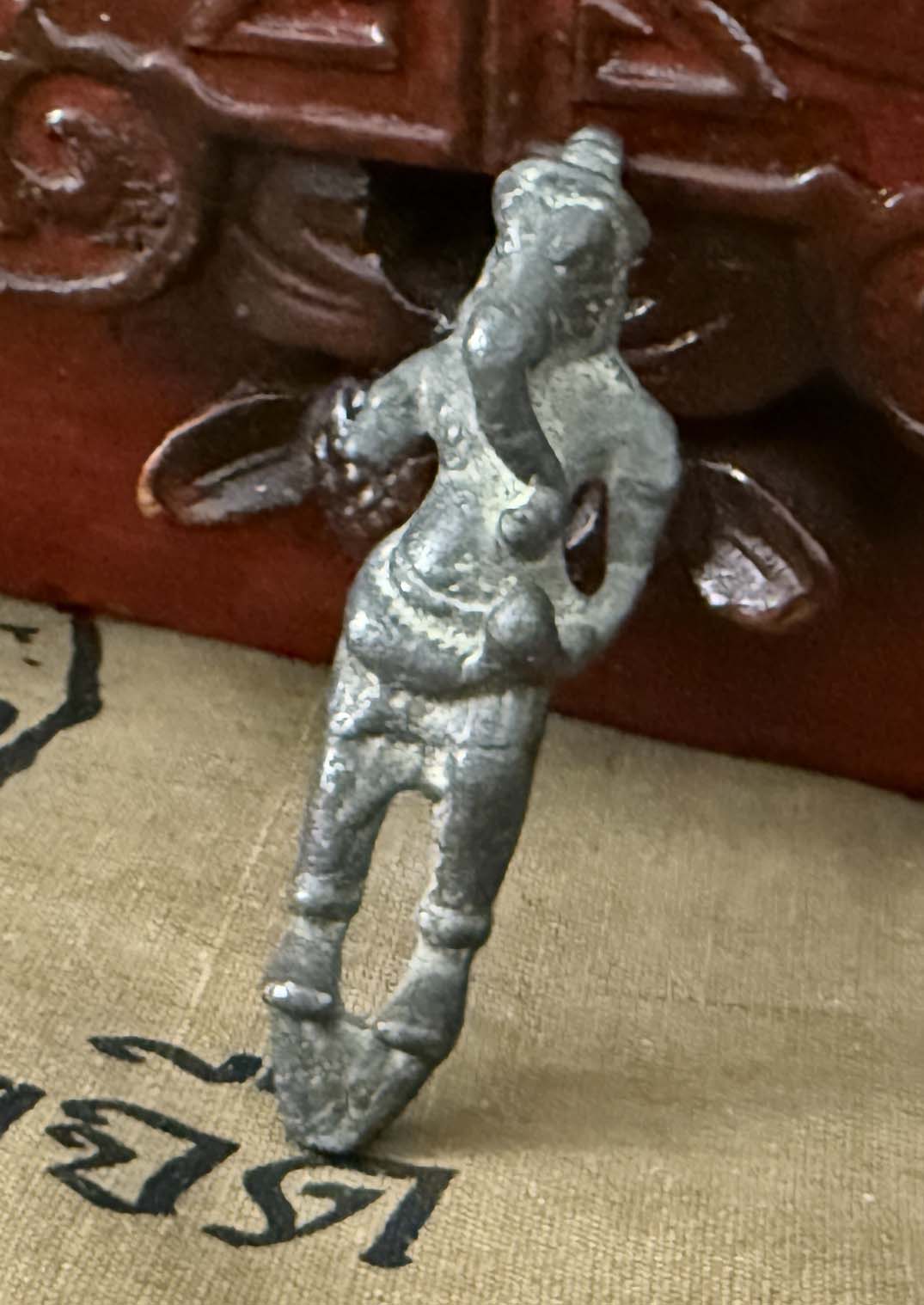
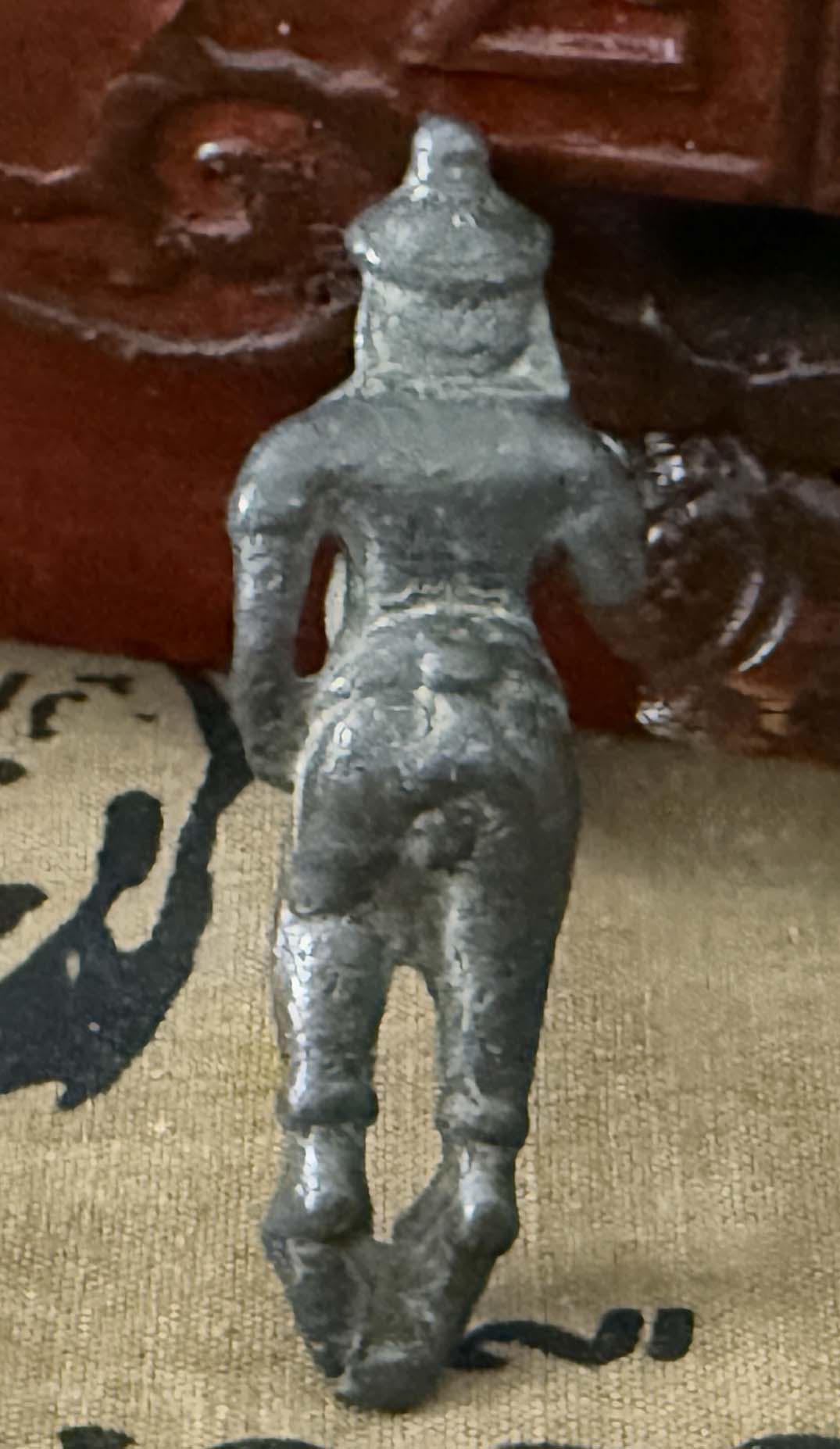
This image was once part of a portable shrine indigenous to the Cambodian/Thai/Laotian/Vietnamese region which we are very familiar with. We have handled or seen examples dating back to the 17th. century. The tab extension at his feet is a dead giveaway, It would fit into a slot on the shrine which was designed to hold one or more of similarly equipped idols.This is a rare depiction that measures approximately 1 13/16 x 9/16" x 5/16" and weighs 12.3 grams.
Depicted here with a left facing trunk, which is the most common and is considered to be more auspicious than one with its trunk facing right. A left-facing trunk is called Vamamukhi and is associated with the moon, which is said to represent the qualities of and bring peace, calm, bliss, purification, prosperity, material gains, purification, reverence to Parvati, family bonding, happiness and success.
His right arm appears to have been broken many years ago and when viewed from the back, he appears anatomically correct.
~!~
Her notes indicate she held numerous candle burnings to, "charge" Ganesh charms in particular, which were influenced by her dreams. What she describes is essentially root work and candle burning incorporating Hindu, Buddhist and Christian deities and prayers. She tells us, "His image is everywhere, it is immediately identified, named and called as Ganesha. And it is upon this energy we call."
She has some rather interesting thoughts on being able to tap into the energy of all of the prayers given at any one time, to an assortment of deities, but she favored using images of Jesus, Buddha, Guan Yin and Ganesh.
Here again she notes; "The Aum mantra belongs to him, as Aum is his form in reference of his personification of primal sound. Aum is his form. The Ganapati Atharvashirsa confirms this. As translated by Swami Chinmayananda. 'O Lord Ganapati! You are (the Trinity) Brahma, Vishnu, and Mahesa. You are Indra. You are fire [Agni] and air [Vayu]. You are the sun [Surya] and the moon [Chandrama). You are Brahman. You are (the three worlds) Bhuloka [earth], Antariksha-loka [space], and Swargaloka [heaven]. You are Om. (That is to say, You are all this)."
"A child's mantra that increases memory is 'Aum shri ganeshaya namah"
Money Draw MoJo Hand
She prescribes a series of, "Spirit Bags" or "Mojo Hands" as she alternately refers to what is known as Mojo Bags, of sorts, in Voodoo Root Work. Some of the journal entries in which she refers to their use read; "A flat top box which is known to you on which to sit him and ntain one or both of a Money Drawing Mojo Hand when they are not being carried, or fed."
"Simple fruit and water offerings to the Buddha in thanks for his blessings, must be renewed daily."
"the candles and bags are fixed, this fixing is so much more than some stuff in a bag. It has been party to specific ritual that began with the assemblage of ingredients and grew during the filling of the bags and dressing of the candles. Awakened to life, it now sleeps and awaits you."
"To bring it to life and bind this presence to you, simply place a drop of whiskey and a drop of your urine or saliva to each of the bags and dry them with the candle or incense smoke. It is now, as you do this, that you repeat the 23rd. Psalm until the fluid has dried. It is upon this that all hinges."
"She goes on to tell us to keep these "Hands fed" this process must be repeated, "to keep the spirit alive."
"Here are Mojo Hands for widows who tend to need enhancement of their personal power which is easily achieved through the use of these charm amulets. So they have been prescribed through spelled ritual to bring favor to their endeavors."
"These are in short, flannel or market velor, color coded pouches, a staple amulet in many cultures. Yours contain nine magical items. These are your mojuba hands, your hands of magic, MoJo Hands, prayer bags offering homage and petition for use in candle burning magic."
These notes are a rare insight, and far too lengthy to publish more here, but we will be more than happy to assist with them to the those, "who embody the spirit of these Mojo Hands."~!~
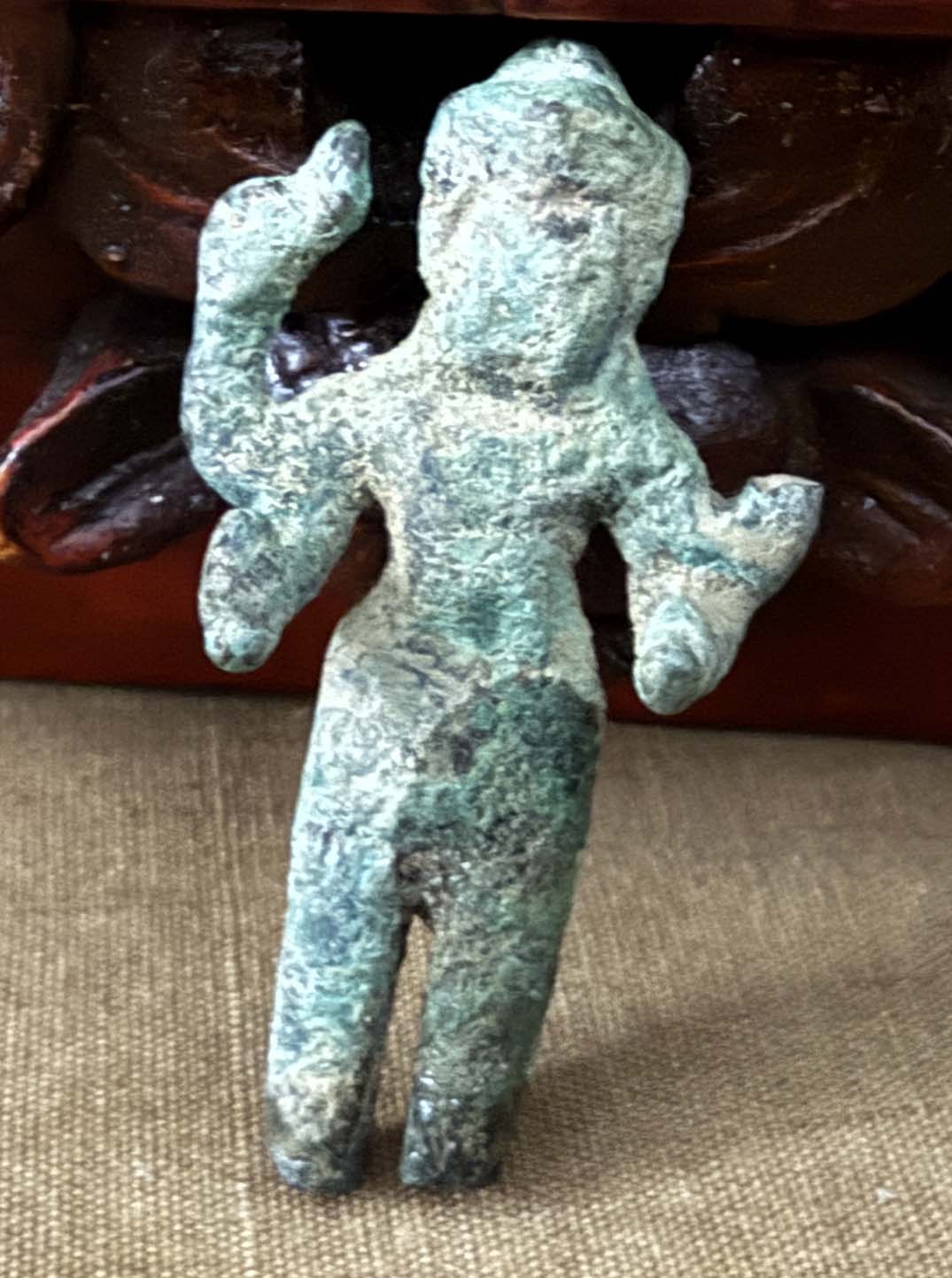
This Lord Vishnu depiction came to the estate from the same dealer as the Ganesh described above. Also an old family heirloom, this one her grandfather and great grandfather had recovered when grandfather was a boy while clearing ground for farmland that had once been flooded. It was recovered amongst the skeletal remains of a flood victim having been entombed in the mud for seventy years!
Here again her notes indicate she held numerous candle burnings and dream sessions using this depiction of Vishnu. She also makes numerous notes on the similarities of Vodoun to Vedic and other religions.
Depicted here with four arms, what he was holding is no longer discernible which is regrettable, as Vishnu's weapons were highly specialized and in our humble opinion the most interesting.
It displays a thick, crusty teal patina (often called verdigris) which is a layer of copper carbonate formed by oxidation, while his feet and the tab (as seen on Ganesh above) are gone. He measures approximately 7/16" x 3/4" x 3/8" and weighs 9 grams, as shown in his current condition.
~!~
Further research revealed;
Vishnu
From Wikipedia, the free encyclopedia, for the most part...
Vishnu, Supreme Being, Parabrahman, God of Protection, Preservation of Good, The Reality, Controller of entire Universe, Karma restoration, Moksha.
Other names are Narayana, Hari, Mukunda, Garbhodakashayi, Kshirodakashayi, Jagadishwar, Jagannath, Padmanabh, Lakshmipati, Suresh, Ramapati, Kamalnayan
Vishnu, also known as Adideva (literally, 'the primeval god'), is one of the principal deities of Hinduism. The "preserver" in the Hindu triad (Trimurti), Vishnu is revered as the supreme being in Vaishnavism as identical to the metaphysical concept of Brahman (Atman, the self, or unchanging ultimate reality), and is notable for adopting various incarnations (such avatars as Rama and Krishna) to preserve and protect dharmic principles whenever the world is threatened with evil, chaos, and destructive forces. In the Smarta Tradition of Hinduism, Vishnu is also one of the five equivalent deities worshiped in Panchayatana puja.
Vishnu means 'all pervasive' and, according to Medhatith (c. 1000 CE), 'one who is everything and inside everything.' Vedanga scholar Yaska (4th century BCE) in the Nirukta defines Vishnu as 'one who enters everywhere,' also 'that which is free from fetters and bondage is Vishnu.'
108 Names of Vishnu
In the tenth part of the Padma Purana (4-15th century CE), Danta (Son of Bhima and King of Vidarbha) lists 108 names of Vishnu (17.98–102). These include the ten primary avatars (see Dashavarara, below) and descriptions of the qualities, attributes, or aspects of God.
The 1000 Names of Vishnu
The Garuda Purana (chapter XV) and the "Anushasana Parva" of the Mahabharata both list over 1000 names for Vishnu, each name describing a quality, attribute, or aspect of God. Known as the Vishnu Sahasranama, Vishnu here is defined as 'the omnipresent.'
Other notable names in this list include Hari ('remover of sins'), Kala ('time'), Vasudeva ('Son of Vasudeva', i.e. Krishna), Atman ('the soul'), Purusa ('the divine being'), and Prakrti ('the divine nature').
MahaVishnu
MahaVishnu ('Great Vishnu'), is another important name that denotes his being the source and creator of the multiverse as the total material energy (mahat-tattva).
Garbhodakasayi (stimulation of energy to create diverse forms) and Vishnu (diffusion of the paramatman or 'supersoul' in the hearts of all living beings) are expansions of MahaVishnu. At the highest level, Vishnu is the formless Parabrahman, and all other deities including Brahma and Shiva are simply expansions of Vishnu.
Appearance
In Hindu mythology, Vishnu is depicted as having a dark blue to black complexion, earrings in the shape of sharks, a garland of flowers hanging from His neck (Vaijayanti); honey bees flying around it symbolic the verses of the YajurVeda. The shrivatsa mark on His chest (in the form of a curl of hair). The Kaustubha gem on His chest, four arms:
Upper-left hand holding the Panchajanya shankha ('conch'). Lower-left hand holding a padma ('lotus flower'). Upper-right hand handing the Sudarshana Chakra ('discus') and lower-right hand the Kaumodaki gada ('mace'), while wearing yellow-colored silk trousers.
The bow of Vishnu is known as Sharanga and His sword is known as Nandaka. A traditional depiction of Vishnu is that of Him reclining on the coils of the serpent Shesha, accompanied by his consort Lakshmi, as he "dreams the universe into reality."
The Trimurti
Particularly in Vaishnavism, the so-called Trimurti (also known as the Hindu Triad or Great Trinity) represents the three fundamental forces through which the universe is created, maintained, and destroyed in cyclic succession. Each of these forces is represented by a Hindu deity:
Brahma: represents Rajas (passion, creation)
Vishnu: represents Sattva (goodness, preservation)
Shiva: represents Tamas (darkness, destruction)
In Hindu tradition, the trio is often referred to as Brahma-Vishnu-Mahesh. All have the same meaning of three in One; different forms or manifestations of One person the Supreme Being.
Avatars
The concept of the avatar (or incarnation) within Hinduism is most often associated with Vishnu, the preserver or sustainer aspect of God within the Hindu Trimurti. The avatars of Vishnu descend to empower the good and to destroy evil, thereby restoring Dharma and relieving the burden of the Earth. An oft-quoted passage from the Bhagavad Gita describes the typical role of an avatar of Vishnu:
Whenever righteousness wanes and unrighteousness increases I send myself forth.
For the protection of the good and for the destruction of evil,
and for the establishment of righteousness,
I come into being age after age.
Bhagavad Gita 4.7–8
Vedic literature, in particular the Puranas ('ancient'; similar to encyclopedias) and Itihasa ('chronicle, history, legend'), narrate numerous avatars of Vishnu. The most well-known of these avatars are Krishna (most notably in the Vishnu Purana, Bhagavata Purana, and Mahabharata; the latter encompassing the Bhagavad Gita), and Rama (most notably in the Ramayana). Krishna in particular is venerated in Vaishnavism as the ultimate, primeval, transcendental source of all existence, including all the other demigods and gods such as Vishnu.
The Mahabharata
In the Mahabharata, Vishnu (as Narayana) states to Narada that He will appear in the following ten incarnations:
Appearing in the forms of a swan [Hamsa], a tortoise [Kurma], a fish [Matsya], O foremost of regenerate ones, I shall then display myself as a boar [Varaha], then as a Man-lion (Nrisingha), then as a dwarf [Vamana], then as Rama of Bhrigu's race, then as Rama, the son of Dasaratha, then as Krishna the scion of the Sattwata race, and lastly as Kalki.
Book 12, Santi Parva, Chapter CCCXL (340), translated by Kisari Mohan Ganguli, 1883-1896.
The Puranas
Specified avatars of Vishnu are listed against some of the Puranas. This however, this is a complicated process and the lists are unlikely to be exhaustive because:
Not all Puranas provide lists per se (e.g. the Agni Purana dedicates entire chapters to avatars, and some of these chapters mention other avatars within them).
A list may be given in one place but additional avatars may be mentioned elsewhere (e.g. the Bhagavata Purana lists 22 avatars in Canto 1, but mentions others elsewhere).
A personality in one Purana may be considered an avatar in another (e.g. Narada is not specified as an avatar in the Matsya Purana but is in the Bhagavata Purana).
Some avatars consist of two or more people considered as different aspects of a single incarnation (e.g. Nara-Narayana, Rama and his three brothers),
While some Hindus consider Buddha as an incarnation of Vishnu, Buddhists in Sri Lanka venerate Vishnu as the custodian deity of Sri Lanka and protector of Buddhism.
~!~
These Wikipedia articles are very lengthy, even by our standards, and much of them does not pertain to the imagery this statuary represents, so we have jumped forward to the sections that do, and are providing a link to the Wikipedia pages at the end of each chapter if you would care to continue reading them, which we highly recommend.
~!~
Vishnu, Thailand
Vishnu iconography such as statues and etchings have been found in archaeological sites of Southeast Asia, which are now predominantly of the Theravada Buddhist tradition. In Thailand, for example, statues of four armed Vishnu have been found in provinces near Malaysia and dated to be from the 4th to 9th-century. Similarly, Vishnu statues have been discovered from the 6th to 8th century eastern Prachinburi Province and central Phetchabun Province of Thailand and southern Ðang Tháp Province and An Giang Province of Vietnam. Krishna statues dated to the early 7th century to 9th century have been discovered in Takéo Province and other provinces of Cambodia.
Archaeological studies have uncovered Vishnu statues on the islands of Indonesia, and these have been dated to the 5th century and thereafter. In addition to statues, inscriptions and carvings of Vishnu, such as those related to the "three steps of Vishnu" (Trivikrama) have been found in many parts of Buddhist southeast Asia. In some iconography, the symbolism of Surya, Vishnu and Buddha are fused.
https://en.wikipedia.org/wiki/Vishnu
~!~
The Bottom Drawer Finds
~!~
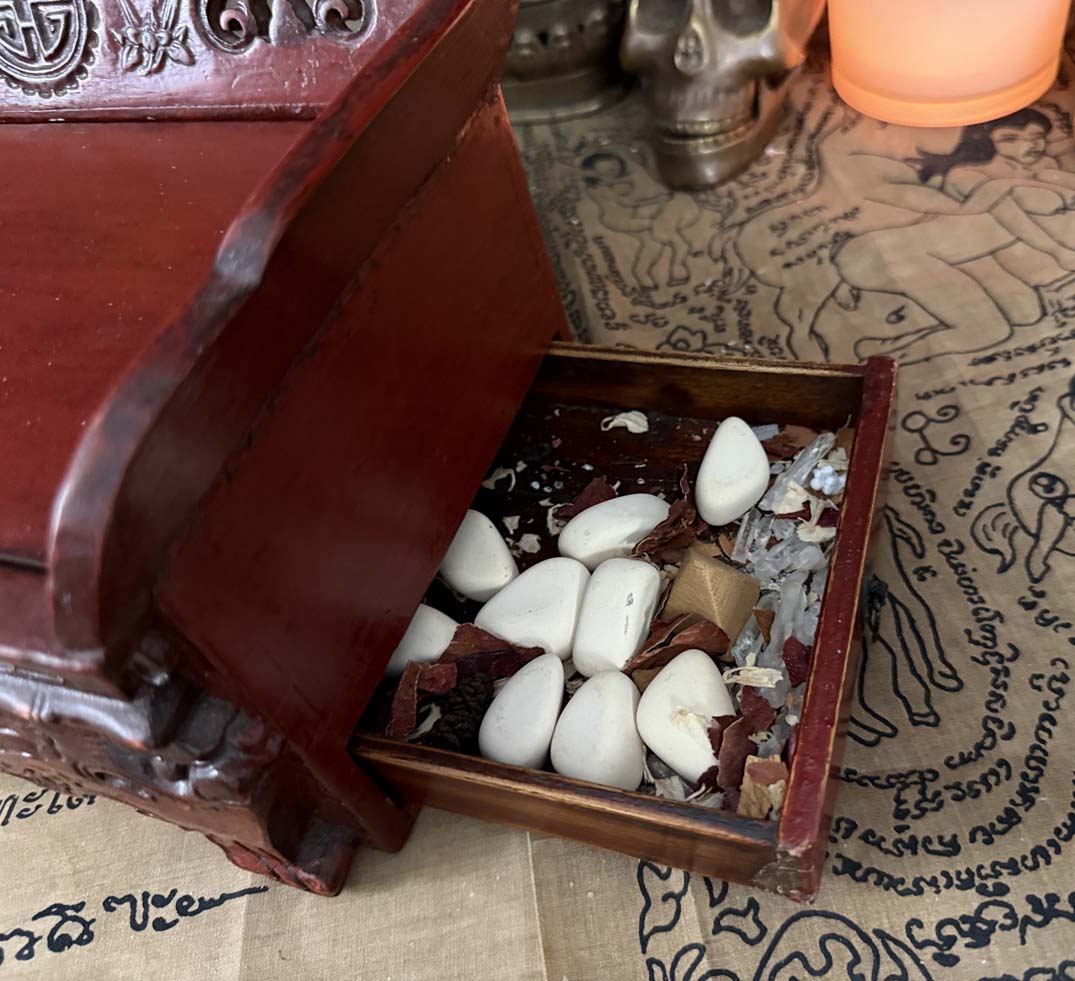
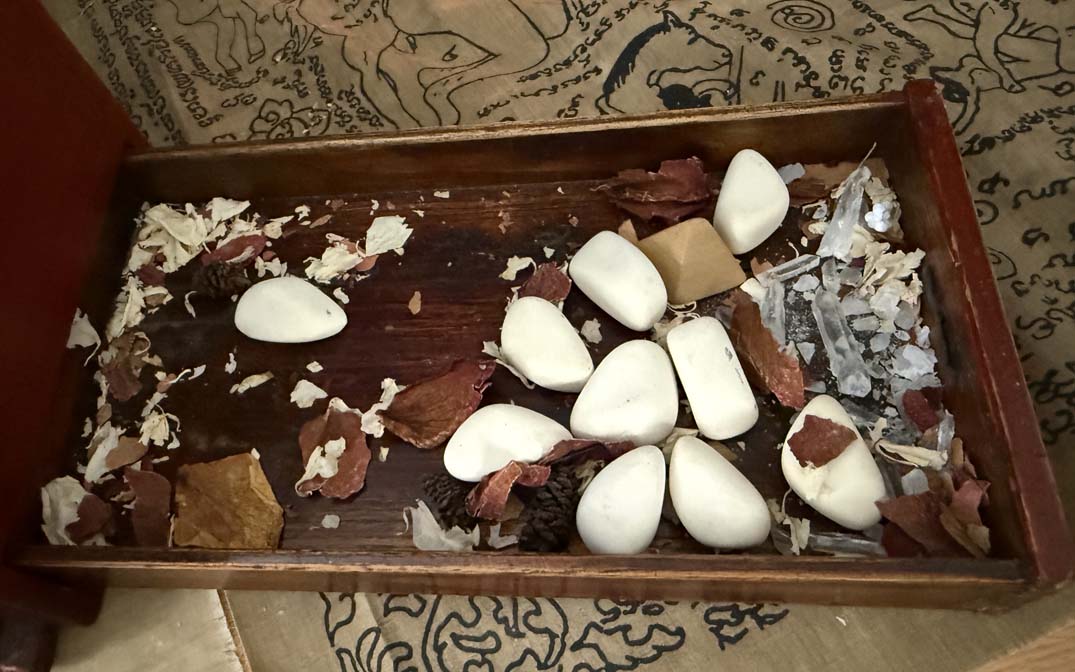
What we have of her journals and inventory were of little help in describing the contents of the bottom drawer of this shrine box. This is due to damaged and/or missing ledgers, not due to some created mystery of hers. She does tell us the contents would be chosen and blessed (chanted over) for a particular patient and ailment while placed in the Buddha's lap as reliquary.
The White Healers
She names the whites stones White Healers, and that's all we have from her. Our own research did not fare much better.
There are ten of these stones in describing them as a lightweight, chalky white rock that gets sticky when wet pointed to a couple of specific geological possibilities such as kaolinite clay or diatomaceous earth. They are neither and their identity remains a mystery to us.
They measure approximately 1 1'8" x 3/4" x 5/8" and weigh 7 grams on average.
~!~
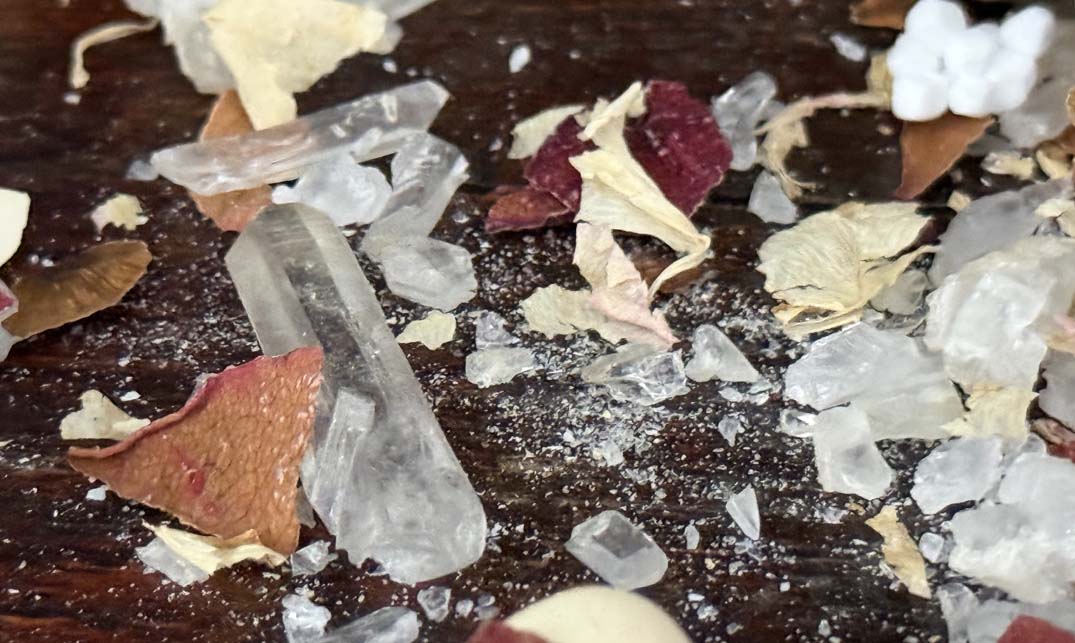
Here she mentions the source of natural quartz crystal formations found in the drawer being babies from the "Lemurian Quartz Dream Crystal Point Clusters with Babies" found in many of her boxes. Her journals and inventory tell us they were intentionally pruned from larger 'teaching crystals' she had brought back from Brazil in 1949. We know very little of this trip due to two missing ledgers but she does tell us her guide had taken her party to a group of crystal caves in southern Brazil where these formations were recovered.
The observatory itself was torn from the roof by Hurricane Andrew and these were broken off of the parent formation by the storm. The largest surviving piece was relegated to a Dream Shrine.
The remaining pieces found their way into spell boxes used in their Dream Works.
Their journals indicate she used these clusters to assist her in past life dream recall divinations and spell invocations. They describe their being, "held aloft in both hands before being drawn into the chakra in descending order as a prelude to entering the meditative state."
~!~
Then we have the single incense pyramid and potpourri. The incense is stale and it is a diamond shaped pyramid. We would be interested to know what happened, if anything, when it is lit. The potpourri.is also stale and odorless. It was most likely made in house from plant material grown on the estate. Many pounds of their potpourri was found throughout the estate. They would also burn it in bowls and candles!
~!~
And that my friend concludes the write-up for what amounts to an unusual assortment of antique and vintage magic artifacts with an extraordinary provenance that is much nicer than the photographs have been able to depict.
~!~
Many of our customers, after receiving items from this estate have reported dream contacts and other unexplained phenomenon.
Rest assured your order will be carefully packed to withstand the onslaught of the most deranged of parcel carriers.

International Buyer's, please email us for a shipping quote.
Payment is due at listing end.
Check our other listings, and sign up for our newsletter as new items are usually posted daily.
©Text and Photos Copyright 2001-2026 bushidobuce, all rights reserved.
The props are not part of the deal, but you knew that already.
~!~
~!~